LiteLLM Alternatives: Managed Gateways vs Self-Hosting
Compare LiteLLM alternatives across self-hosted proxies, managed BYOK gateways, and prepaid model access, including operations, billing, and security.

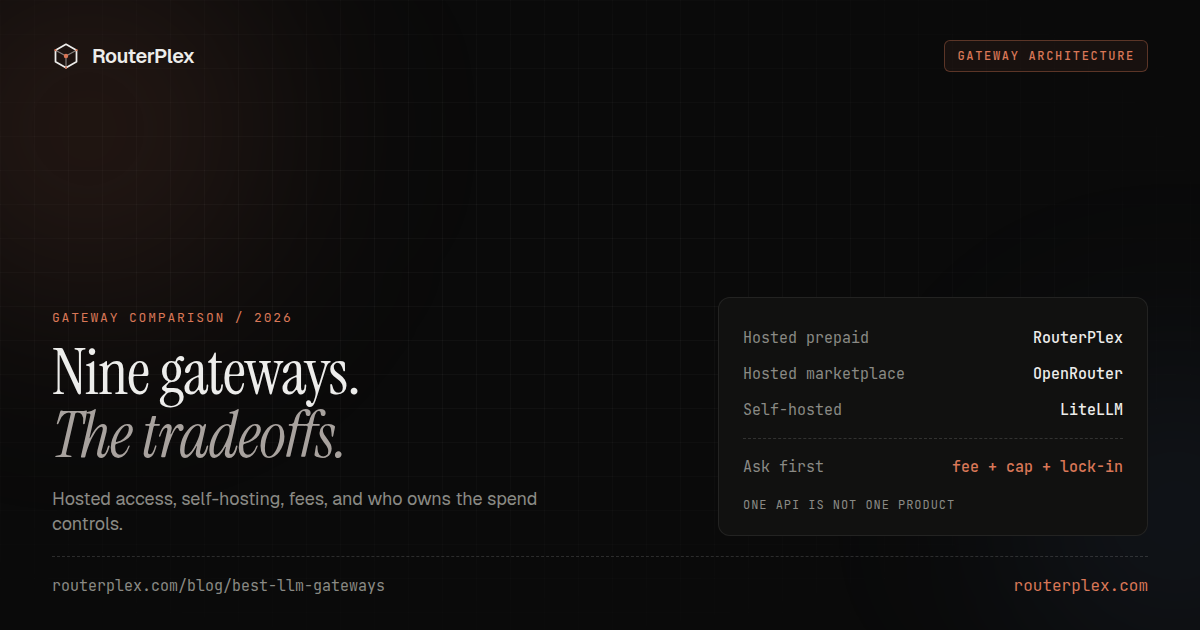
LiteLLM alternatives fall into three groups: self-hosted proxies, managed bring-your-own-key gateways, and prepaid services that include model access. The right choice depends on whether you want infrastructure control or simply want one reliable API endpoint and bill.
LiteLLM itself is an open-source proxy and SDK. It is a strong fit when a team already has provider accounts and needs a programmable compatibility layer. A managed gateway is a different purchase: you give up some control to avoid owning the operational surface.
OpenSEO keyword data checked July 19, 2026 shows litellm alternatives at 320 monthly US searches with keyword difficulty 0. That low score does not make the topic automatic to rank for; the page still needs to answer the architectural choice more clearly than a generic product list.
The three common architectures #
| Architecture | You provide vendor keys | You run the proxy | Unified prepaid balance |
|---|---|---|---|
| Self-hosted LiteLLM | Yes | Yes | You build it |
| Managed BYOK gateway | Usually | No | Usually no |
| Prepaid multi-provider gateway | No | No | Yes |
The phrase "LiteLLM alternative" can refer to any of these, which is why feature checklists often become confusing. Start with the responsibility boundary.
What self-hosting actually includes #
A basic proxy container can be running quickly. Production ownership is broader:
- Store and rotate provider credentials.
- Run the proxy database and backups.
- Configure authentication and tenant isolation.
- Patch the proxy and its dependencies.
- Protect administrative endpoints and webhooks.
- Reconcile provider spend with internal users and keys.
- Handle rate limits, retries, fallbacks, and provider outages.
- Build or integrate payment, credit, refund, and tax workflows if users pay you.
- Monitor logs without accidentally retaining sensitive prompt content.
None of these tasks makes self-hosting a bad choice. They are simply part of the cost. A team with platform engineers and negotiated vendor contracts may prefer that control.
When self-hosted LiteLLM is the right answer #
Choose self-hosting when several of these are true:
- You must keep the proxy inside your network or cloud account.
- You already have OpenAI, Anthropic, Google, and other provider contracts.
- You need custom routing logic or unsupported providers.
- Your security team requires direct control over logs, secrets, and data regions.
- You have engineers on call for the gateway.
- Your volume is large enough that infrastructure ownership is economical.
For an internal platform team, the proxy is a product. Treat it like one: assign an owner, define an upgrade cadence, test provider failures, and document the billing source of truth.
When a managed gateway is the better trade #
A hosted gateway is usually better for an indie developer or small team that wants model access rather than proxy ownership.
The practical advantages are:
- One account instead of separate vendor approvals and billing setups.
- One OpenAI-compatible base URL and key format.
- A catalog that can be switched with the model string.
- A single usage view and balance.
- No proxy database, deployment, or upgrade work.
- Faster setup for coding tools, evaluations, and small production apps.
The costs are reduced control, dependency on the gateway's reliability, and possible platform fees. The exit plan matters. An OpenAI-compatible gateway limits lock-in because moving usually means changing a base URL, key, and model ID rather than rewriting the application.
BYOK versus prepaid access #
Managed gateways also differ in who pays the underlying model provider.
With bring-your-own-key, you keep vendor accounts and attach their credentials to the gateway. This can preserve enterprise contracts and direct provider billing, but it does not solve account sprawl.
With prepaid access, the gateway holds provider relationships and deducts usage from one wallet. This is simpler for small teams, but you should inspect purchase fees, credit expiration, refund terms, and whether the wallet can become negative.
RouterPlex uses prepaid access. A top-up starts at $5, has no top-up fee, and model usage is charged at the published vendor list price. Funded PAYG has no RouterPlex RPM/TPM or usage-window cap. Optional plans add bonus credits with account-wide spend windows; they are not required for access.
Security and budget questions to ask #
Before choosing a managed LiteLLM alternative, ask for concrete answers:
- Can each API key have a hard server-side spend cap?
- What happens when the account balance reaches zero?
- Are prompt and response bodies stored, and where is that configured?
- How are webhook signatures verified?
- Can an old subscription event overwrite the current plan?
- Are refunds cumulative and idempotent?
- What happens to API requests when billing or usage data is unavailable?
- Can all keys be revoked immediately?
These are operational questions, not marketing details. A proxy that routes correctly but reconciles money incorrectly is not production-ready.
RouterPlex as the narrow managed option #
RouterPlex is designed for developers who want a smaller responsibility surface:
- OpenAI- and Anthropic-compatible APIs for 64 models.
- One prepaid balance paid by card or crypto.
- No token markup and no top-up fee.
- Hard budgets on individual keys.
- Hosted operation and model-provider integration.
- A base-URL-level exit path.
It is not the right fit for a company that needs to inject its own provider contracts, write arbitrary routing plugins, or control the proxy deployment. In those cases, self-hosted LiteLLM is likely the more honest answer.
For a small team deciding whether to operate a proxy, compare one month of engineering and on-call time with the restrictions and fees of a hosted service. Then run a small paid workload on the final two options.
Start a $5 RouterPlex test, review the model catalog, or use the quickstart to send the same request through your existing OpenAI SDK.
Common questions
Frequently asked questions
Is a managed LLM gateway the same as hosted LiteLLM?
Not always. Some products host LiteLLM for you, while others provide an OpenAI-compatible gateway with their own control plane and prepaid model access. Compare the operational outcome and billing model, not only the underlying proxy.
When should I self-host LiteLLM?
Self-host when you need full configuration control, already have vendor contracts and keys, can operate the database and proxy securely, and accept ownership of upgrades and incidents.
When is RouterPlex a LiteLLM alternative?
RouterPlex is an alternative when the goal is one hosted OpenAI-compatible endpoint, one prepaid balance, multi-provider model access, and per-key budgets without operating the proxy or separate vendor accounts.
Run the smallest paid test.
Add $5, cap the key, and verify the result with your own workload. No subscription, and credit never expires — a first top-up of $25+ is matched with $25 extra.