Do OpenRouter Credits Expire? Fees and the 365-day Rule
OpenRouter may expire unused credits 365 days after purchase; its COO says it doesn't in practice. Buying costs 5.5% ($0.80 min), refunds only within 24h.
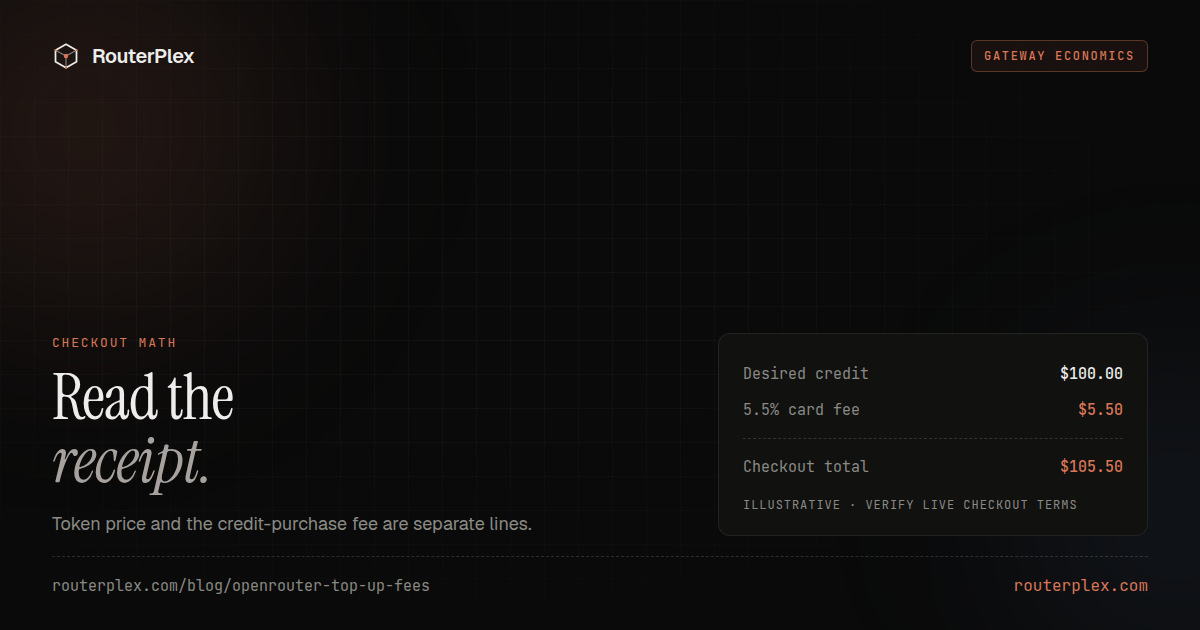
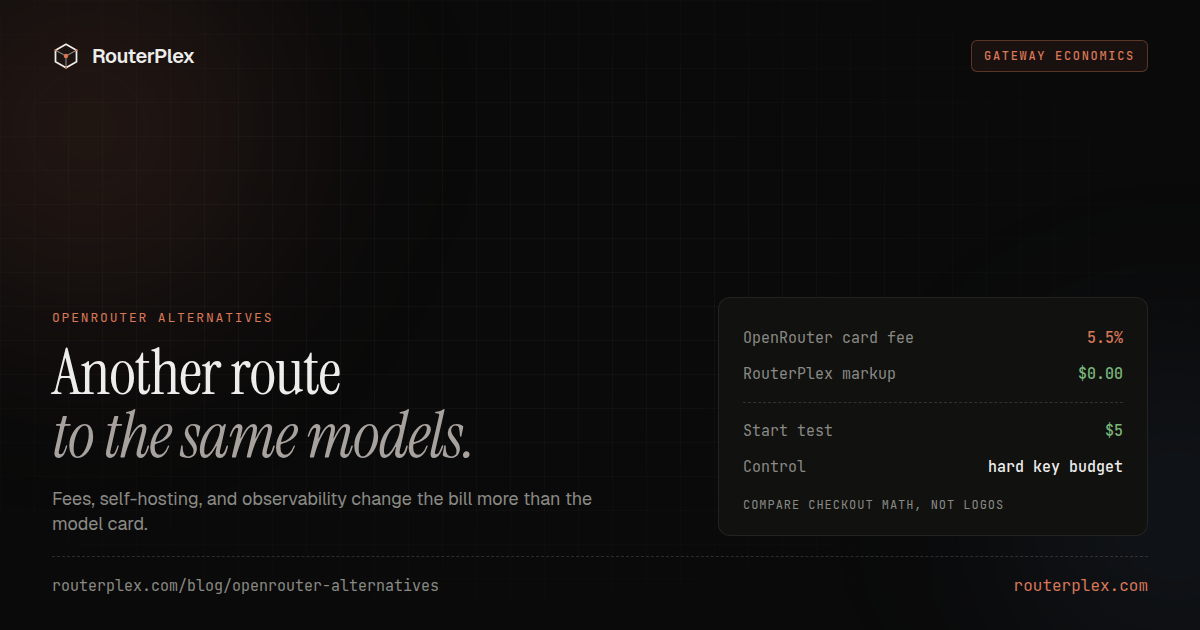
OpenRouter credits are prepaid deposits, denominated in USD, that OpenRouter deducts from on every request. As of 26 Aug 2026, buying them costs 5.5% by card with a $0.80 minimum, or 5% by cryptocurrency. OpenRouter's terms reserve the right to expire unused credits 365 days after purchase, and refunds for unused credits may be requested only within 24 hours of the transaction. OpenRouter says it does not mark up the underlying model rate.
So OpenRouter pricing has two layers: the selected model's provider rate, and the fee charged when credits are purchased. That distinction matters because a page showing vendor list price can still cost more than vendor list price once the credit-purchase fee is included.
Sources: OpenRouter FAQ, OpenRouter terms, OpenRouter pricing, and its platform fee announcement, checked 26 Aug 2026. Peer-wallet figures: LLM Gateway pricing, Requesty pricing, Vercel AI Gateway pricing, same date. Terms can change, so verify the current checkout and terms before making a large purchase.
What OpenRouter credits are #
Credits are not a subscription and not a token allowance. They are a dollar balance you fund in advance, and each API or chat request subtracts its computed cost from that balance. Three properties are worth knowing before you fund a large amount:
| Property | OpenRouter (per its published terms) | RouterPlex |
|---|---|---|
| Cost to buy $100 of credit | $105.50 by card, $105.00 by crypto | $100.00 |
| Unused credit expires | Reserves the right to expire after 365 days | Purchased credit does not expire |
| Refund window on unused credit | 24 hours from the transaction | Unused purchased credit refundable on request, at our discretion |
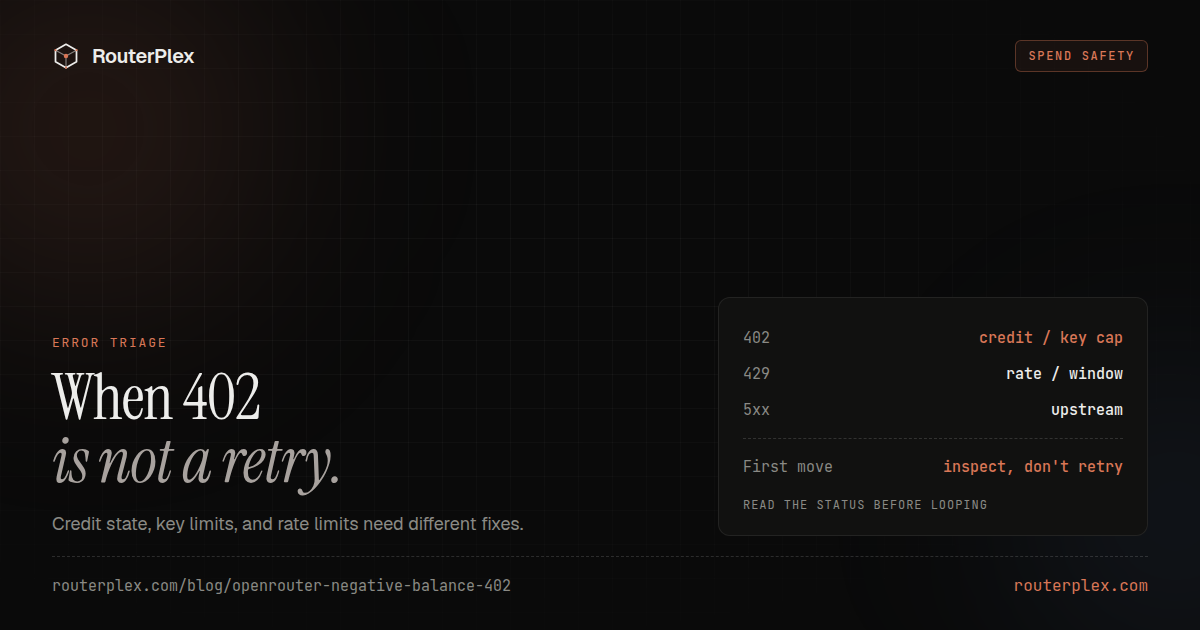
| Balance can go negative | Yes — see the 402 guide | No; requests stop at zero |
Do OpenRouter credits expire? #
Yes, they can. OpenRouter's terms reserve the right to expire unused credits 365 days after purchase. That is a reserved right, not a promise that every unused dollar vanishes on day 365.
OpenRouter's COO said as much on Hacker News in June 2025: *"In practice we don't expire the credits, but have to reserve the right to, or else we have a uncapped liability literally forever."* (source). So the practical risk has been low. The written terms are still what applies to your account if the practice changes, and they are the rule to budget against if you pre-fund a large amount.
If you pre-fund a year of usage to amortise the 5.5% card fee, the unused remainder sits inside that 365-day window. Funding in smaller increments avoids the expiry risk but pays the $0.80 minimum more often — on a $5 top-up that minimum is a 16% effective fee.
Purchased RouterPlex credit does not expire.
How OpenRouter pricing works #
OpenRouter is pay-as-you-go rather than a required monthly subscription. Each model has input, output, and sometimes cache or image rates. Usage is deducted from purchased account credits. The purchase fee sits outside the model rate, which is why total cost should be calculated from money paid to usable balance.
total cost = model usage + credit purchase fee + optional products
For most developers comparing gateways, the funding fee is the predictable platform-level difference. Model rates vary by model and provider, while 5.5% applies whenever card credits are purchased under the published terms.
The $100 fee math #
| Payment route | Usable model credit | Purchase fee | Total paid |
|---|---|---|---|
| OpenRouter card | $100.00 | $5.50 | $105.50 |
| OpenRouter crypto | $100.00 | $5.00 | $105.00 |
| RouterPlex card or crypto | $100.00 | $0.00 | $100.00 |
The arithmetic is simple: multiply the credit amount by the purchase-fee rate, then add that fee to the amount charged.
$100.00 credit × 5.5% card fee = $5.50 fee$100.00 credit + $5.50 fee = $105.50 charged
For a small card top-up, the minimum matters more. A 5.5% fee on $5 would be $0.275, but a $0.80 minimum means the effective fee is much higher on that purchase. You would pay $5.80 to receive $5.00 in credit, an effective cost of 16% relative to the usable credit.
How other wallets fund $100 #
OpenRouter is not the only hosted wallet. The same $100 question on peers, checked 26 Aug 2026 against official pages:
| Wallet | What you pay for $100 of credit / usage | Source |
|---|---|---|
| OpenRouter card | $105.50 (5.5%, $0.80 min) | openrouter.ai/docs/faq |
| OpenRouter crypto | $105.00 (5%) | openrouter.ai/docs/faq |
| LLM Gateway | $105.00 (5% on credits) | llmgateway.io/pricing |
| Requesty PAYG | $105.00 of usage for $100 provider cost | requesty.ai/pricing |
| Vercel AI Gateway | $100.00 + any processor fees that may apply | vercel.com/docs/ai-gateway/pricing |
| RouterPlex | $100.00 | routerplex.com/pricing |
Vercel publishes no token markup and no platform fee. Their docs say you are responsible for any payment processing fees that may apply; enterprise invoice has none. We do not invent a processor percentage. Direct comparisons: RouterPlex vs OpenRouter, vs LLM Gateway, vs Vercel AI Gateway, and the OpenRouter alternatives list.
A purchase fee is not a token markup #
It is useful to separate three numbers when comparing an LLM gateway:
- Model rate: the input and output token price shown for a model.
- Purchase fee: the amount charged to turn dollars into gateway credits.
- Operational extras: logging, routing, observability, or support products that may have separate prices.
Two gateways can show the same Claude or GPT token rate while producing different total costs. If Gateway A charges $105.50 for $100 of credit and Gateway B charges $100 for $100 of credit, Gateway A is effectively 5.5% more expensive before a single token is generated.
This is why comparisons based only on a model table are incomplete. Follow the money from payment method to usable balance. If the fee is the reason you are comparing services, start with the broader OpenRouter alternatives guide.
What the fee costs over time #
The dollar amount becomes more visible once usage is recurring.
| Credits purchased per month | 5.5% monthly fee | Fee over 12 months |
|---|---|---|
| $20 | $1.10 | $13.20 |
| $100 | $5.50 | $66.00 |
| $500 | $27.50 | $330.00 |
| $1,000 | $55.00 | $660.00 |
This is not a claim that OpenRouter is always the wrong choice. It has a broad catalog and mature routing features that may justify the fee for a particular team. The point is to include the purchase fee in the comparison instead of treating it as invisible.
How RouterPlex handles top-ups #
RouterPlex uses a prepaid balance with no top-up fee and no model markup. Pay $5 and the account receives $5 in usable credits. Pay $100 and it receives $100.
The tradeoff is explicit: RouterPlex is focused on one OpenAI-compatible endpoint, a curated multi-provider catalog, and spend controls. It is not trying to reproduce every feature of every larger gateway.
Each API key can have its own hard lifetime budget. That lets you create separate keys for a coding agent, production app, evaluation job, or client without giving each workload access to the entire account balance. See the full model price list and the detailed RouterPlex vs OpenRouter comparison.
A practical comparison checklist #
Before choosing a gateway, record these numbers for your actual workload:
- The amount charged to receive $100 in usable credit.
- The input and output price of the models you use most.
- Whether unused credit expires.
- Whether a balance can become negative.
- Whether keys support a hard server-side spend limit.
- Whether switching away requires code changes beyond a base URL and key.
The cheapest-looking token table is not necessarily the lowest total cost. The useful question is: how many usable model dollars arrive after payment, and how tightly can you cap the downside?
Start with the smallest real test #
For a self-serve API, a paid $5 test is more informative than a feature matrix. Create one key with a $5 budget, run the same prompt set against the models you care about, and inspect latency, output quality, and the final balance.
Start RouterPlex with a $5 top-up, or compare every published rate in the model catalog.
Common questions
Frequently asked questions
What are OpenRouter credits?
Credits are prepaid deposits denominated in USD that OpenRouter deducts from as you make API or chat requests. You buy them up front by card or cryptocurrency, and inference cost is subtracted per request.
Do OpenRouter credits expire?
They can. OpenRouter's terms state it reserves the right to expire unused credits three hundred sixty-five (365) days after purchase. OpenRouter's COO wrote on Hacker News in June 2025 that in practice they don't expire credits but must reserve the right. Purchased RouterPlex credit does not expire.
Can I get a refund on OpenRouter credits?
Only within a narrow window. OpenRouter's terms say refunds for unused credits may be requested within twenty-four (24) hours of the transaction. Platform fees and cryptocurrency payments are not refundable.
Does OpenRouter mark up model token prices?
OpenRouter says it does not mark up the underlying provider price. Its platform fee is charged when credits are purchased, which is separate from the per-token model rate.
How much does $100 of OpenRouter credit cost by card?
At a 5.5% purchase fee, $100 of usable credit costs $105.50. Re-check the current checkout and OpenRouter documentation before purchasing because fees can change.
How does that $100 compare on LLM Gateway, Requesty, or Vercel?
Checked 26 Aug 2026: LLM Gateway $105 at a 5% credit fee; Requesty PAYG $105 of usage for $100 of provider cost; Vercel AI Gateway $100 of credits plus any processor fees their page says may apply (no published token markup). RouterPlex is $100 for $100.
Does RouterPlex charge a top-up fee?
No. A $100 RouterPlex top-up adds $100 in usable prepaid credits. Published model rates are vendor list prices with no additional markup.
Compare the OpenRouter alternative.
Fees, reliability, and the catalog trade-off are on the product comparison.