Grok 4.7 API: Pricing, 500K Context and Setup
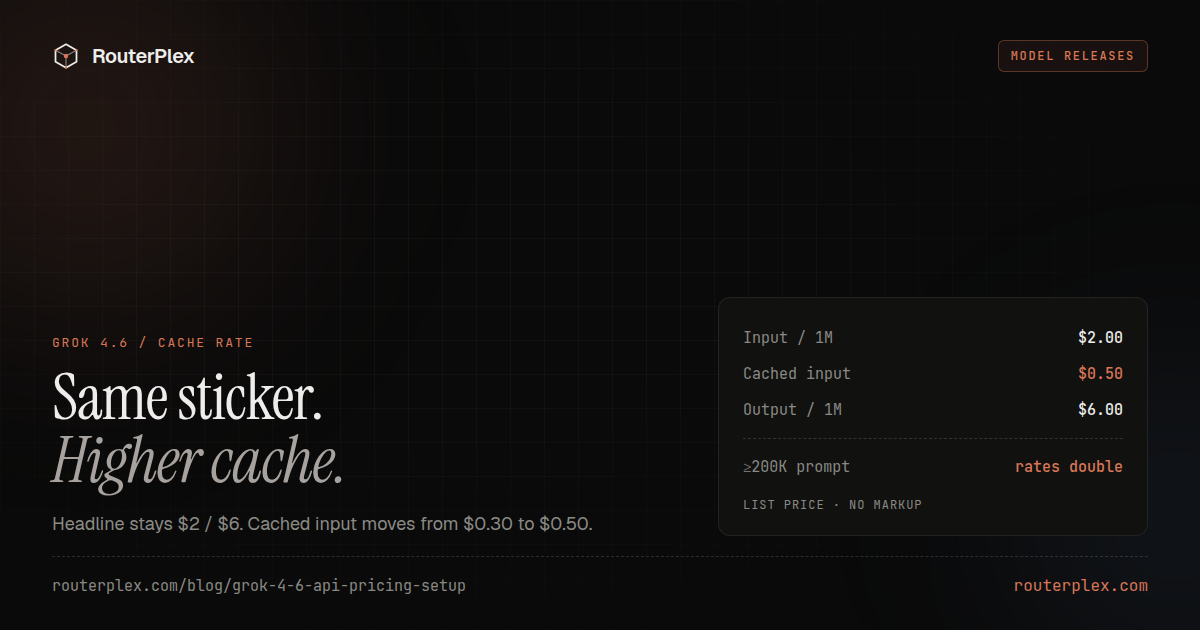
Grok 4.7 API pricing is $2 per 1M input and $6 per 1M output tokens, same as 4.6. 500K context, 200K cliff, live as grok-4.7.
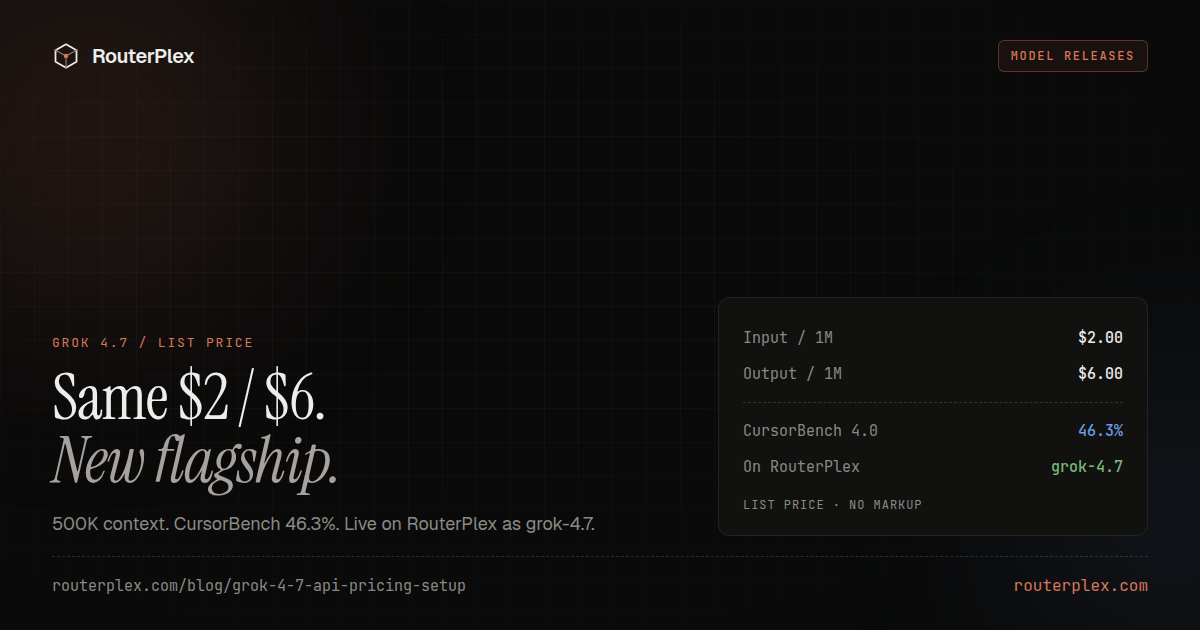
Grok 4.7 is xAI's new flagship, released on 21 September 2026. The API model ID is grok-4.7, the context window is 500,000 tokens, and the list price is $2 per 1M input tokens and $6 per 1M output tokens.
That is the same headline price and the same speed as Grok 4.6. What changed is the model: a larger base, a longer reinforcement-learning run on multi-hour tasks, and stronger self-verification. It is live on RouterPlex today.
Sources: xAI's Introducing Grok 4.7 post (21 September 2026), Grok 4.7 model docs, and the live RouterPlex grok-4.7 price page, checked 21 September 2026. Rates change; verify before committing to a budget.
Grok 4.7 API pricing #
All figures are USD per 1M tokens. The first row is the standard rate for prompts under 200K tokens; the second is long-context pricing at or above 200K.
| Tier | Input | Output |
|---|---|---|
| Standard (<200K prompt) | $2.00 | $6.00 |
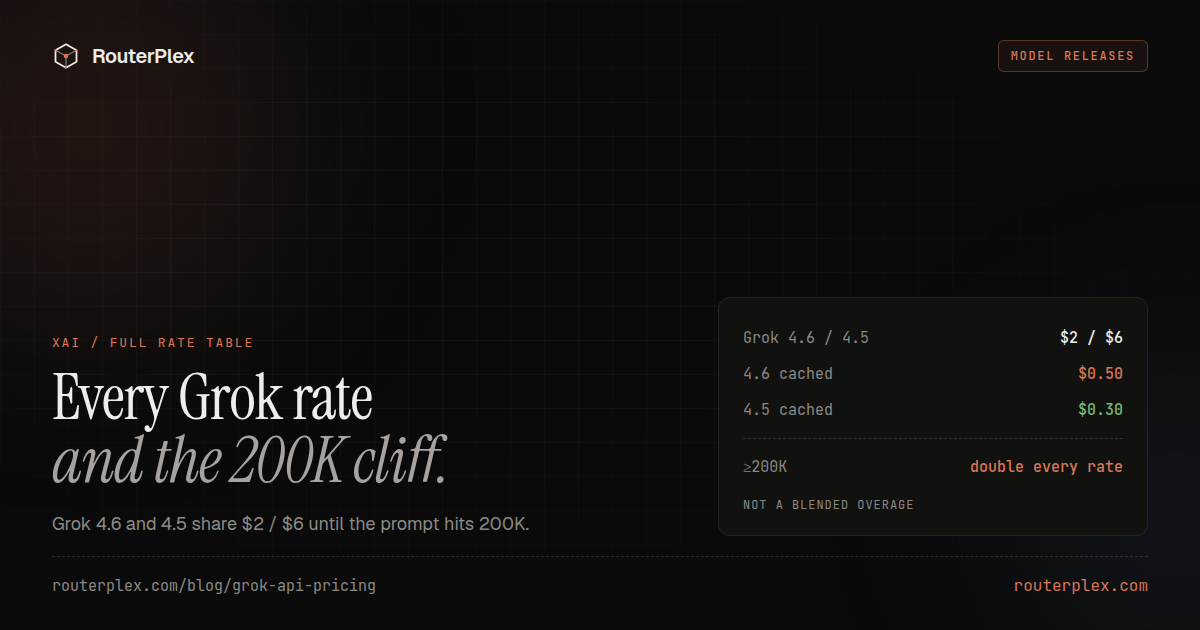
| Long context (≥200K prompt) | $4.00 | $12.00 |
xAI lists cached input at $0.50 per 1M on this model ($1.00 at or above 200K). On RouterPlex, cached prompt tokens on grok-4.7 currently bill at the full input rate. The $0.50 cache-read tier is not passed through yet. Price a cache-heavy agent loop on $2 input until that row changes on the live grok-4.7 page.
A $5 prepaid balance buys 2.5 million input tokens, or 833,333 output tokens, if a workload used only one category. Real requests mix both, and reasoning tokens count as output.
The 200K cliff still applies #
xAI's long-context rule is unchanged, and it is not a marginal rate. Requests whose prompt reaches 200K tokens are billed at the higher rate for every token in the request.
199,000-token prompt on grok-4.7 → 199,000 × $2.00/1M = $0.398201,000-token prompt on grok-4.7 → 201,000 × $4.00/1M = $0.804
Two thousand extra tokens double the cost of the request. If you are anywhere near 200K, trimming the prompt below the threshold is the highest-leverage cut available.
Grok 4.7 vs Grok 4.6 #
Headline price, context, and speed match. The upgrade is quality.
grok-4.7 | grok-4.6 | |
|---|---|---|
| List input / output | $2 / $6 | $2 / $6 |
| Context | 500K | 500K |
| Long-context cliff | 200K, rates double | 200K, rates double |
| CursorBench 4.0 (xAI) | 46.3% | 40.4% |
| DeepSWE v1.1 (xAI) | 71.0%* | 65.2% |
| EEBench (xAI) | 64.0% | 53.0% |
| Harvey Legal Agent (xAI) | 19.6% | 15.8% |
- xAI marks the 4.7 DeepSWE score as high effort.
xAI's line is that 4.7 uses a new, larger base than 4.6, trained with a longer RL run weighted toward problems that take many hours, and trained natively on the Grok Bot harness. xAI did not publish a parameter count. Treat the table above as vendor-run numbers on tasks xAI chose.
How Grok 4.7 compares on price #
Flagship list prices on RouterPlex, USD per 1M tokens:
| Model | Context | Input | Output |
|---|---|---|---|
grok-4.7 | 500K | $2.00 | $6.00 |
qwen3.8-max | 1M | $2.00 | $6.00 |
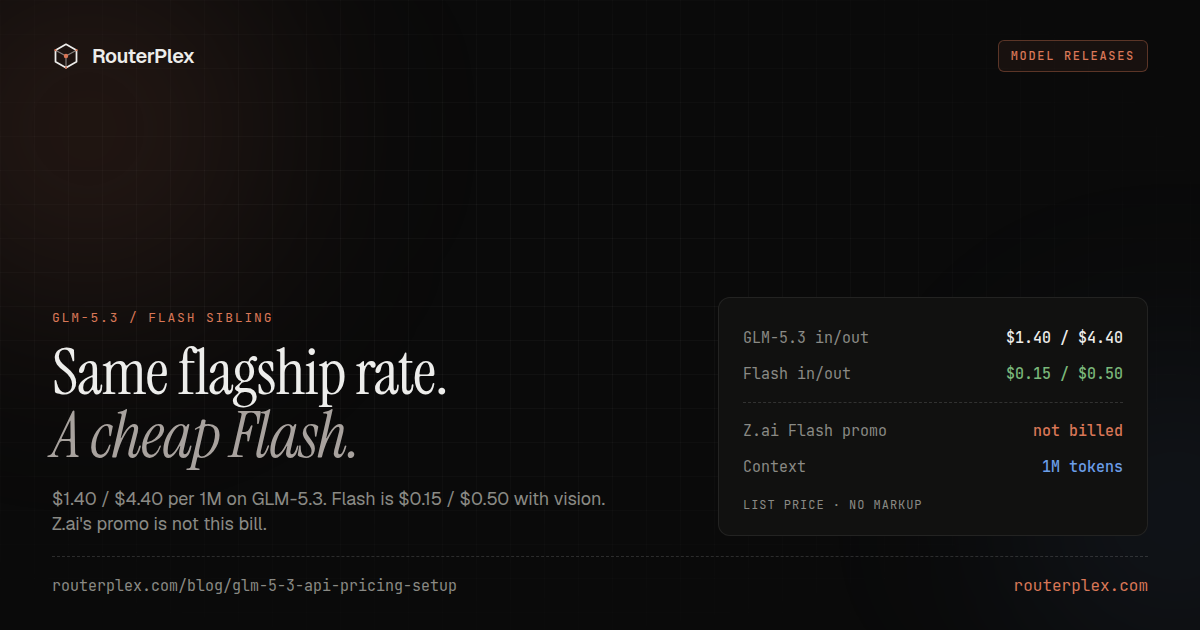
glm-5.3 | 1M | $1.40 | $4.40 |
gemini-3.1-pro | 1M | $2.00 | $12.00 |
kimi-k3 | 1M | $3.00 | $15.00 |
claude-opus-5 | 1M | $5.00 | $25.00 |
gpt-5.6-sol | 258K | $5.00 | $30.00 |
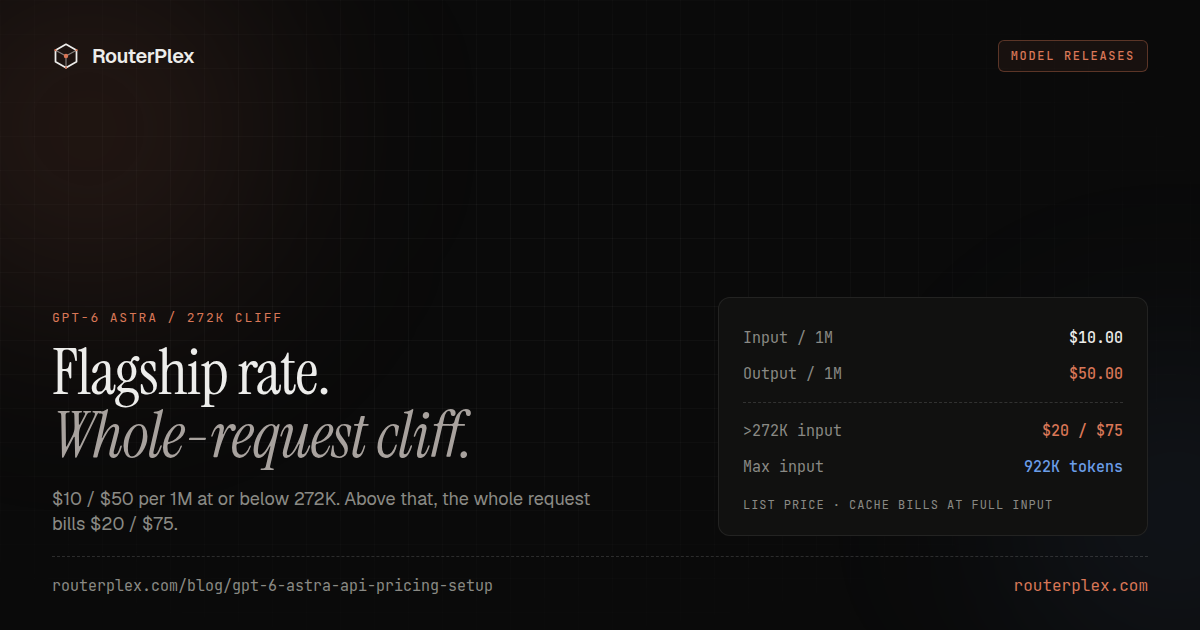
gpt-6-astra | 922K | $10.00 | $50.00 |
claude-fable-5 | 1M | $10.00 | $50.00 |
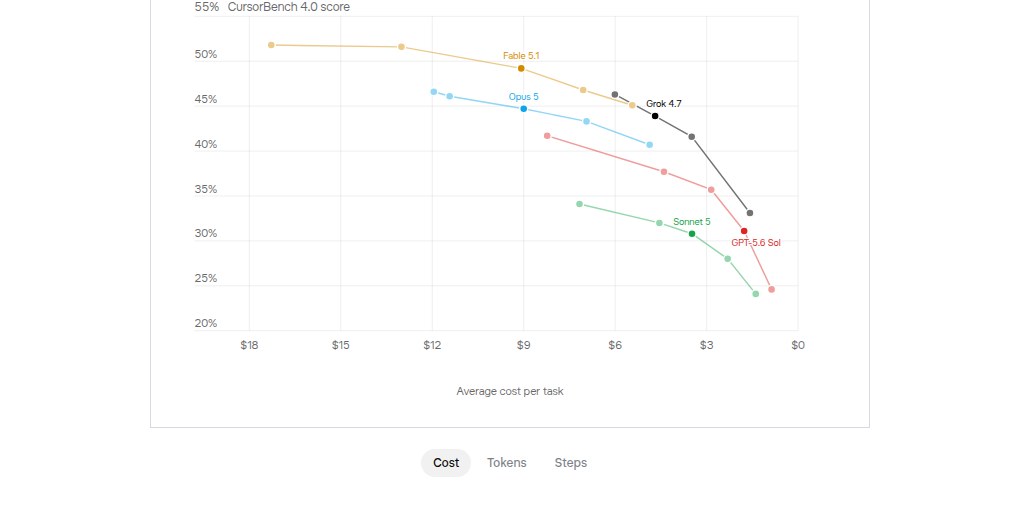
On a 40K-in / 2K-out agent turn with no cache, Grok 4.7 costs $0.092. That is the same turn cost as Qwen3.8-Max, $0.250 for Claude Opus 5, $0.260 for GPT-5.6 Sol, and $0.500 for GPT-6 Astra or Claude Fable 5.
xAI's own launch table prices GPT-5.6 Sol Max at $4 / $20 and Fable 5.1 Max at $10 / $50. Those are vendor Max SKUs. The RouterPlex rows above are the catalog IDs you can actually send: gpt-5.6-sol at $5 / $30 and claude-fable-5 at $10 / $50.
xAI's OG line for 4.7 is "twice as fast, at half the price of comparable models." That comparison is against that Max-SKU class. Against Grok 4.6, 4.7 is the same sticker and the same served speed.
What xAI measured #
xAI published this table on the launch post. Vendor-run, on tasks xAI chose.
| Benchmark | Grok 4.7 xHigh | Grok 4.6 High | GPT-5.6 Sol Max | Fable 5.1 Max |
|---|---|---|---|---|
| CursorBench 4.0 | 46.3% | 40.4% | 41.7% | 51.8% |
| DeepSWE v1.1 | 71.0%* | 65.2% | 72.7% | 70.0% |
| EEBench | 64.0% | 53.0% | 39.4% | 56.4% |
| AA Briefcase v1.1 | 1,657 | 1,546 | 1,487 | 1,678 |
| Terminal-Bench 4.0 | 38.0% | 20.3% | 37.3% | 57.9% |
| Harvey Legal Agent | 19.6% | 15.8% | 2.5% | 6.7% |
| HealthBench Professional | 56.7% | 48.5% | 60.5% | 62.1% |
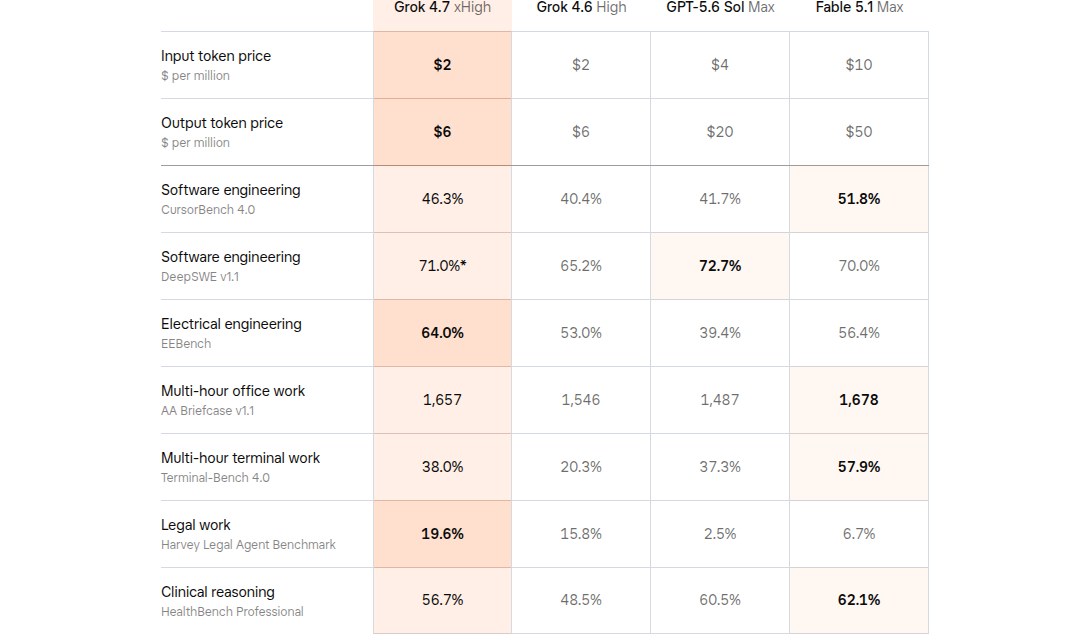
The pattern: 4.7 clears 4.6 on every row xAI showed. Fable 5.1 Max still leads CursorBench, Terminal-Bench, Briefcase, and HealthBench, at $10 / $50. Grok 4.7 is the value side of that frontier: close enough on several agent benches that the $2 / $6 sticker is the decision.
On safety, xAI says 4.7 ships a new safeguard stack, scores 62.4% on LatchBio biosafety, and allows 3.3% of risky dual-use prompts through on HackerBench v0.3.
Grok 4.7 Fast is a different SKU #
xAI also serves a Fast variant: twice the output speed at twice the price. That SKU is in Cursor and Grok Build. It is not on the public xAI API, so RouterPlex has no grok-4.7-fast (or similar) ID. If a Cursor screenshot shows Fast, that is Cursor's route, not grok-4.7 on api.routerplex.com.
The model you get on RouterPlex is the public API flagship: grok-4.7 at $2 / $6.
What the catalog actually lists #
Live RouterPlex row for grok-4.7:
| Capability | Result |
|---|---|
| Model ID | grok-4.7 |
| Provider | xAI |
| Context window | 500,000 tokens |
| Max output per request | 500,000 tokens |
| Image input | Yes |
| Tool calling | Yes |
| Reasoning | Yes, configurable |
| Streaming | Yes |
| OpenAI-compatible chat API | Yes |
Anthropic-compatible /v1/messages | Yes |
| Pricing basis | Vendor list, 0% markup |
Grok 4.7 is a reasoning model, and reasoning tokens are billed as output at $6 per 1M. A short reply is not always a cheap one. A two-token answer preceded by 200 reasoning tokens bills as 202 output tokens. Check usage.completion_tokens_details.reasoning_tokens if a simple prompt costs more than the visible completion suggests.
Call Grok 4.7 with RouterPlex #
Create a RouterPlex key, give it a hard budget, and send a standard chat-completions request:
curl https://api.routerplex.com/v1/chat/completions \-H "Authorization: Bearer $ROUTERPLEX_API_KEY" \-H "Content-Type: application/json" \-d '{"model": "grok-4.7","messages": [{"role": "user", "content": "Name the riskiest assumption in this migration plan."}]}'
The Python version uses the regular OpenAI client. Only the base URL, key, and model ID change:
import osfrom openai import OpenAIclient = OpenAI(api_key=os.environ["ROUTERPLEX_API_KEY"],base_url="https://api.routerplex.com/v1",)response = client.chat.completions.create(model="grok-4.7",messages=[{"role": "user", "content": "Design a rollback-safe deployment plan."}],)print(response.choices[0].message.content)
Claude Code and the Anthropic SDK reach the same model through the Anthropic-compatible format. Set ANTHROPIC_BASE_URL=https://api.routerplex.com and use grok-4.7 as the model. See the Claude Code setup guide for the full configuration.
Should you switch from Grok 4.6? #
- Coding agents and long-running tasks — this is the job xAI trained 4.7 for. Same sticker as 4.6, higher CursorBench, DeepSWE, EEBench, and Terminal-Bench scores on xAI's table. Switch and A/B on the same key.
- Legal and office-agent loops — Harvey and Briefcase both moved up versus 4.6. Still priced as a value flagship.
- Cache-heavy prefixes — price the loop on full $2 input until RouterPlex passes xAI's $0.50 cache-read tier. The 4.6 catalog row currently bills cache at full input as well, so the two IDs match on that line today.
- Anything near 200K tokens — the cliff is identical. Trim below the threshold, then pick a model.
Both are live on RouterPlex at xAI list prices with no per-token markup, so you can A/B them on the same prepaid key and compare real spend. See the live pricing for grok-4.7, the Grok 4.6 write-up, or the full Grok API pricing table for the rest of the xAI catalogue.
Common questions
Frequently asked questions
How much does the Grok 4.7 API cost?
xAI lists Grok 4.7 at $2 per 1M input tokens and $6 per 1M output tokens for prompts under 200K tokens. At or above 200K every rate doubles to $4 input and $12 output. RouterPlex bills those list rates with no per-token markup.
Is Grok 4.7 more expensive than Grok 4.6?
On the headline rate, no. Both are $2 input and $6 output per 1M tokens, with the same 200K cliff. On RouterPlex, cached prompt tokens on grok-4.7 currently bill at the full $2 input rate: the $0.50 xAI cache-read tier is not passed through yet.
What is the Grok 4.7 context window?
500,000 tokens, the same as Grok 4.6 and Grok 4.5. On RouterPlex the per-request output cap is also 500,000 tokens.
Is Grok 4.7 live on RouterPlex?
Yes. The model ID is grok-4.7. It is callable today through the OpenAI-compatible chat API and the Anthropic-compatible /v1/messages format, billed at xAI list prices from a prepaid RouterPlex key.
Does Grok 4.7 support images and tool calling?
Yes to both. The live catalog marks grok-4.7 as vision, reasoning, and tool-calling. Image input uses the standard OpenAI image_url content block.
What is Grok 4.7 Fast?
xAI serves a Fast variant at twice the output speed and twice the price. That SKU is available in Cursor and Grok Build. It is not on the public xAI API, so there is no RouterPlex model ID for it.
Can I use Grok 4.7 with the OpenAI or Anthropic SDK?
Yes. Point the OpenAI SDK at https://api.routerplex.com/v1 with model ID grok-4.7, or point the Anthropic SDK and Claude Code at https://api.routerplex.com to reach the same model through /v1/messages.
Run the smallest paid test.
Add $5, cap the key, and verify the result with your own workload. No subscription, and credit never expires — a first top-up of $25+ is matched with $25 extra.