OpenRouter Alternatives (2026): 9 Options Compared
Compare 9 OpenRouter alternatives: RouterPlex, LLM Gateway, Requesty, Vercel, LiteLLM and more. $100 credit math, fees, and which wallet fits.
An OpenRouter alternative can solve one of three different problems: buy access to many models through one account, put a gateway in front of provider keys you already own, or self-host the routing layer. Those products look similar from the application because they expose an OpenAI-compatible API, but the billing and operational responsibility are different.
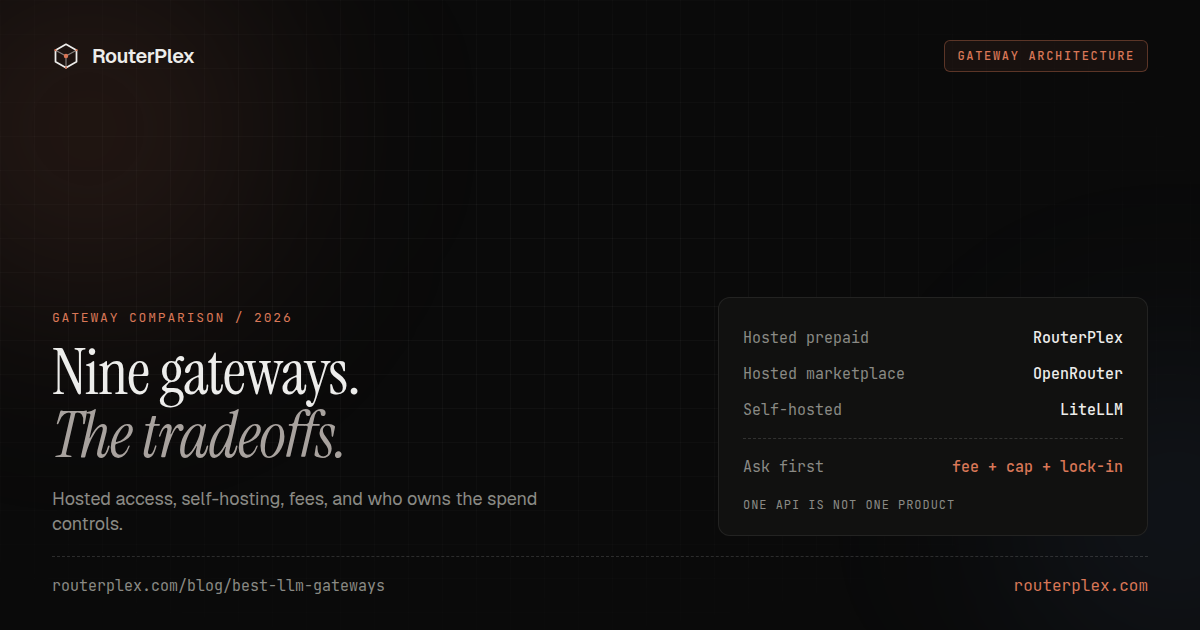
This guide compares nine practical options for 2026. It does not pretend one gateway is best for everyone. The useful question is which responsibility boundary fits your workload.
For the commercial comparison, start with the OpenRouter alternative page. It covers fees, reliability, and the catalog trade-off in one place. This article stays a list of nine options.
Disclosure: RouterPlex publishes this comparison and is one of the products covered. We identify where RouterPlex fits, where OpenRouter remains stronger, and use the same decision criteria for every option.
Pricing and product capabilities change. Fees below were checked against official vendor pages on 26 Aug 2026: OpenRouter FAQ, LLM Gateway pricing, Requesty pricing, and Vercel AI Gateway pricing. Verify each vendor's current documentation before moving production traffic.
The short answer #
RouterPlex is the closest OpenRouter alternative when you want one API key for mainstream models, 1-step integration, always-on hosted reliability, a built-in optimizer that can cut cost by up to 40% with no quality loss, no credit-purchase fee, and a balance that cannot go negative. LLM Gateway is the closest wallet peer if you want BYOK at 0% or an AGPLv3 self-host and will pay 5% on credits. Requesty is the other large hosted catalog. Vercel AI Gateway is the right wallet if the app already runs on Vercel — they publish no token markup; processor fees may apply.
LiteLLM is the strongest fit when you want to self-host and bring provider keys. Portkey and Helicone make more sense when policy or observability matters more than bundled model access. Cloudflare is a natural choice when the surrounding application already runs on Workers.
That answer changes if catalog breadth is non-negotiable. OpenRouter carries far more niche and community models than RouterPlex, and keeping OpenRouter can be the correct decision for those workloads.
What $100 of credit actually costs #
Most alternative roundups copy model tables and skip the funding fee. The table below is the information that is missing from those lists. It is not a claim that the cheapest row is always the right product.
| Wallet | What you pay for $100 of credit / usage | Catalog (official) | Negative balance | BYOK |
|---|---|---|---|---|
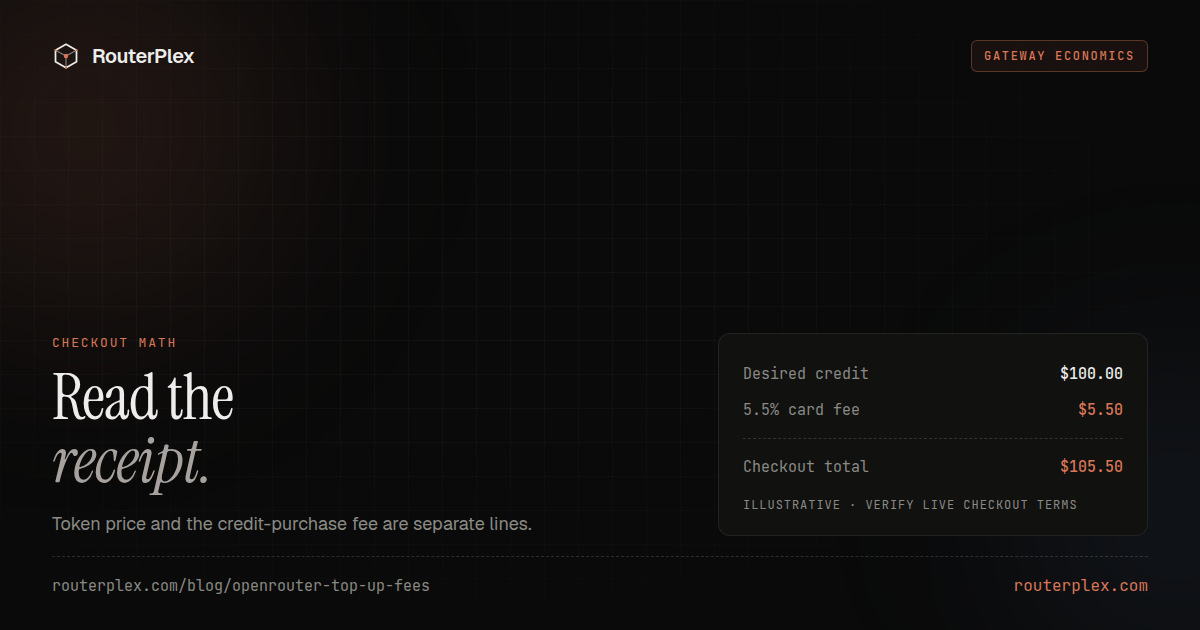
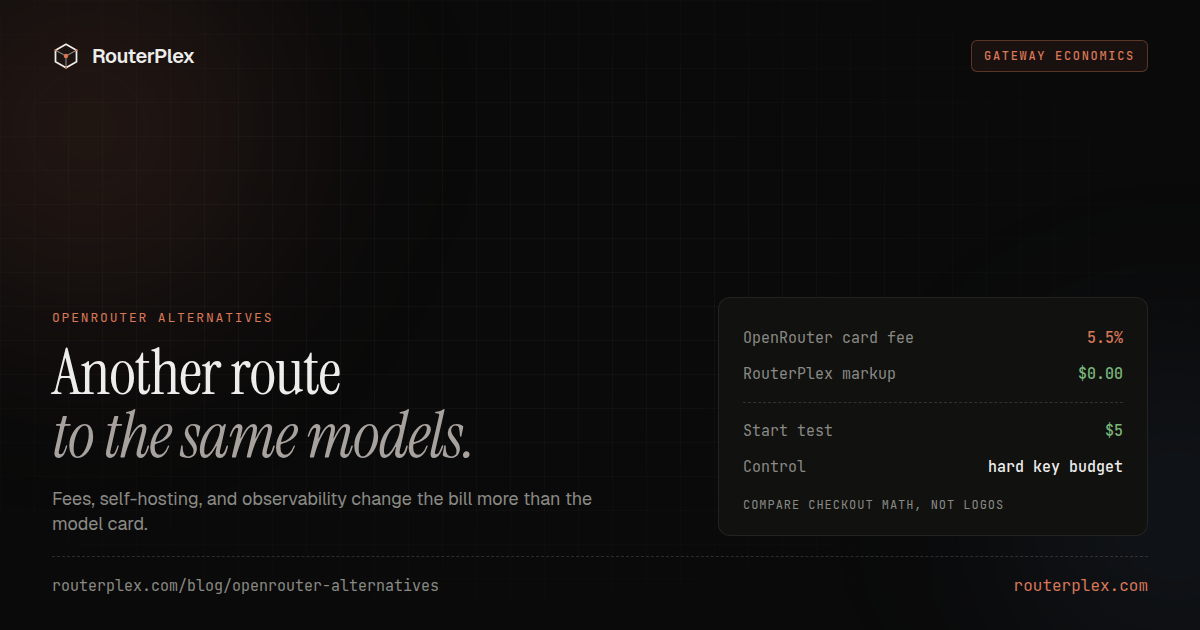
| OpenRouter (card) | $105.50 (5.5%, $0.80 min) | Hundreds of models | Yes — 402 until repaid | Not the product |
| OpenRouter (crypto) | $105.00 (5%) | Hundreds of models | Yes | Not the product |
| LLM Gateway | $105.00 (5% on credits) | 200+ models, 40+ providers | Not published as stop-at-zero | 0% (official) |
| Requesty PAYG | $105.00 of usage for $100 provider cost | 600+ models | PAYG as you go | 0% (official) |
| Vercel AI Gateway | $100.00 + any processor fees that may apply | Vercel catalog; free tier is a subset | Credits deducted | 0% on paid (official) |
| RouterPlex | $100.00 | 64 models, 15 providers | Never — requests stop at $0 | Not offered |
Vercel does not publish a processor percentage; their docs say you are responsible for any payment processing fees that may apply, and enterprise invoice has none. We do not invent a Stripe 2.9% as Vercel's fee.
Spend-safety is the other column most lists omit. OpenRouter can go negative. RouterPlex cannot. LLM Gateway and Vercel publish budgets and credit balances, not the same stop-at-zero overdraft guarantee. See the OpenRouter 402 and negative-balance guide if that is why you are shopping.
How these alternatives were evaluated #
Each option is compared on the boundary that creates real switching work: whether model access is included, who operates the gateway, provider and model coverage, pricing outside the token rate, spend controls, observability, and how much application code must change. Product claims link to vendor documentation where practical, and the recommendations name both the best fit and the main tradeoff.
OpenRouter alternatives at a glance #
| Alternative | Best fit | What changes from OpenRouter |
|---|---|---|
| RouterPlex | Developers wanting 1-step hosted access, always-on reliability, and up to 40% savings with no quality loss | Smaller curated catalog, $0 top-up fee, built-in optimizer, never negative |
| LLM Gateway | Hosted wallet with BYOK or self-host | 5% on credits, 200+ models, BYOK 0%, AGPLv3 self-host |
| Requesty | Large managed catalog and routing | PAYG is provider cost + 5%; 600+ models; 200 free requests/day |
| Vercel AI Gateway | Next.js and AI SDK applications | No published token markup; processor fees may apply; Vercel-native |
| LiteLLM | Teams wanting full proxy control | You operate the gateway and usually keep separate provider accounts |
| Portkey | Teams combining gateway policy and observability | Bring provider relationships into a broader control plane |
| Helicone | Observability-first AI applications | Put monitoring, caching, and gateway controls around model calls |
| Cloudflare AI Gateway | Workloads already using Cloudflare | Add edge controls while retaining provider-specific setup |
| Direct provider APIs | Applications committed to one or two vendors | Remove the gateway layer but manage separate keys, bills, and SDK details |
1. RouterPlex: prepaid multi-model access without a top-up fee #
RouterPlex is the closest alternative when you want one API key, 1-step OpenAI-compatible integration, always-on hosted reliability, and model access included. You do not bring separate OpenAI, Anthropic, Google, DeepSeek, or Moonshot accounts.
The commercial difference is at funding time, plus a built-in optimization layer for every account. RouterPlex adds $100 to the balance when you pay $100. It does not add a card or crypto purchase fee, supported models are billed at their published vendor list prices, and the optimizer can route requests to cut cost by up to 40% with no quality loss. Every API key can also carry a hard lifetime budget, while the account balance is prepaid and stops at zero.
If you are comparing services after an unexpected credit failure, read the OpenRouter negative-balance and 402 recovery guide. For a local multi-provider control plane, see Claude Code Router setup. For a single Anthropic-compatible upstream, use the Claude Code docs.
The honest limitation is catalog breadth. RouterPlex focuses on 64 mainstream frontier and value models across 15 providers. OpenRouter carries hundreds of models and more provider-routing options. If a project depends on niche community models, OpenRouter may remain the better fit.
Best for: indie developers, small teams, coding-agent users, and agencies that value simple billing and spend containment more than the largest possible catalog.
See the exact RouterPlex vs OpenRouter comparison, including fee math and migration details.
2. LLM Gateway: 5% on credits, BYOK at 0% #
LLM Gateway is the closest hosted-wallet peer after RouterPlex. It bills provider rates, charges a flat 5% when you buy credits, offers BYOK at 0%, optional payload storage at $0.01 per 1M tokens, and an AGPLv3 self-host. Official catalog: 200+ models across 40+ providers. API base: https://api.llmgateway.io/v1.
That is a real OpenRouter alternative if the 5.5% card fee is the pain and you still want a large catalog, or if you want to keep vendor keys. It is not a $0-fee wallet on the hosted credit path. $100 of credits is $105 at their published 5% rate. Non-US cards add a 1.5% international fee on their pricing page.
RouterPlex will not match the catalog, BYOK, or self-host. LLM Gateway does not publish the same stop-at-zero overdraft guarantee. See RouterPlex vs LLM Gateway.
Best for: teams that want a hosted wallet with BYOK or a self-host option, and will pay 5% on credits.
3. Requesty: large catalog, PAYG +5% #
Requesty is another hosted multi-model gateway: 600+ models, 200 free requests per day with no card, PAYG, and BYOK. Official PAYG pricing is provider cost plus 5% — $10 of model cost is $10.50. BYOK is 0% on your own contracts. They also publish included EU data residency.
Test the exact models you use. A long provider list matters less than whether the gateway supports your required model, tool-calling behavior, context limits, data policy, and payment method. See RouterPlex vs Requesty.
Best for: teams that want a larger managed catalog, a daily free lane, or included EU residency, and accept 5% on PAYG.
4. Vercel AI Gateway: no token markup, Vercel-native #
Vercel AI Gateway is a hosted wallet inside Vercel. Official pricing (26 Aug 2026): no markup and no platform fee on tokens; you pay provider list prices from purchased AI Gateway credits. The free tier includes $5/month on a subset of models. Buying credits moves you to paid and the monthly free credit stops. BYOK is paid-tier only at 0%; if your key fails, Vercel retries with system credentials and bills that fallback to your credits. Base URL: https://ai-gateway.vercel.sh/v1.
You are responsible for any payment processing fees that may apply. Enterprise invoice has none. We do not invent a processor percentage.
The strongest reason to choose it is already being on Vercel and the AI SDK, not merely that it speaks OpenAI-compatible. It is a weaker fit as a standalone prepaid key for Claude Code or Cursor with a hard stop at zero. See RouterPlex vs Vercel AI Gateway.
Best for: Next.js applications and teams already standardized on Vercel's AI tooling.
5. LiteLLM: self-hosted control #
LiteLLM is an open-source proxy and SDK. It is a strong OpenRouter alternative when the goal is protocol compatibility and routing control rather than bundled model access.
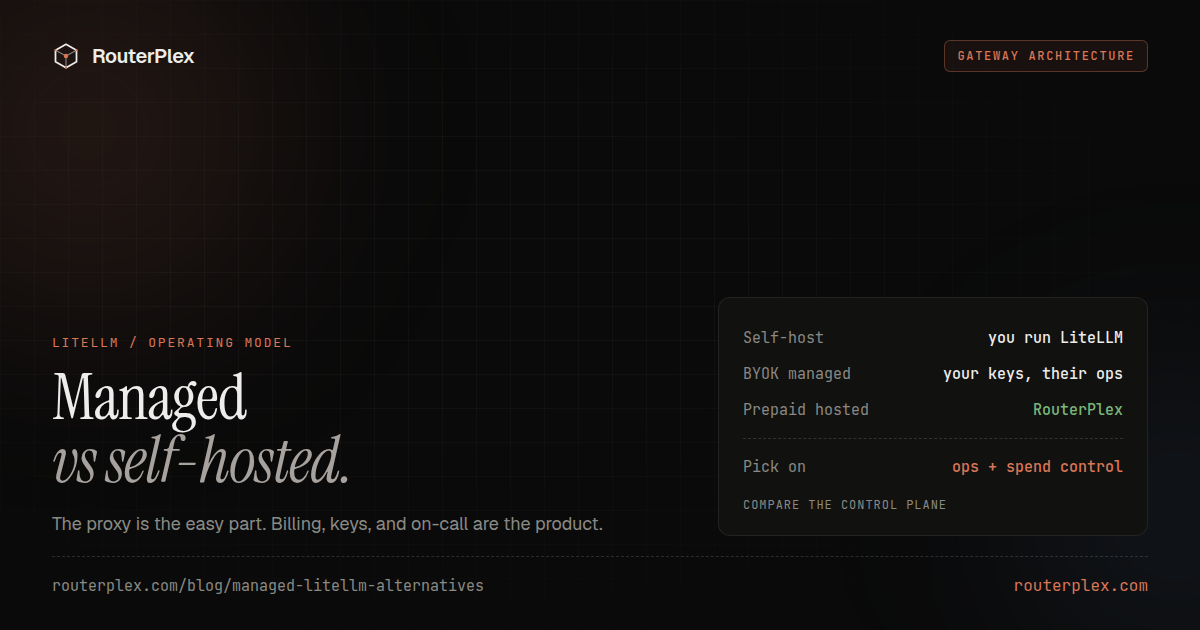
Self-hosting moves responsibility back to your team. You manage provider accounts and credentials, deploy the proxy, secure its administrative surface, operate its database, plan upgrades, and reconcile provider spend. In exchange, you control the network boundary, routing logic, logs, and provider contracts.
Best for: platform teams that already have vendor agreements, infrastructure ownership, and a real reason to customize the gateway.
Read the deeper hosted gateway vs self-hosted LiteLLM comparison.
6. Portkey: gateway policy plus observability #
Portkey combines an AI gateway with controls for routing, reliability, governance, and observability. It is more relevant when a team wants to standardize how many internal applications reach models than when a solo developer simply wants to buy tokens through one wallet.
Evaluate it around policy: fallbacks, retries, access controls, logs, data handling, and how it connects to provider accounts. Those capabilities can be worth more than a small funding fee for an organization with production governance requirements.
Best for: teams treating the model gateway as shared infrastructure.
7. Helicone: observability-first gatewaying #
Helicone is a natural option when request visibility is the first problem. Its gateway and observability tooling focus on tracing model usage, latency, cost, caching, and application behavior.
This is a different purchase from prepaid model aggregation. Decide whether you primarily need one bill for model access or better control and analysis around provider calls. Some teams need both, but they should be evaluated separately.
Best for: AI products that already have provider access and need production telemetry.
8. Cloudflare AI Gateway: edge controls for Cloudflare workloads #
Cloudflare AI Gateway fits teams already building on Workers or using Cloudflare for application traffic. It can centralize analytics and gateway behavior close to the edge.
The main tradeoff is ecosystem fit. It is compelling when Cloudflare already owns the surrounding request path. It is less obviously the simplest answer for a small standalone script whose only requirement is one prepaid key for several commercial models.
Best for: Cloudflare-native applications and teams that want gateway controls beside their edge stack.
9. Direct provider APIs: fewer layers, more accounts #
The simplest architectural alternative is to use OpenAI, Anthropic, Google, or another model provider directly. Direct access removes an intermediary and can make provider-specific features available sooner.
The cost is operational fragmentation. Each provider has its own account, key, billing threshold, rate limits, SDK details, and usage dashboard. Direct APIs work well when one vendor handles nearly all traffic. They become less attractive when an application changes models frequently or needs one spend view across providers.
Best for: workloads committed to one or two providers and teams willing to maintain provider-specific integrations.
How to choose an OpenRouter alternative #
Use these questions before comparing feature grids:
- Do you need model access included, or will you bring provider keys?
- Do you want to operate the proxy yourself?
- Which exact models and API features are non-negotiable?
- Can each application key have a hard server-side budget?
- What happens when prepaid credit reaches zero?
- Are prompts and responses stored, and can storage be disabled?
- What purchase, subscription, or platform fees apply before token usage?
- Can you leave by changing a base URL and key, or does the SDK create lock-in?
The first two questions usually eliminate half the list. A self-hosted BYOK gateway and a hosted prepaid model marketplace are not interchangeable, even when both accept the same curl request. If the remaining shortlist is hosted wallets, start from the $100 table above, then read RouterPlex vs OpenRouter, vs LLM Gateway, and vs Vercel AI Gateway.
A low-risk migration test #
Do not move production traffic first. Create a separate key with a small hard budget, then replay representative requests against the final two candidates.
Check plain chat, streaming, tool calls, structured output, error handling, context limits, and the final billed amount. Confirm that model IDs and provider-specific parameters behave as expected. Keep the old route available until logs and costs match your assumptions.
If you want hosted access to mainstream models without a purchase fee, start a $5 RouterPlex test. The API is OpenAI-compatible, so the first comparison can be as small as changing the base URL, key, and model ID.
Common questions
Frequently asked questions
What is the best OpenRouter alternative?
The best choice depends on the job. RouterPlex fits developers who want one API key for mainstream models, 1-step OpenAI-compatible integration, always-on hosted reliability, a built-in optimizer that can cut cost by up to 40% with no quality loss, and no top-up fee. LLM Gateway is the closest wallet peer if you want BYOK at 0% or an AGPLv3 self-host and will pay 5% on credits. LiteLLM fits teams that want to self-host and keep their own provider accounts. Portkey, Helicone, Cloudflare AI Gateway, Vercel AI Gateway, and Requesty emphasize different combinations of routing, observability, control, and managed access.
What does $100 of credit cost on OpenRouter vs other wallets?
Checked 26 Aug 2026 against official pages: OpenRouter card $105.50 for $100 credit (5.5%, $0.80 min); LLM Gateway $105 at a 5% credit fee; Requesty PAYG $105 of usage for $100 of provider cost; Vercel AI Gateway $100 of credits plus any processor fees their page says may apply (no published token markup); RouterPlex $100 for $100.
Is there a free OpenRouter alternative?
Open-source gateways such as LiteLLM or LLM Gateway's AGPLv3 self-host can run without a gateway subscription, but model providers still charge for tokens and you still operate the infrastructure. Vercel AI Gateway includes $5/month on a subset of models. A free proxy is not the same as free model usage.
Does RouterPlex charge an OpenRouter-style credit fee?
No. RouterPlex adds the full payment amount to the prepaid balance and bills supported models at their published vendor list prices. OpenRouter's published fee was 5.5% for card purchases, with a $0.80 minimum, and 5% for crypto when checked 26 Aug 2026.
How hard is it to switch from OpenRouter?
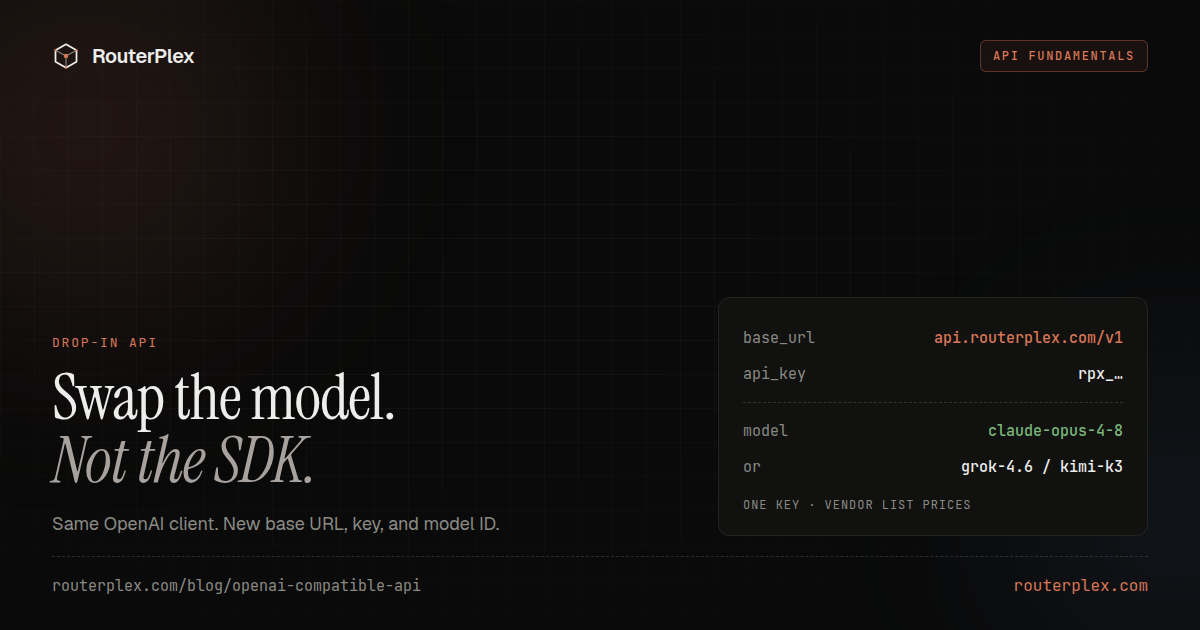
One step for an OpenAI-compatible application: point the base URL at https://api.routerplex.com/v1 and swap in a RouterPlex key. Model IDs drop the provider prefix. Test tool calling, structured output, streaming, and provider-specific parameters before moving production traffic.
Compare the OpenRouter alternative.
Fees, reliability, and the catalog trade-off are on the product comparison.