Best LLM Gateways for Developers (2026): 11 Compared
Compare 11 LLM gateways: RouterPlex, OpenRouter, LLM Gateway, Vercel, Requesty, Fireworks, Together, LiteLLM, Portkey, Helicone, AgentRouter.
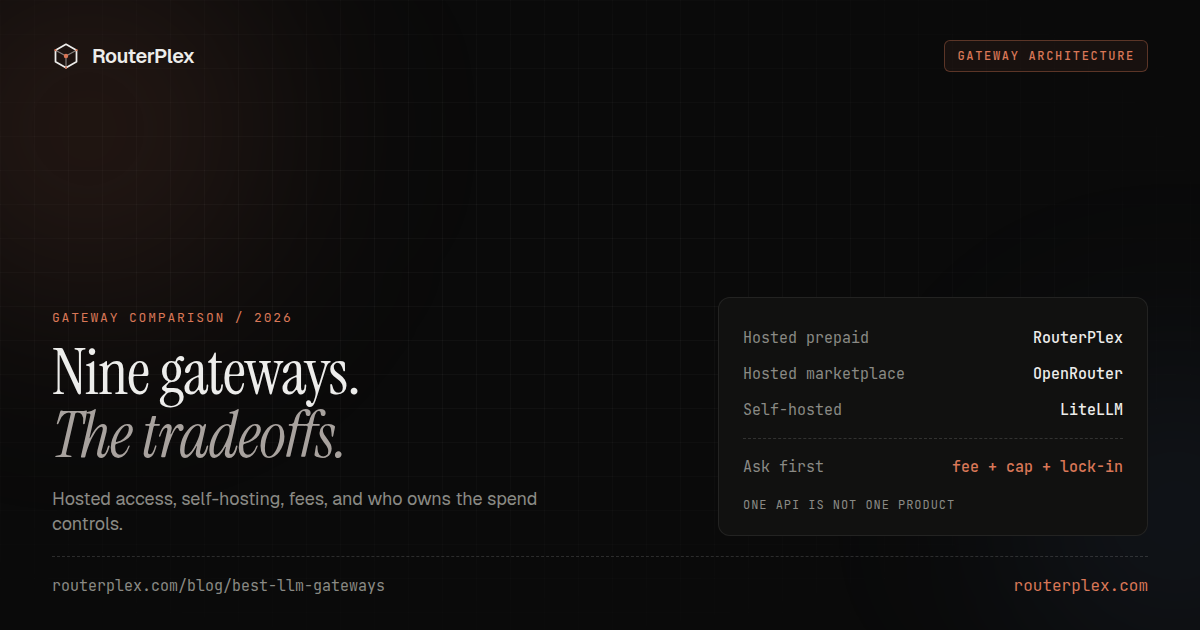
The best LLM gateway depends on what you want the gateway to own. RouterPlex, OpenRouter, LLM Gateway, Vercel AI Gateway, Requesty, and AgentRouter can bundle access to models behind one account. LiteLLM, Portkey, and Helicone usually sit in front of provider relationships you control. Fireworks AI and Together AI run model inference infrastructure and overlap with gateways without being the same product category.
Many of these products expose an OpenAI-compatible API, but a shared request shape does not make their model coverage, billing, routing controls, or supported endpoints identical.
This comparison separates those responsibility boundaries before comparing feature lists.
Product pages and documentation were checked 26 Aug 2026. RouterPlex publishes this comparison and is one of the products covered. Claims about competitors link to their official sites; verify current pricing, data policies, and service terms before buying.
LLM gateway comparison #
| Product | Category | Model access included | Best fit |
|---|---|---|---|
| RouterPlex | Hosted multi-provider gateway | Yes | Prepaid access, no top-up fee, hard per-key budgets |
| OpenRouter | Hosted model marketplace and router | Yes | Broad catalog and provider routing |
| LLM Gateway | Hosted wallet, BYOK, AGPLv3 self-host | Yes, plus BYOK | 5% on credits; 0% BYOK; 200+ models |
| Vercel AI Gateway | Hosted wallet inside Vercel | Yes, plus paid-tier BYOK | No token markup; processor fees may apply |
| Requesty | Hosted AI gateway and router | Yes and configurable routes | Large catalog and managed routing |
| AgentRouter | Community-oriented hosted gateway | Advertised free quota and hosted access | Experiments where free quota outweighs support concerns |
| Fireworks AI | Inference platform | Models hosted by Fireworks | Fast open-model inference, deployment, and fine-tuning |
| Together AI | AI cloud and inference platform | Models hosted by Together | Open-model inference, dedicated endpoints, and training |
| LiteLLM | Open-source proxy and SDK | No, typically BYOK | Self-hosted control and provider abstraction |
| Portkey | Managed AI gateway and control plane | Typically BYOK | Governance, routing policy, and organization controls |
| Helicone | Observability and gateway platform | Typically provider-backed | Tracing, cost visibility, caching, and application telemetry |
RouterPlex #
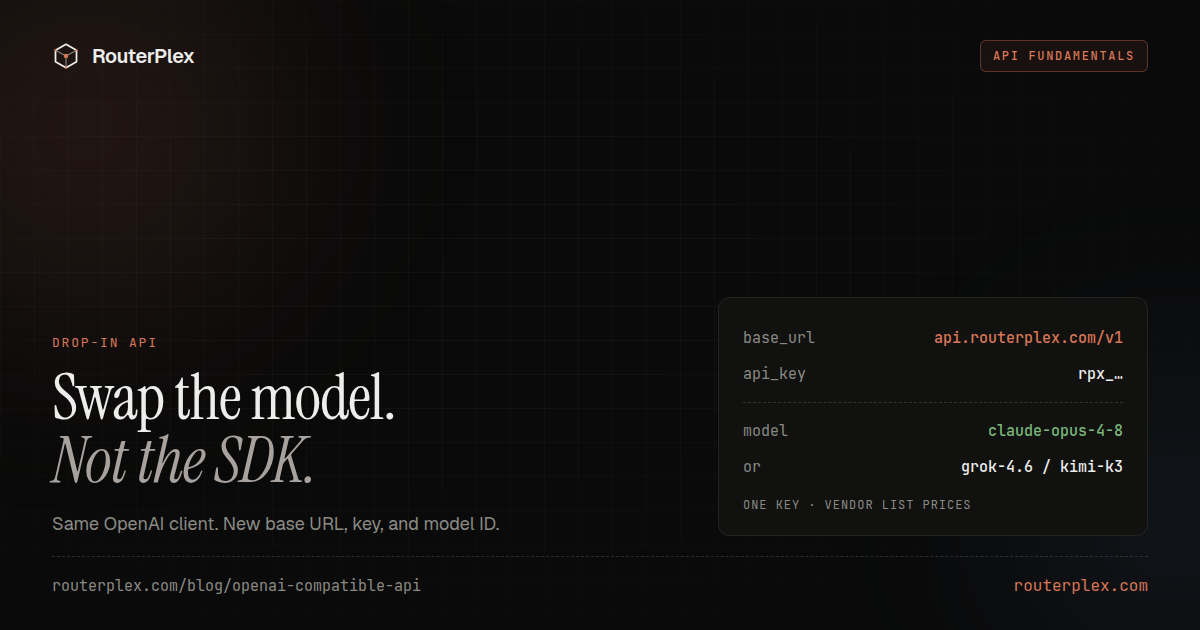
RouterPlex is a hosted gateway for developers who want model access included rather than bringing separate vendor accounts. One prepaid balance covers 64 curated models across 15 providers through OpenAI- and Anthropic-compatible endpoints.
RouterPlex charges supported models at vendor list price and adds no card or crypto top-up fee. Every key can carry a hard lifetime budget, and the prepaid account balance stops at zero.
The limitation is deliberate: the catalog is much smaller than OpenRouter or Requesty. RouterPlex fits mainstream Claude, GPT, Gemini, DeepSeek, Qwen, Kimi, and similar workloads, not every niche community model.
Best for: indie developers and small teams that value billing simplicity and spend containment.
OpenRouter #
OpenRouter is the category leader for broad hosted model access. It offers hundreds of models, multiple providers for many models, routing controls, and an active developer ecosystem.
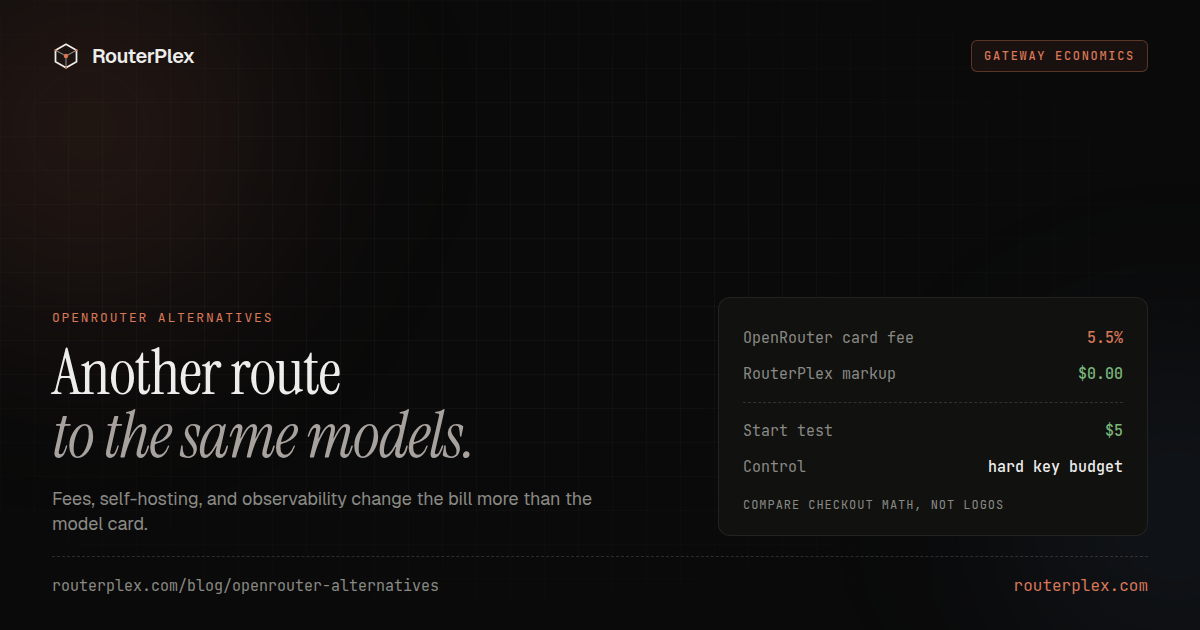
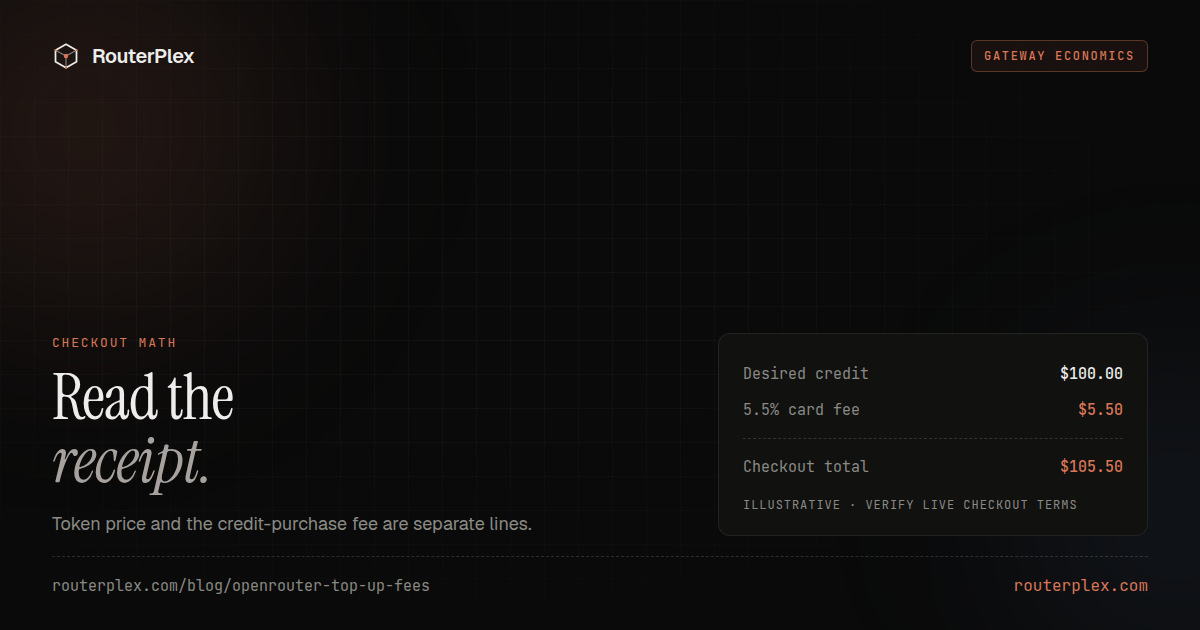
OpenRouter says it passes through provider token prices, then charges when credits are purchased. Its published card fee was 5.5% with a $0.80 minimum and its crypto fee was 5% when checked July 19, 2026.
Best for: developers who need the broadest catalog or provider-routing depth and accept the funding fee.
Read the OpenRouter alternatives comparison, the detailed OpenRouter pricing and fee math, or the negative-balance and 402 recovery guide. Coding-agent users can also compare a local routing layer in the Claude Code Router setup guide.
LLM Gateway #
LLM Gateway is a hosted multi-model wallet with BYOK and an AGPLv3 self-host. Official pricing (26 Aug 2026): provider rates, a flat 5% when you buy credits, BYOK at 0%, optional payload storage at $0.01 per 1M tokens. Catalog: 200+ models across 40+ providers.
It is a closer OpenRouter peer than an inference host. Choose it when you want BYOK or self-host and will pay 5% on hosted credits. Choose RouterPlex when you want $0 to fund a smaller catalog and a balance that cannot go negative. See RouterPlex vs LLM Gateway.
Best for: hosted access with BYOK or a self-hosted AGPLv3 gateway.
Vercel AI Gateway #
Vercel AI Gateway is a hosted wallet inside Vercel. Official pricing (26 Aug 2026): no markup and no platform fee on tokens; processor fees may apply when buying credits; enterprise invoice has none. Free tier is $5/month on a subset of models. BYOK is 0% on the paid tier; failed keys fall back to system credentials billed to credits.
Do not invent a card-processor percentage as Vercel's fee. The product fit is the Vercel/AI SDK workflow, not a standalone stop-at-zero prepaid key. See RouterPlex vs Vercel AI Gateway.
Best for: Next.js applications already on Vercel.
Requesty #
Requesty describes itself as an AI gateway and LLM router for more than 600 models. It emphasizes routing, provider access, observability, and enterprise gateway features.
OpenSEO shows Requesty earning search traffic from model directories, cheapest-model rankings, and provider pages. That is useful evidence of its product shape: it competes as both a gateway and a model-discovery layer.
Best for: teams that want a large managed catalog and routing features. Compare billing, supported endpoints, logging, and data terms for the exact models you use.
AgentRouter #
AgentRouter is a hosted unified API aimed heavily at coding-tool users. Its public messaging emphasizes free quota, Claude Code compatibility, and access to multiple model families.
The tradeoff is confidence. Its public search footprint is small, and promotional affiliate content makes strong free-credit claims without the depth of pricing, privacy, support, or sustainability evidence available from larger services. Treat free quota as a test budget, not a production guarantee.
Best for: non-sensitive experiments where the current free offer is worth testing. Avoid making it a single point of failure until service terms, data handling, and support meet your requirements.
Fireworks AI #
Fireworks AI is primarily an inference platform for generative and open-weight models. It offers serverless inference, deployments, fine-tuning, and model-serving infrastructure.
That is not the same purchase as a neutral wallet spanning every proprietary model vendor. Fireworks competes when you want fast inference for models it hosts, especially open models, and are willing to choose the serving platform as well as the model.
OpenSEO shows Fireworks ranking strongly for open source LLMs, inference providers, and model-specific queries. That matches its infrastructure position.
Best for: production open-model inference, deployment control, and performance work.
Together AI #
Together AI is an AI cloud for model inference, dedicated endpoints, and training. Like Fireworks, it runs model infrastructure rather than acting only as a billing and routing layer over unrelated vendors.
Together earns organic visibility through model pages for DeepSeek, Kimi, Sora, and other hosted models. Choose it when the desired model and deployment mode are available directly on Together.
Best for: teams building on open or hosted models that want inference infrastructure and optional dedicated capacity.
LiteLLM #
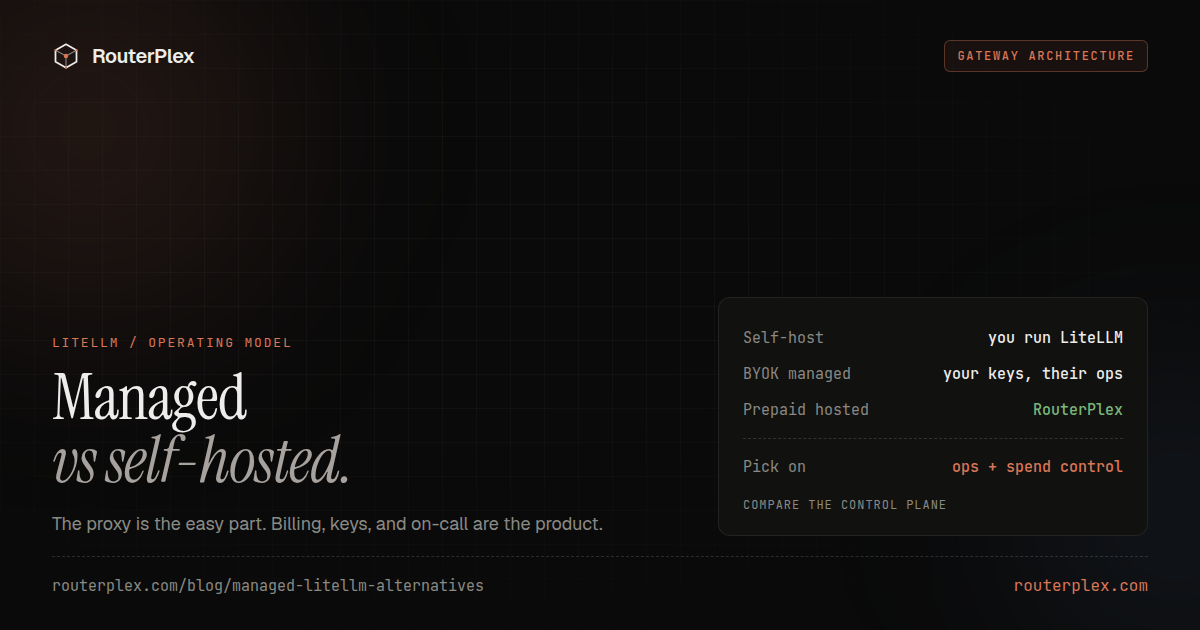
LiteLLM is an open-source SDK and proxy that normalizes many model-provider APIs. In a self-hosted setup, you keep the provider accounts, credentials, infrastructure, database, upgrades, and incident response.
LiteLLM removes protocol fragmentation but not vendor-account fragmentation. That is a good trade when your team already has contracts and needs control over the proxy boundary.
Best for: platform teams with provider relationships and engineers available to own the gateway. Read the LiteLLM alternatives and self-hosting guide.
Portkey #
Portkey combines an AI gateway with routing, reliability, access controls, observability, and governance features.
Portkey is relevant when the gateway is an organization control plane rather than merely a cheaper way to buy tokens. Evaluate it on policy, auditability, data controls, and how it connects to existing provider accounts.
Best for: teams standardizing model access across several applications or business units.
Helicone #
Helicone leads with LLM observability and adds gateway capabilities such as caching, routing, and request controls.
Choose Helicone when the primary pain is understanding production model behavior: cost, latency, errors, prompts, traces, and cache performance. Decide separately whether model access should come through direct provider accounts or another aggregator.
Best for: AI applications that already call models and need better telemetry.
Which LLM gateway should you choose? #
Use the responsibility boundary first:
| Requirement | Start with |
|---|---|
| One prepaid balance, mainstream models, hard budgets | RouterPlex |
| Largest hosted model catalog | OpenRouter, LLM Gateway, or Requesty |
| Hosted wallet with BYOK or self-host | LLM Gateway |
| Already on Vercel / AI SDK | Vercel AI Gateway |
| Free experimental quota | AgentRouter, after checking current terms |
| Open-model inference infrastructure | Fireworks AI or Together AI |
| Self-hosted BYOK proxy | LiteLLM or LLM Gateway AGPLv3 |
| Organization policy and governance | Portkey |
| Observability-first gateway | Helicone |
Then test the final two with the same requests. Verify streaming, tool calls, structured output, context limits, error behavior, data retention, and final billed cost.
Cost questions most comparisons miss #
Ask each provider:
- Is there a markup on model tokens?
- Is there a fee when purchasing credits?
- Does BYOK usage have a platform fee?
- Is observability priced separately?
- Can balances become negative?
- Can each key enforce a hard server-side budget?
- Do credits expire or become non-refundable?
- What happens when billing state is unavailable?
The cheapest-looking model rate can still produce a more expensive account if funding fees, minimums, or operational work are excluded.
If your shortlist starts with one hosted balance and hard spend limits, run a $5 RouterPlex test. Use a dedicated key, replay a representative workload, and compare the exact billed amount before moving traffic.
Common questions
Frequently asked questions
What is the best LLM gateway for developers?
RouterPlex, OpenRouter, LLM Gateway, Vercel AI Gateway, and Requesty fit developers who want model access included. LiteLLM fits teams that want to self-host with their own provider keys. Portkey and Helicone fit governance or observability-heavy teams. Fireworks AI and Together AI are inference platforms rather than neutral gateways across every proprietary provider.
What is the difference between an LLM gateway and an inference provider?
A gateway provides one control point across model providers. An inference provider runs the model infrastructure itself. Fireworks AI and Together AI primarily operate inference platforms; RouterPlex, OpenRouter, LLM Gateway, and Vercel AI Gateway aggregate access; LiteLLM proxies keys you already own.
Is AgentRouter a RouterPlex competitor?
Yes, for developers seeking one API across models. AgentRouter emphasizes free quota and community access, while RouterPlex emphasizes transparent prepaid billing, hard key budgets, published business terms, and a smaller curated catalog.
Do LLM gateways add fees?
Some do and some do not. Compare token markup, credit-purchase fees, subscriptions, BYOK charges, and optional observability plans separately. A model table alone does not show total cost.
Run the smallest paid test.
Add $5, cap the key, and verify the result with your own workload. No subscription, and credit never expires — a first top-up of $25+ is matched with $25 extra.