Kimi K3.1 Pro API: $2/$10 Pricing, Benchmarks and Setup
Kimi K3.1 Pro API pricing: $2 input, $10 output per 1M tokens. Highspeed is $4/$20. Both live on RouterPlex, 1M context. Python and Claude Code setup.
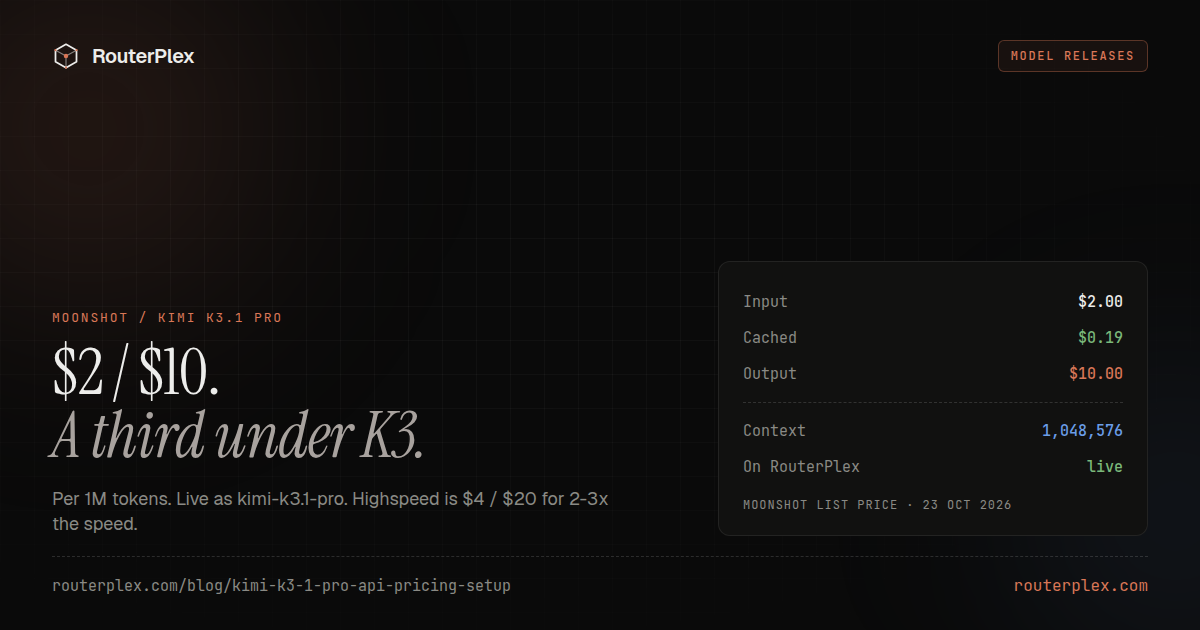
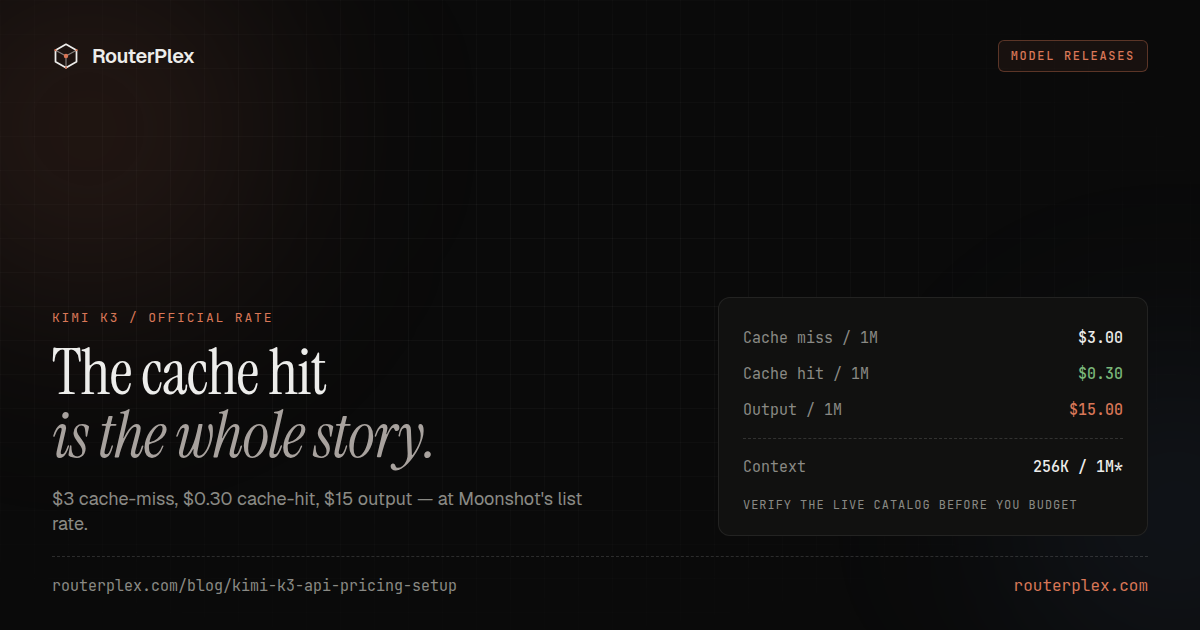
Kimi K3.1 Pro API pricing is $2 per 1M input tokens and $10 per 1M output tokens, Moonshot's list price. Kimi K3.1 Pro Highspeed costs $4 / $20 and runs 2-3x faster. Both are live on RouterPlex today as kimi-k3.1-pro and kimi-k3.1-pro-highspeed, with a 1,048,576-token context window. K3.1 Pro is one third cheaper than Kimi K3, which lists at $3 / $15.
Moonshot released both models on 23 October 2026. One RouterPlex key reaches them through the OpenAI and the Anthropic API formats, so they also run inside Claude Code.
Checked 23 October 2026: Moonshot's K3.1 Pro quickstart, the Kimi K3.1 Pro launch post, Moonshot's pricing page as listed on models.dev, and the live RouterPlex catalog. Benchmark scores below are Moonshot-reported. Rates change, so check the Kimi K3.1 Pro price page before you lock a budget.
Create an account, put kimi-k3.1-pro on a key with a hard budget, and send one request. There is no per-token markup and no top-up fee.
Kimi K3.1 Pro API pricing #
USD per 1M tokens, as billed on RouterPlex on 23 October 2026.
| Line | K3.1 Pro (Moonshot) | K3.1 Pro (RouterPlex) | Highspeed (Moonshot) | Highspeed (RouterPlex) |
|---|---|---|---|---|
| Input | $2.00 | $2.00 | $4.00 | $4.00 |
| Output | $10.00 | $10.00 | $20.00 | $20.00 |
| Cached input (read) | $0.20 | $0.19 | $0.20 | $0.32 |
| Long-context surcharge | None | None | None | None |
Input and output match Moonshot's list price on both models. Cached input is the part of a prompt the provider has seen before, billed at a lower rate. We set every cache price from what our own upstream charges us, not from the lab's sheet. On K3.1 Pro that gives $0.19 per 1M, a cent under Moonshot's $0.20. On Highspeed it gives $0.32, which is above Moonshot's $0.20. If you run Highspeed with a heavy cache, Moonshot's own API is cheaper on that one line.
Two worked examples on K3.1 Pro, both with 2,000 output tokens:
- A cold 40,000-token prompt costs $0.10. That is $0.08 of input plus $0.02 of output.
- The same prompt with 36,000 tokens served from cache costs $0.035. Agent loops resend the same context every turn, so most of their input lands on the cache line.
A $5 balance covers about 2.5 million fresh input tokens or 500,000 output tokens on K3.1 Pro. Reasoning tokens bill as output, and reasoning is always on.
Kimi K3.1 Pro vs Highspeed: which one to call #
Both IDs serve the same model. Moonshot's guide says Highspeed "delivers 2-3x the speed of K3.1 Pro for more responsive interactions." You pay double per token for that speed.
Pick kimi-k3.1-pro for batch jobs, background agents and long coding runs. Nobody is watching the tokens arrive, so speed matters less than cost. The cache price is also lower, which matters on long agent sessions.
Pick kimi-k3.1-pro-highspeed when a person waits on the answer. Chat front ends, pair programming and interactive Claude Code sessions are the fit. Reasoning is always on, so a reply can spend thousands of thinking tokens before the first visible word. Faster decoding shortens that wait.
You can mix them on one RouterPlex key. Send planning turns to Highspeed and bulk work to Pro, and both bill from the same prepaid balance.
Kimi K3.1 Pro vs Kimi K3 and other frontier models #
List prices on RouterPlex, USD per 1M tokens, checked 23 October 2026. The last two columns are the cost of one 40K-in / 2K-out turn, first with no cache and then with 36K of the prompt cached.
| Model ID | Input | Output | Cache read | Cold turn | Cached turn |
|---|---|---|---|---|---|
kimi-k3.1-pro | $2.00 | $10.00 | $0.19 | $0.100 | $0.035 |
kimi-k3.1-pro-highspeed | $4.00 | $20.00 | $0.32 | $0.200 | $0.068 |
kimi-k3 | $3.00 | $15.00 | $0.70 | $0.150 | $0.067 |
claude-opus-5-5 | $4.00 | $20.00 | $0.425 | $0.200 | $0.071 |
gemini-4-argon | $2.00 | $10.00 | n/a | $0.100 | n/a |
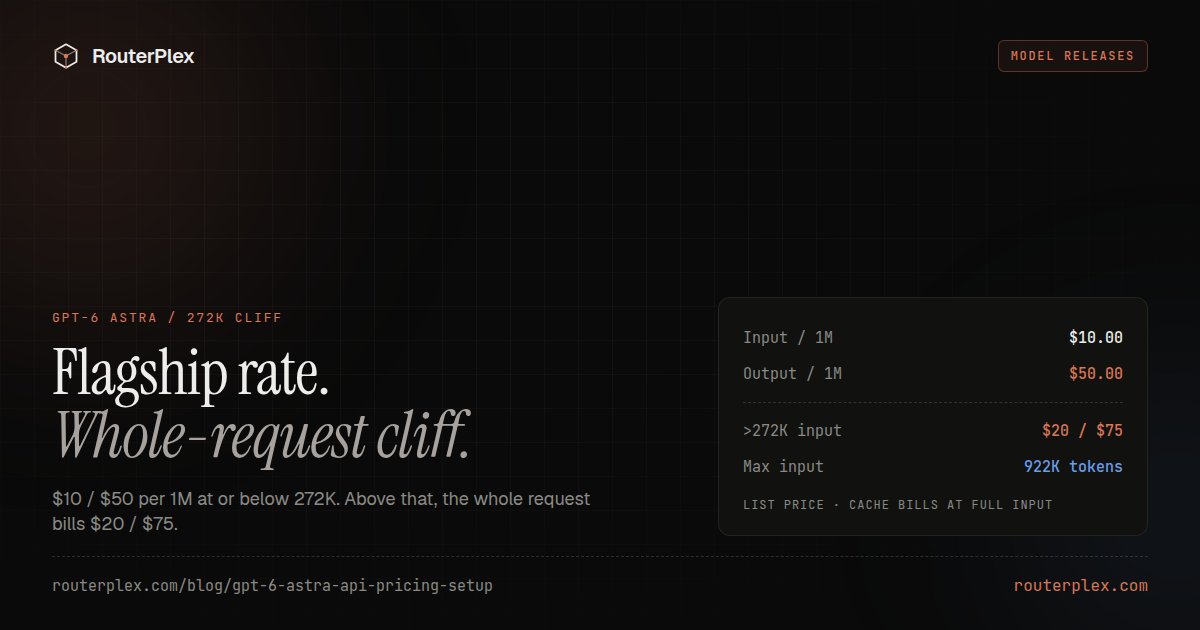
gpt-6-astra | $10.00 | $50.00 | $0.80 | $0.500 | $0.169 |
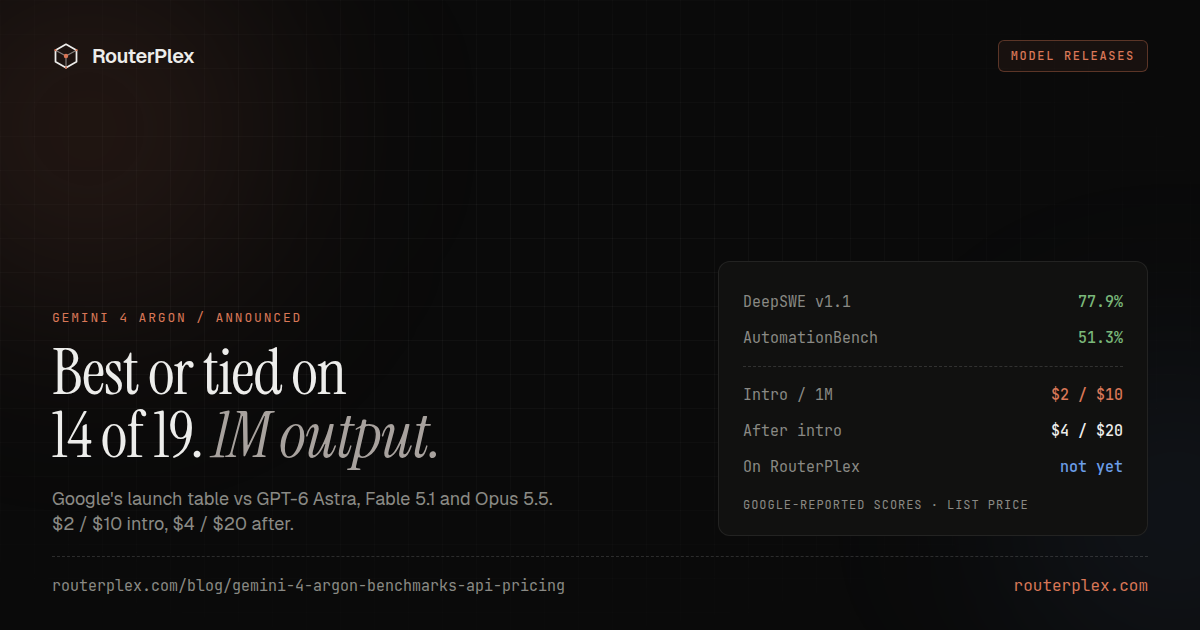
Against Kimi K3, the cached turn costs about half as much on K3.1 Pro. Most of that gap comes from the cache line: $0.19 against $0.70. Gemini 4 Argon has the same $2 / $10 sticker, but that is an introductory rate. Google moves it to $4 / $20 on 1 December 2026, per its model page.
Kimi K3.1 Pro benchmarks #
These numbers come from Moonshot's launch post, checked 23 October 2026. They are vendor-run. RouterPlex has not re-run them, and no independent scores existed on launch day.
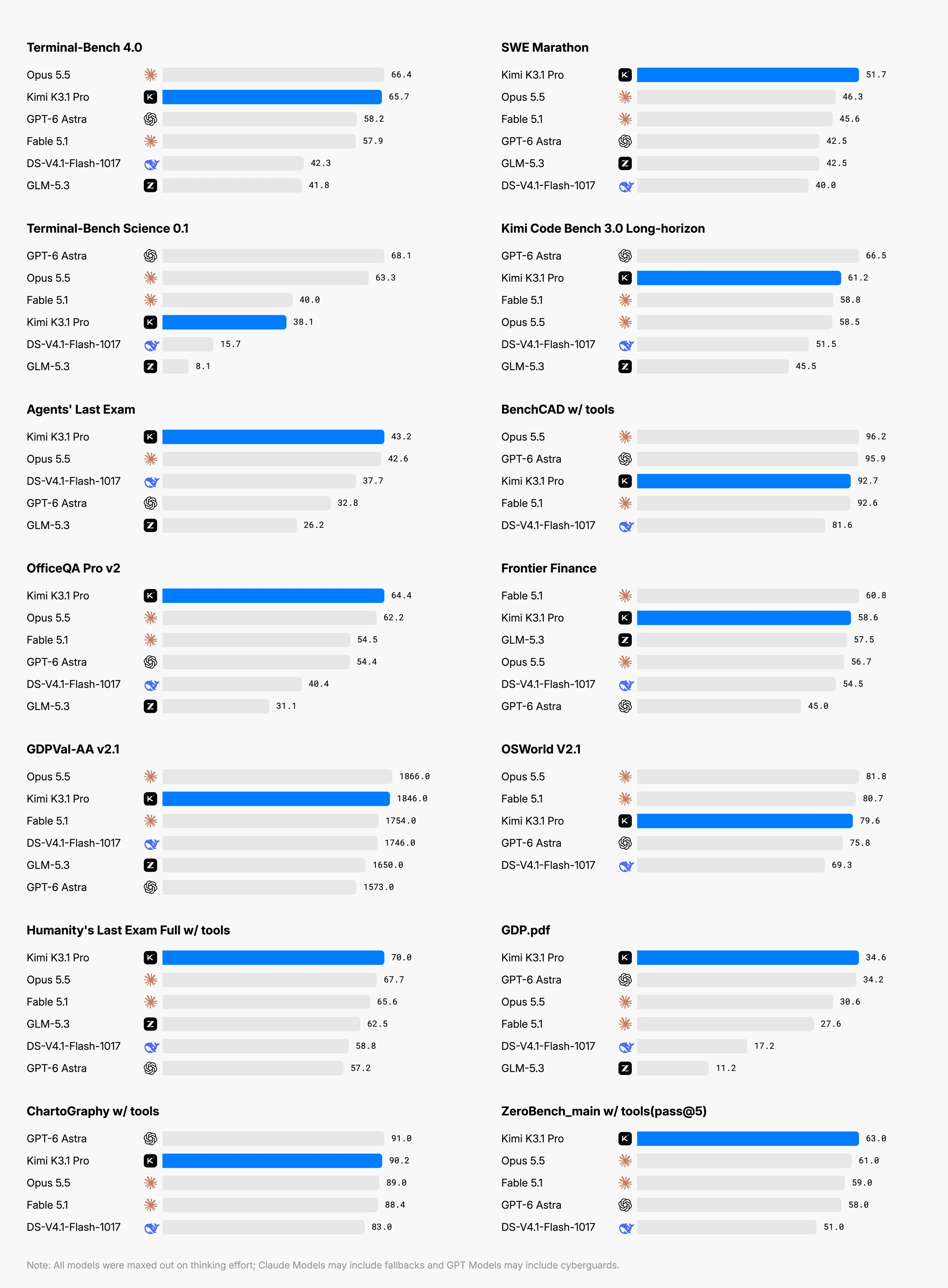
Source: Moonshot AI, Kimi K3.1 Pro launch post. All models ran at maximum thinking effort.
| Benchmark | K3.1 Pro | Comparison (Moonshot's table) |
|---|---|---|
| Terminal-Bench 4.0 | 65.7% | Claude Opus 5.5 66.4%, GPT-6 Astra 58.2% |
| Kimi Code Bench 3.0 (long-horizon) | 61.2% | Kimi K3 55.95% |
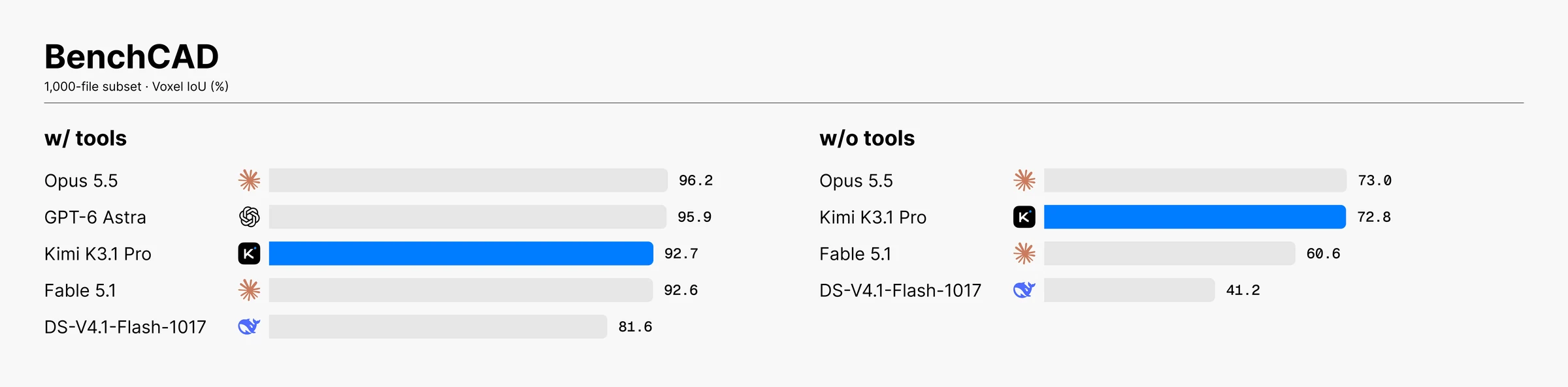
| BenchCAD, with tools | 92.7 | Opus 5.5 96.2, GPT-6 Astra 95.9, Fable 5.1 92.6 |
| BenchCAD, without tools | 72.8 | Opus 5.5 73.0, Fable 5.1 60.6 |
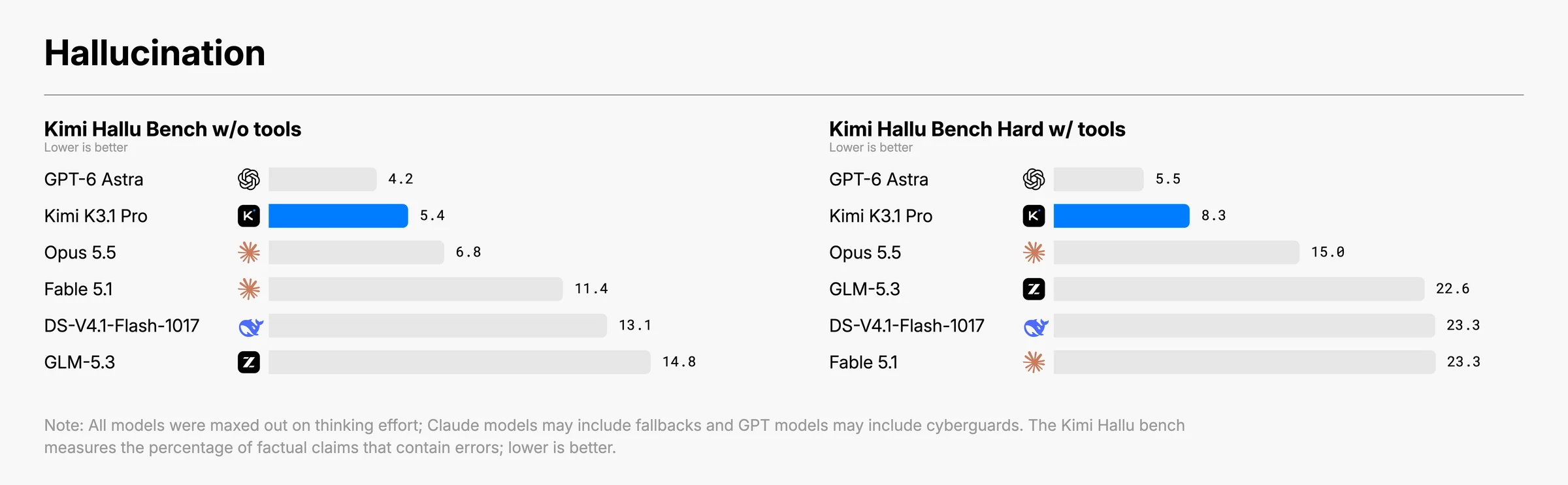
| Kimi Hallu Bench Hard, with tools (lower is better) | 8.3% | Kimi K3 23.4%, GPT-6 Astra 5.5%, Opus 5.5 15.0% |
| Financial Research (internal) | 70.4 | Kimi K3 58.8 |
On Terminal-Bench 4.0, a test of hard shell and terminal tasks, K3.1 Pro sits 0.7 points behind Opus 5.5 at half its token price. Moonshot's cost chart makes the same point per task. K3.1 Pro at max effort scores about 66% for roughly $5 per task. Opus 5.5 scores about the same for roughly $14, and Claude Sonnet 5.5 costs about $22. Kimi Code Bench and the finance tests are Moonshot's own internal suites, so treat them as a vendor view.
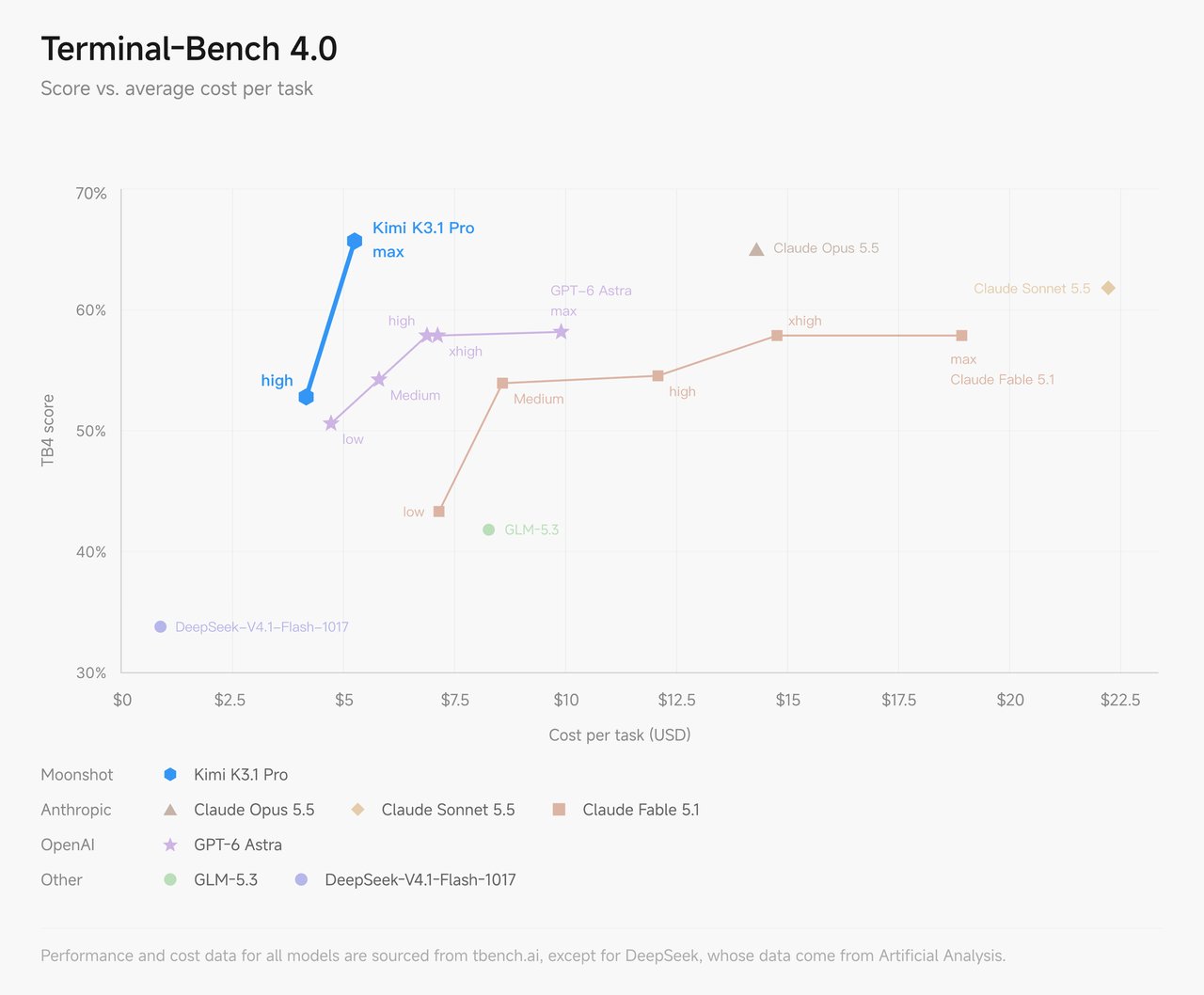
Source: Moonshot AI, using tbench.ai cost and score data (DeepSeek from Artificial Analysis). RouterPlex did not re-run the eval, and these are not RouterPlex bills.
The hallucination row is the biggest change from K3. Moonshot reports the claim-level error rate fell from 23.4% to 8.3% with tools. Moonshot also says the test targets error-prone cases, so it does not reflect a typical error rate.
For 3D and CAD work, BenchCAD measures how closely a generated model matches a reference part. K3.1 Pro ties Fable 5.1 with tools and nearly matches Opus 5.5 without them.
On finance work, K3.1 Pro leads OfficeQA Pro v2 and places second on Frontier Finance.
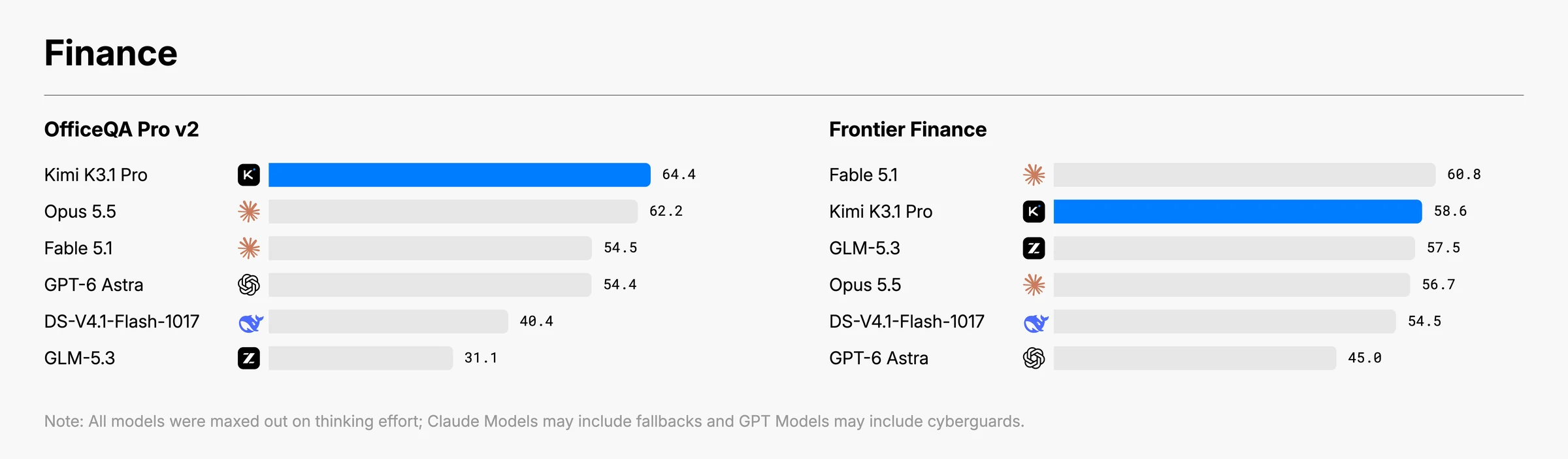
Charts: Moonshot AI, Kimi K3.1 Pro launch post, 23 October 2026. Vendor-run.
Specs and API behavior #
| Spec | Kimi K3.1 Pro |
|---|---|
| Model IDs on RouterPlex | kimi-k3.1-pro, kimi-k3.1-pro-highspeed |
| Released | 23 October 2026 |
| Base | Post-trained version of Kimi K3 |
| Context window | 1,048,576 tokens |
| Max output on RouterPlex | 131,072 tokens |
| Input / output | Text and image in, text out |
| Reasoning | Always on. Effort: low, high, max (default max) |
| Tool calling | Yes |
| Open weights | Moonshot says by 4 November 2026 |
Moonshot describes K3.1 Pro as "a post-trained version of Kimi K3, with substantially larger post-training compute". It calls the model "our most capable 3T-class open-weight model to date".
Reasoning cannot be switched off. Pass reasoning_effort on Chat Completions to choose low, high or max. The reasoning text arrives in a separate reasoning_content field. Keep one effort level for a whole conversation. Switching it mid-conversation invalidates the prompt cache, so the next turn bills at the full input rate.
Moonshot fixes temperature and top_p on this model. Leave them out of your requests.
Max output on RouterPlex is 131,072 tokens per response. Moonshot's own API allows more, but our upstream caps it there.
Call Kimi K3.1 Pro from Python #
Install the official SDK (pip install openai) and point it at RouterPlex.
import osfrom openai import OpenAIclient = OpenAI(api_key=os.environ["ROUTERPLEX_API_KEY"],base_url="https://api.routerplex.com/v1",)response = client.chat.completions.create(model="kimi-k3.1-pro",reasoning_effort="high",messages=[{"role": "user", "content": "Review this pull request and list the riskiest change."}],)print(response.choices[0].message.content)
The same call with curl:
curl https://api.routerplex.com/v1/chat/completions \-H "Authorization: Bearer $ROUTERPLEX_API_KEY" \-H "Content-Type: application/json" \-d '{"model": "kimi-k3.1-pro","reasoning_effort": "low","messages": [{"role": "user", "content": "Summarize this changelog in five bullets."}]}'
To use the fast variant, change the model to kimi-k3.1-pro-highspeed. Vision works on the same endpoint. Send the image as a base64 data URL in an image_url content part. Moonshot rejects plain https image links on this model.
Use Kimi K3.1 Pro in Claude Code #
RouterPlex serves both models on the Anthropic-compatible /v1/messages format too, with streaming and tool calls. Claude Code needs three environment variables and no local proxy.
export ANTHROPIC_BASE_URL="https://api.routerplex.com"export ANTHROPIC_AUTH_TOKEN="$ROUTERPLEX_API_KEY"export ANTHROPIC_MODEL="kimi-k3.1-pro"claude
Long coding sessions resend the same context on every turn, so most of their input bills at the $0.19 cache rate. Swap in kimi-k3.1-pro-highspeed when you want faster replies while you watch. The Claude Code with RouterPlex docs cover per-key model allowlists. To route different models to planning and background work, see the Claude Code Router guide.
Moving off Kimi K2 #
Moonshot's pricing page says K2 series models close to newly registered users on 31 October 2026. Moonshot plans to retire all K2 models by the end of December 2026. It points K2 users to K3.1 Pro.
If you call kimi-k2.6 or kimi-k2.7 today, plan the move now. On RouterPlex the change is one string. Swap the model ID to kimi-k3.1-pro and keep the same key and base URL.
| What changes | Kimi K2.6 / K2.7 | Kimi K3.1 Pro |
|---|---|---|
| Price per 1M (input / output) | $0.95 / $4 | $2 / $10 |
| Context window | 256K | 1,048,576 |
| Reasoning | Yes | Always on, bills as output |
Test a day of real traffic on a key with a hard budget before you move production.
Where it goes wrong #
These five errors cover most failed first calls.
- A 402 on the first call means the prepaid balance is at $0. Top up, or raise the key's spend limit on the dashboard.
- A model-not-found error usually means a typo in the ID. The IDs use a dot, as in
kimi-k3.1-pro. - Path errors from the Anthropic SDK come from the base URL. Use
https://api.routerplex.comwithout/v1there, andhttps://api.routerplex.com/v1for the OpenAI SDK. - Errors on sampling settings mean
temperatureortop_pis in the request. Moonshot fixes both on this model, so remove them. - A bill higher than you expected often comes from the default
maxeffort. Setreasoning_efforttolowfor short, simple calls.
Start using Kimi K3.1 Pro #
Create a RouterPlex account, add a prepaid balance, and call kimi-k3.1-pro at Moonshot's $2 / $10 list rate. One key reaches K3.1 Pro, Highspeed and the rest of the model catalog. You pay 0% per-token markup and $0 top-up fees. Every key can carry a hard budget, and the balance stops at $0.
Common questions
Frequently asked questions
How much does the Kimi K3.1 Pro API cost?
Moonshot lists Kimi K3.1 Pro at $2 per 1M input tokens and $10 per 1M output tokens, checked 23 October 2026. RouterPlex bills that same list rate on model ID kimi-k3.1-pro with no per-token markup. Cached prompt tokens bill at $0.19 per 1M on RouterPlex, a cent under Moonshot's $0.20. There is no long-context surcharge, and reasoning tokens bill as output.
What is Kimi K3.1 Pro Highspeed and what does it cost?
Kimi K3.1 Pro Highspeed is the same model served faster. Moonshot says it delivers 2-3x the speed of K3.1 Pro. It costs $4 per 1M input tokens and $20 per 1M output tokens, double the standard rate. On RouterPlex the model ID is kimi-k3.1-pro-highspeed. Cached input bills at $0.32 per 1M, above Moonshot's $0.20, because our cache price follows what our upstream charges us.
Is Kimi K3.1 Pro cheaper than Kimi K3?
Yes. Kimi K3 lists at $3 input and $15 output per 1M tokens, so K3.1 Pro at $2 and $10 is one third cheaper per token. On RouterPlex the cache line widens the gap: $0.19 per 1M on K3.1 Pro against $0.70 on K3. A 40K-in, 2K-out agent turn with 36K cached costs about $0.035 on K3.1 Pro and $0.067 on K3, checked 23 October 2026.
Can I use Kimi K3.1 Pro in Claude Code?
Yes. Set ANTHROPIC_BASE_URL to https://api.routerplex.com, ANTHROPIC_AUTH_TOKEN to your RouterPlex key, and ANTHROPIC_MODEL to kimi-k3.1-pro, then run claude. RouterPlex serves both K3.1 Pro models on the Anthropic /v1/messages format, with streaming and tool calls. Use kimi-k3.1-pro-highspeed for faster interactive sessions.
What is the Kimi K3.1 Pro context window and max output?
Kimi K3.1 Pro has a 1,048,576-token context window. On RouterPlex, one response can carry up to 131,072 output tokens. Moonshot's own API allows a larger output setting, but our upstream caps it at 131,072. Input can be text or images, and output is text.
How does Kimi K3.1 Pro score on benchmarks?
Moonshot reports 65.7% on Terminal-Bench 4.0, against 66.4% for Claude Opus 5.5 and 58.2% for GPT-6 Astra. On its own Kimi Code Bench 3.0 long-horizon test, K3.1 Pro scores 61.2% against 55.95% for Kimi K3. These scores come from Moonshot's 23 October 2026 launch post. They are vendor-run, and no independent scores existed on launch day.
Run the smallest paid test.
Add $5, cap the key, and verify the result with your own workload. No subscription, and credit never expires — a first top-up of $25+ is matched with $25 extra.