MiniMax M3.1 Flash API: Pricing, Benchmarks and Setup
MiniMax M3.1 Flash is live as MiniMax-M3.1-flash: $0.15 input, $0.60 output per 1M tokens, 1M context, always-on reasoning. Setup for Python and Claude Code.
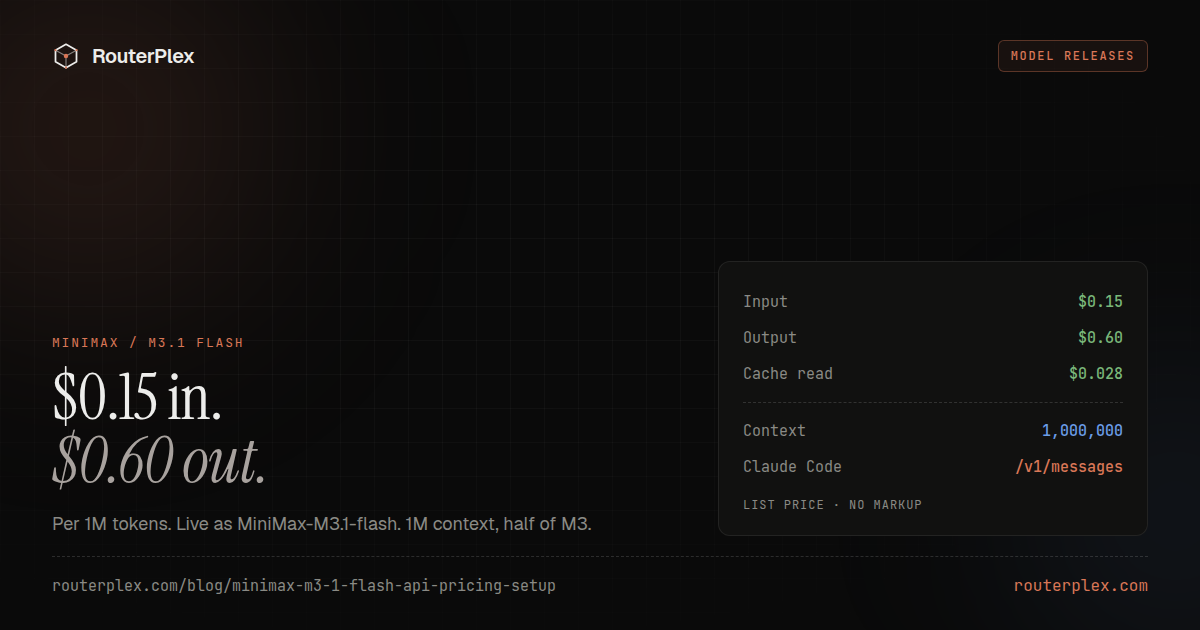
MiniMax M3.1 Flash is live on RouterPlex as MiniMax-M3.1-flash. MiniMax M3.1 Flash API pricing is $0.15 per 1M input tokens and $0.60 per 1M output tokens, flat at every prompt length. That is half the per-token rate of MiniMax M3. One RouterPlex key reaches it through both the OpenAI and the Anthropic API formats, so it also runs inside Claude Code.
MiniMax released the model on 19 October 2026. It was the anonymous "Space Bunny" model that served more than 200 trillion tokens before the reveal. RouterPlex listed it on 20 October 2026, after we tested chat, streaming, tool calls, vision and /v1/messages through api.routerplex.com.

Checked 20 October 2026: MiniMax's M3.1 Flash announcement, the models.dev entry for MiniMax-M3.1-Flash, the Artificial Analysis model page, and the live RouterPlex catalog. Benchmark scores below are MiniMax-reported. Rates change, so confirm the MiniMax M3.1 Flash price page before you lock a budget.
Create an account, put MiniMax-M3.1-flash on a key with a hard budget, and send one request. The same prepaid key reaches DeepSeek, GLM, Qwen, Kimi, Claude, GPT and the rest of the catalog. There is no per-token markup and no top-up fee.
MiniMax M3.1 Flash API pricing #
USD per 1M tokens, as billed on RouterPlex.
| Line | MiniMax list | RouterPlex |
|---|---|---|
| Input | $0.15 | $0.15 |
| Output | $0.60 | $0.60 |
| Cached input (read) | $0.015 | $0.028 |
| Long-context surcharge | None | None |
Input and output match MiniMax's list price exactly. The cache-read line does not. RouterPlex bills cache reads at $0.028 per 1M. We price every cache read from what our own upstream bills us, not from the lab's sheet. For this model, that rule gives $0.028. It is still about 81% below the $0.15 input rate. Cache writes bill at the input rate.
A cache hit is automatic. MiniMax caches any repeated prompt prefix of 512 tokens or more. You do not send cache_control markers. Change the tool list or the reasoning effort and the cache resets, because the prefix order is tools, then system prompt, then messages.
Two worked examples, both with 2,000 output tokens:
- A cold 40,000-token prompt costs $0.0072. That is $0.0060 of input plus $0.0012 of output.
- The same prompt with 36,000 tokens served from cache costs $0.0028. Agent loops resend the same context every turn, so most of their input lands on the cache line.
A $5 balance covers about 33 million fresh input tokens or 8.3 million output tokens. Real requests mix both. Reasoning tokens bill as output, and reasoning is always on for this model.
MiniMax M3.1 Flash vs other budget models #
List prices on RouterPlex, USD per 1M tokens. The last two columns are the cost of one 40K-in / 2K-out turn, first with no cache and then with 36K of the prompt cached.
| Model ID | Input | Output | Cache read | Cold turn | Cached turn |
|---|---|---|---|---|---|
MiniMax-M3.1-flash | $0.15 | $0.60 | $0.028 | $0.0072 | $0.0028 |
MiniMax-M3 | $0.30 | $1.20 | $0.030 | $0.0144 | $0.0047 |
deepseek-v4.1-flash | $0.18 | $0.73 | $0.065 | $0.0087 | $0.0045 |
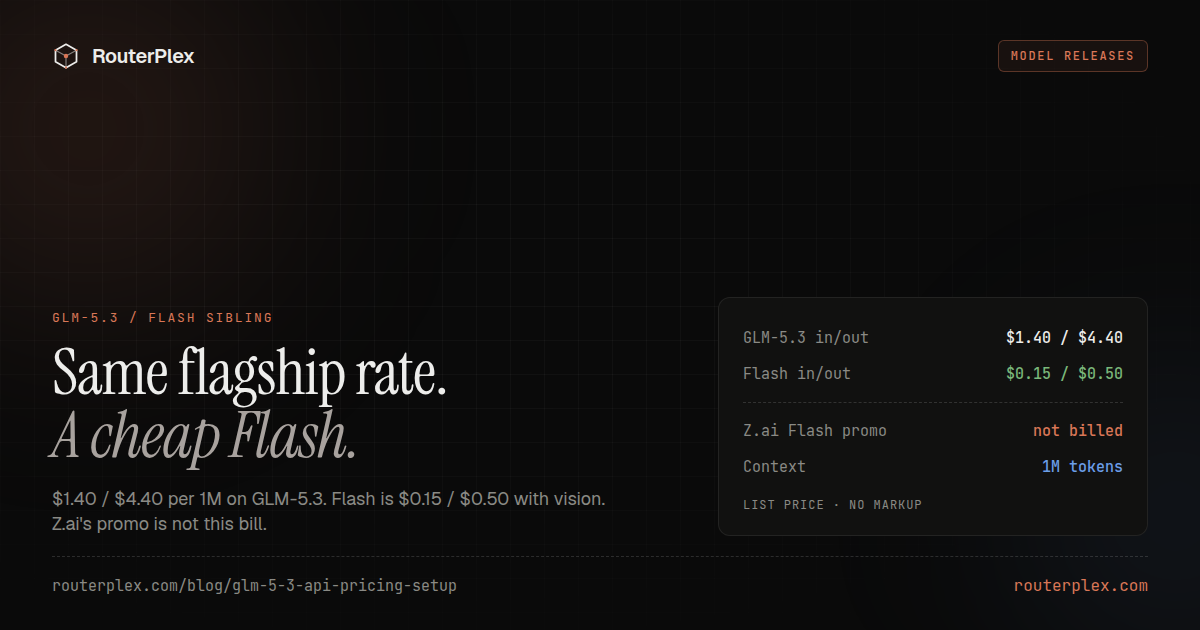
glm-5.3-flash | $0.15 | $0.50 | $0.030 | $0.0070 | $0.0027 |
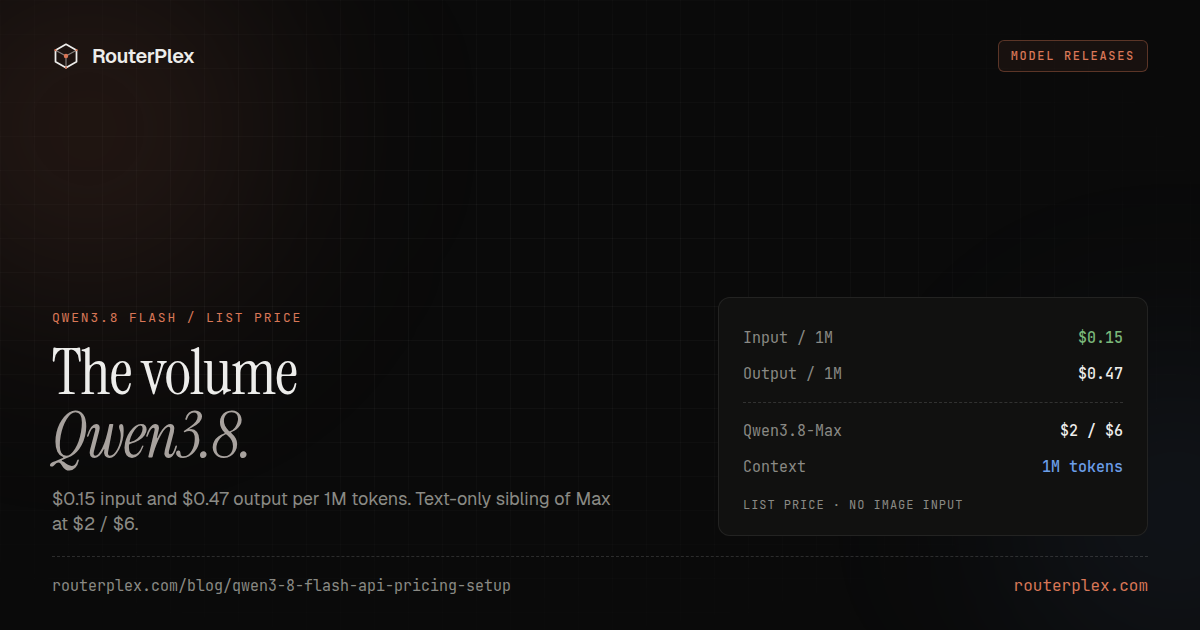
qwen3.8-flash | $0.15 | $0.47 | $0.016 | $0.0069 | $0.0021 |
gpt-6-luna | $0.10 | $0.50 | $0.014 | $0.0050 | $0.0019 |
So M3.1 Flash is not the lowest sticker on the list. GPT-6 Luna and Qwen3.8 Flash cost less per token. What M3.1 Flash adds is agent performance that MiniMax puts near frontier models, at the same price tier. Against MiniMax M3, the same turn costs half as much. The full ranking by real agent-turn cost is on the cheapest models ledger.
What MiniMax reports on benchmarks #
These numbers come from MiniMax's 19 October 2026 announcement and its comparison table. They are vendor-run. RouterPlex has not re-run them.
| Benchmark | MiniMax M3.1 Flash | What it tests |
|---|---|---|
| Automation-Bench v1.0.6 | 62.8 | End-to-end SaaS workflows in sales, ops, finance and HR |
| BankerToolBench | 76.2 | Multi-step planning and chained tool calls on finance tasks |
| DeepSWE v1.1 | 73.7% | Real software tasks: build, fix and test code |
| OSWorld V2 | 61.7 | Operating a computer across apps |
| Agents' Last Exam | 29.6 | Paid professional work |
| CyberGym | 82% | Finding and validating vulnerabilities |
| Terminal Bench 4.0 | 38.1 | Hard terminal and shell tasks |
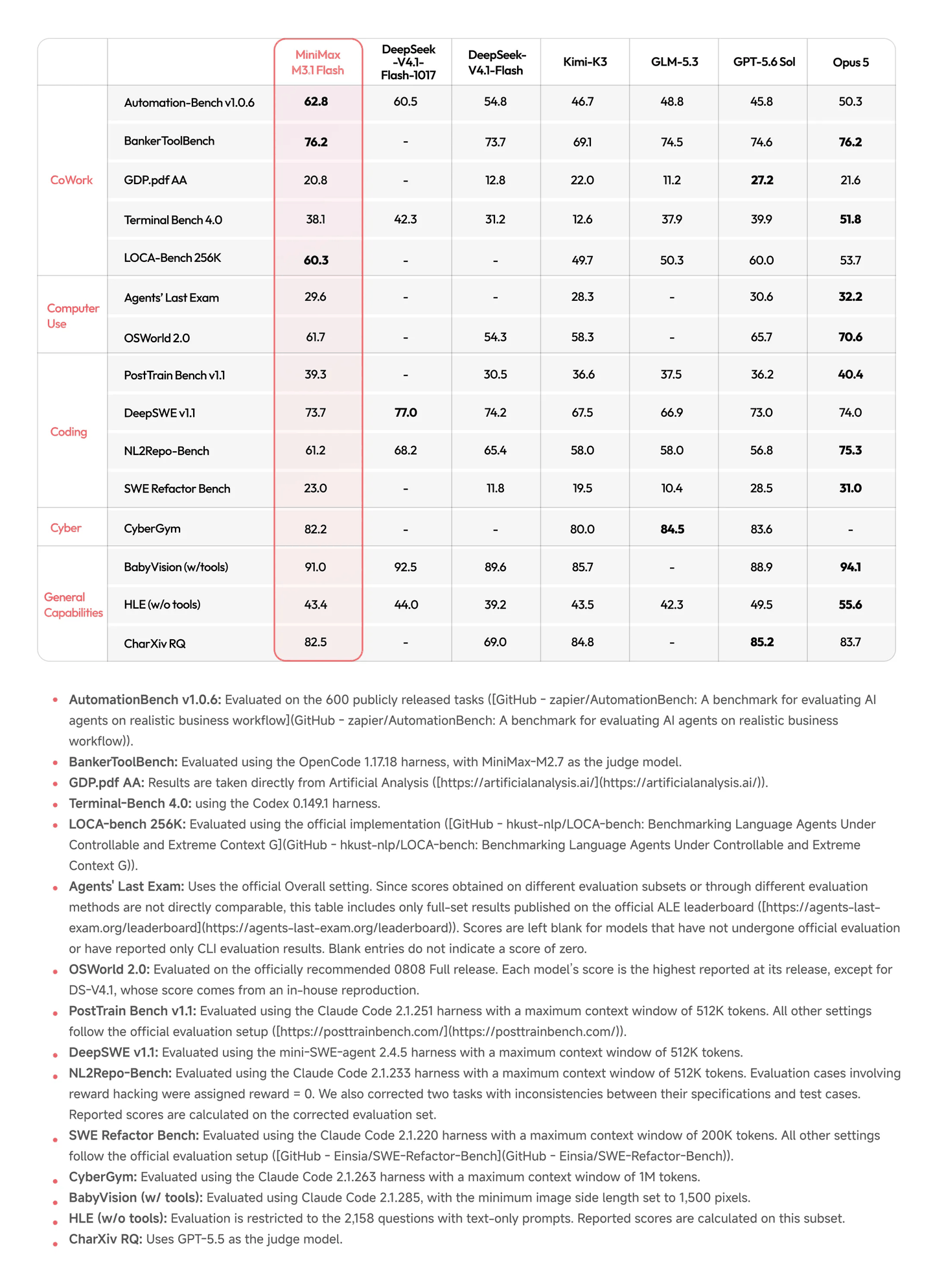
Automation-Bench v1.0.6 is the top score in MiniMax's table. Opus 5 scores 50.3 there. On DeepSWE, M3.1 Flash lands just above GPT-5.6 Sol (73.0) and below both DeepSeek V4.1 Flash builds (74.2, and 77.0 for the 1017 build). Terminal Bench 4.0 is the weak spot: Opus 5 leads it by 13.7 points. Some early write-ups quote 62.2 for Automation-Bench. MiniMax's published table and chart both show 62.8.
MiniMax's full table compares M3.1 Flash with both DeepSeek V4.1 Flash builds, Kimi K3, GLM-5.3, GPT-5.6 Sol and Opus 5. The notes under it list the test setup for each benchmark. Several coding scores were run inside Claude Code.
One independent caveat matters for production use. Artificial Analysis reports a 93% hallucination rate on its knowledge test, as The Decoder summarized. The model tries to answer every question rather than decline when unsure. Give it tools and sources for factual work, and check its claims.
MiniMax also reports speed. Everyday output reaches 200+ tokens per second, with a median of about 170. MiniMax calls that close to three times the speed of M3.
Cost per task, from MiniMax's charts #
MiniMax frames the launch around cost per task, not cost per token. Its three charts plot score against what a full run costs. These are MiniMax's charts with MiniMax's cost math, so treat them as vendor claims.
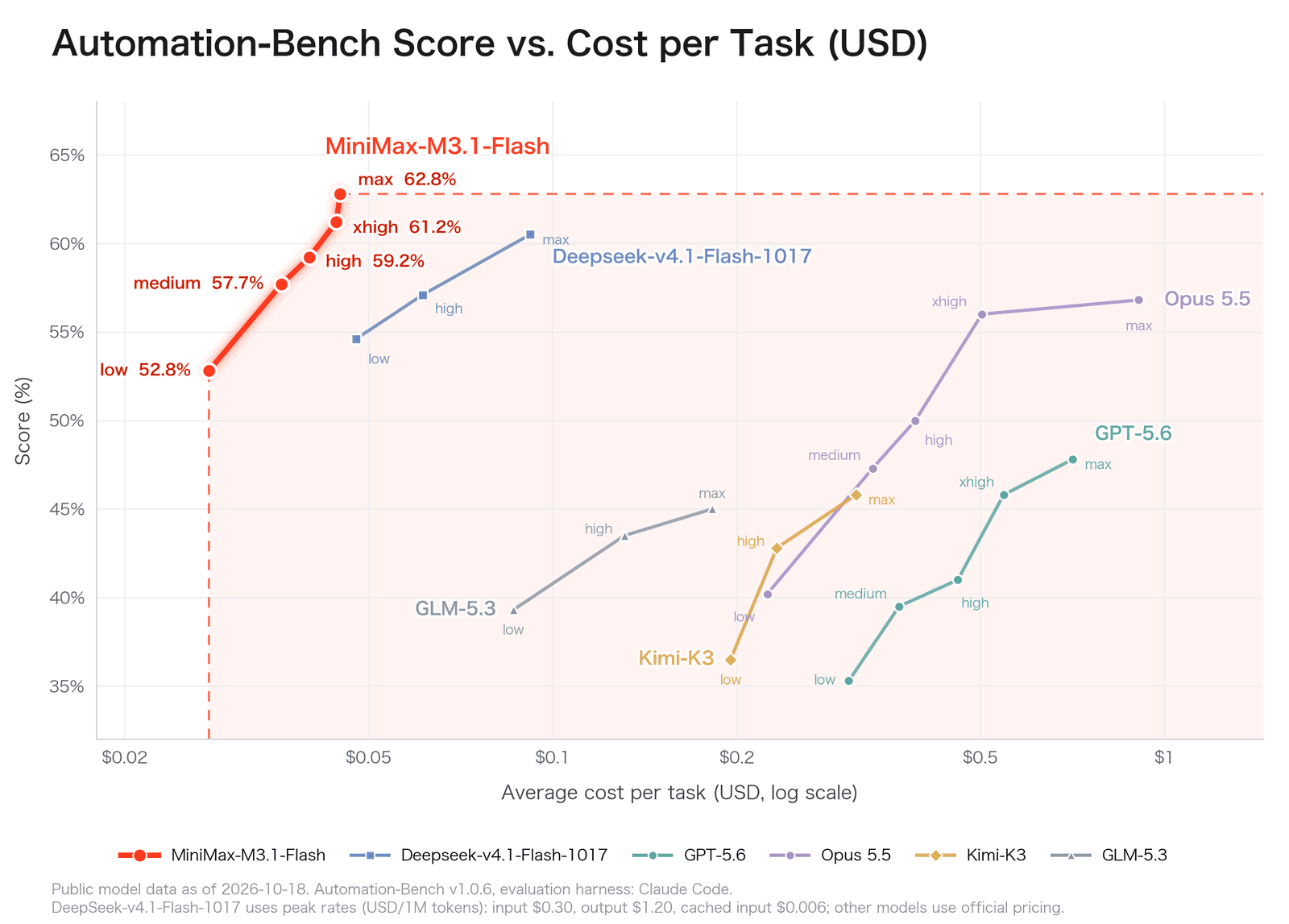
On Automation-Bench, every effort level costs under $0.05 per task. Scores climb from 52.8% at low effort to 62.8% at max. DeepSeek V4.1 Flash 1017 tops out at 60.5% for about $0.09 per task. Opus 5.5 and GPT-5.6 sit near $0.50 to $1 per task, below 57%.
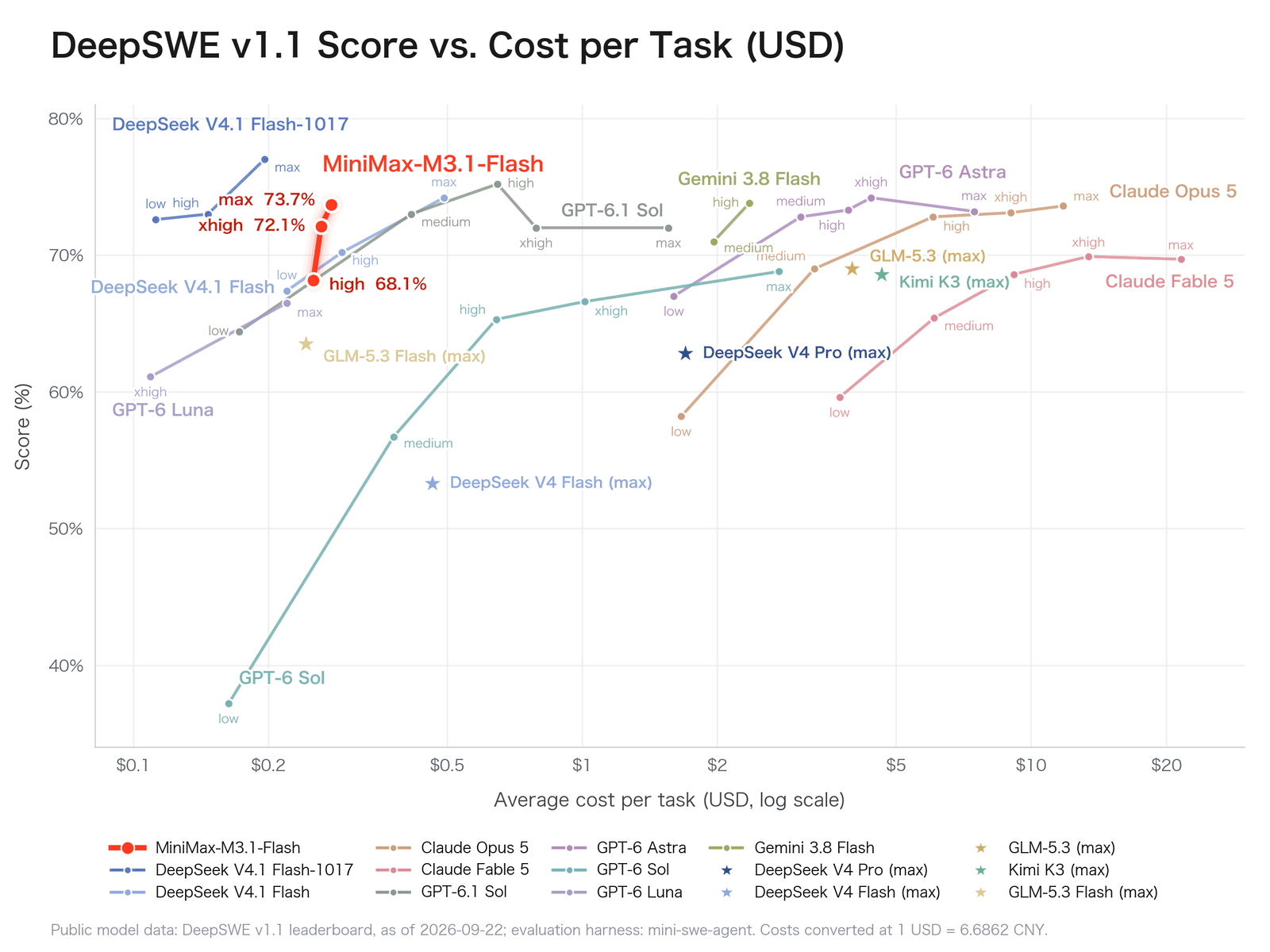
DeepSWE tells a different story. M3.1 Flash scores 68.1% at high, 72.1% at xhigh and 73.7% at max, for roughly $0.25 per task. DeepSeek V4.1 Flash 1017 sits higher and slightly cheaper, at 77% near $0.20. On coding tasks, M3.1 Flash is not the clear cost leader.
On Agents' Last Exam, a full 152-task run cost $111 at max effort for a 29.6% pass rate. That is the cheapest point on the chart. Claude Opus 5.5 leads on pass rate, near 38%, at over $1,000 for the run. M3.1 Flash ran inside Claude Code for this test.
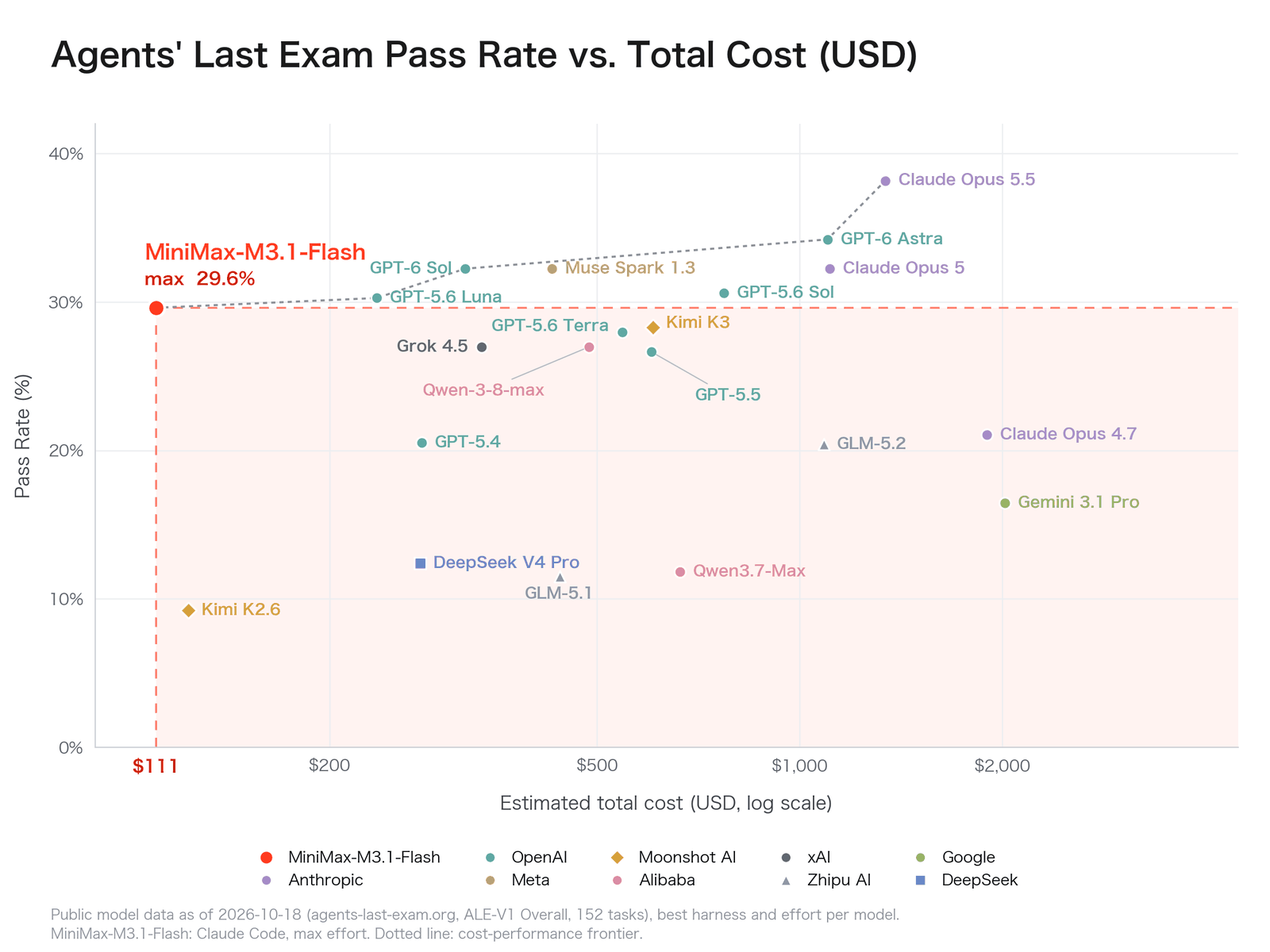
Images: MiniMax, from the M3.1 Flash announcement (19 October 2026).
Specs and API behavior #
| Spec | MiniMax M3.1 Flash |
|---|---|
| Model ID on RouterPlex | MiniMax-M3.1-flash |
| Released | 19 October 2026 |
| Architecture | Mixture of experts, 428B total, about 23B active |
| Context window | 1,000,000 tokens |
| Max output | 524,288 tokens |
| Input / output | Text, image and video in, text out |
| Reasoning | Always on. Effort: low, medium, high, xhigh, max |
| Tool calling | Yes, tool_choice auto |
| Open weights | Announced for 23 October 2026 |
Reasoning cannot be switched off. On MiniMax's own API, thinking.type=disabled or an effort of none returns an error. Through RouterPlex, pass reasoning_effort on Chat Completions to pick a level. On a simple sum, low answered with 2 output tokens in our test. The reasoning text arrives in a separate reasoning_content field, not as inline <think> tags. If your parser was written for M3's inline tags, update it.
Structured output is not enforced. You can send a JSON schema, but MiniMax does not guarantee the reply matches it. Validate JSON on your side.
Call MiniMax M3.1 Flash from Python #
Install the official SDK (pip install openai) and point it at RouterPlex.
import osfrom openai import OpenAIclient = OpenAI(api_key=os.environ["ROUTERPLEX_API_KEY"],base_url="https://api.routerplex.com/v1",)response = client.chat.completions.create(model="MiniMax-M3.1-flash",reasoning_effort="medium",messages=[{"role": "user", "content": "Find the bug in this function and suggest a fix."}],)print(response.choices[0].message.content)
The same call with curl:
curl https://api.routerplex.com/v1/chat/completions \-H "Authorization: Bearer $ROUTERPLEX_API_KEY" \-H "Content-Type: application/json" \-d '{"model": "MiniMax-M3.1-flash","messages": [{"role": "user", "content": "Summarize this changelog in five bullets."}]}'
Vision works on the same endpoint. Send an image_url content part with an https URL or a base64 data URL. In our test it described a logo's shape, colors and layout correctly.
Use MiniMax M3.1 Flash in Claude Code #
RouterPlex serves this model on the Anthropic-compatible /v1/messages format too, including streaming. Claude Code can use it with three environment variables and no local proxy:
export ANTHROPIC_BASE_URL="https://api.routerplex.com"export ANTHROPIC_AUTH_TOKEN="$ROUTERPLEX_API_KEY"export ANTHROPIC_MODEL="MiniMax-M3.1-flash"claude
That runs Claude Code on a $0.15 / $0.60 model. Long coding sessions resend the same context on every turn, so most of their input bills at the $0.028 cache rate. The Claude Code with RouterPlex docs cover per-key model allowlists. If you want different models for planning and background work, see the Claude Code Router guide.
When to pick MiniMax M3.1 Flash #
Pick it for:
- High-volume coding agents where cost per task matters more than the last few points of accuracy.
- Office and SaaS automation with many tool calls in a row.
- Long inputs up to 1M tokens, such as repositories, logs or document sets, with no long-context surcharge.
- Screenshots and short video clips mixed into an agent loop.
Pick something else for:
- Factual question answering without tools, given the hallucination result above.
- Hard terminal and shell work, where Terminal Bench 4.0 shows a gap to frontier models.
- Tasks that need a strict JSON schema.
- Very short, simple calls where always-on reasoning adds latency you do not need.
Start using MiniMax M3.1 Flash #
Create a RouterPlex account, add a prepaid balance, and call MiniMax-M3.1-flash at MiniMax's $0.15 / $0.60 list rate. You get one key for M3.1 Flash and the rest of the catalog, 0% per-token markup, $0 top-up fees, and a hard budget on every key that stops at $0. Compare it with the rest of the model catalog before you move a production workload.
Common questions
Frequently asked questions
How much does the MiniMax M3.1 Flash API cost?
MiniMax lists M3.1 Flash at $0.15 per 1M input tokens and $0.60 per 1M output tokens, flat at every prompt length. RouterPlex bills that same list rate on model ID MiniMax-M3.1-flash with no per-token markup. Cache reads bill at $0.028 per 1M on RouterPlex.
Is MiniMax M3.1 Flash available on RouterPlex?
Yes, since 20 October 2026. The model ID is MiniMax-M3.1-flash. Point the OpenAI SDK at https://api.routerplex.com/v1, or the Anthropic SDK and Claude Code at https://api.routerplex.com, and use a prepaid RouterPlex key.
Can I use MiniMax M3.1 Flash in Claude Code?
Yes. Set ANTHROPIC_BASE_URL to https://api.routerplex.com, ANTHROPIC_AUTH_TOKEN to your RouterPlex key, and ANTHROPIC_MODEL to MiniMax-M3.1-flash, then run claude. RouterPlex serves the model on the Anthropic /v1/messages format, including streaming and tool calls.
What is the MiniMax M3.1 Flash context window?
1,000,000 tokens of context, with up to 524,288 output tokens per response. Input can be text, images or video, and output is text. MiniMax charges no long-context surcharge, unlike MiniMax M3, whose MiniMax list price doubles above 512K input.
Can I turn off reasoning on MiniMax M3.1 Flash?
No. Reasoning is always on. You can lower it with reasoning_effort, choosing low, medium, high, xhigh or max. Reasoning tokens bill as output, and the reasoning text arrives in a separate reasoning_content field.
How does MiniMax M3.1 Flash compare with MiniMax M3?
Per token, M3.1 Flash costs half of M3: $0.15 and $0.60 per 1M against $0.30 and $1.20 on RouterPlex. MiniMax reports it is about three times faster and stronger on agent tasks. Both keep a 1M context window.
Run the smallest paid test.
Add $5, cap the key, and verify the result with your own workload. No subscription, and credit never expires — a first top-up of $25+ is matched with $25 extra.