Abliteration: What It Is, and the Hosted API Price
Abliteration removes refusal behaviour from model weights. RouterPlex hosts three routes for security research, from $0.50 per 1M input tokens.
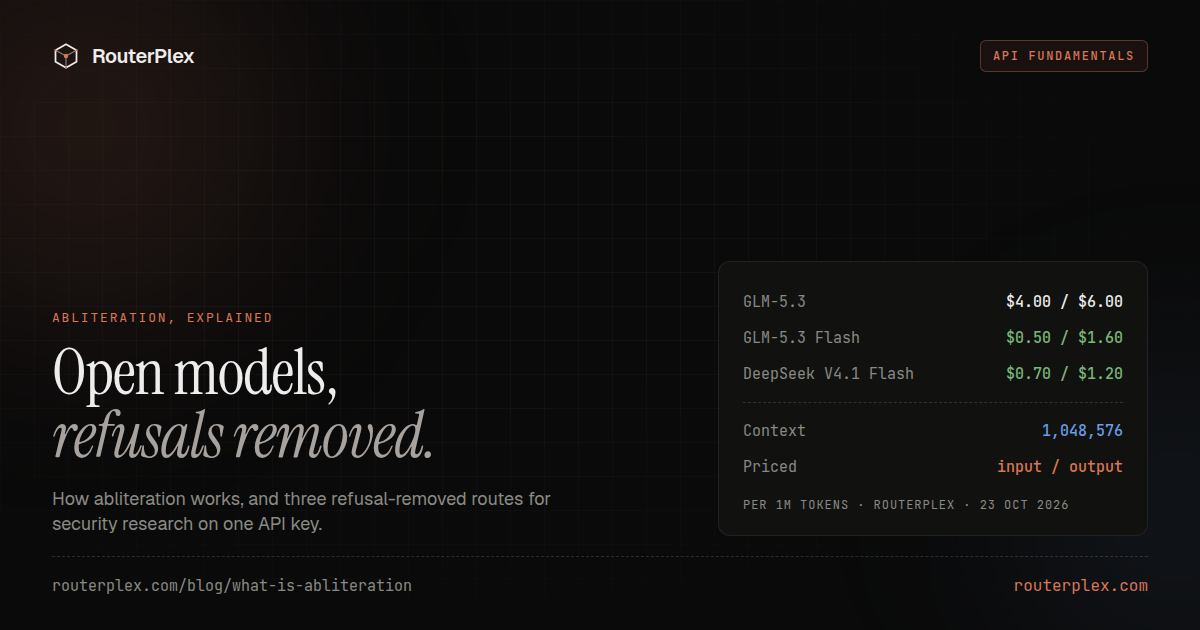
Abliteration is a weight edit that takes refusal behaviour out of a model, so some requests the original build declines can now get an answer. RouterPlex hosts three abliterated routes, with input at $4, $0.50, or $0.70 per 1M tokens and output at $6, $1.60, or $1.20. Checked 23 October 2026.
RouterPlex sets these prices. They are not a vendor list price, and they sit above the stock models the routes come from. Most teams use them for security research, where stock models refuse too often.
RouterPlex publishes this page and sells the prepaid wallet described below.
Create a free RouterPlex account, add a $5 top-up, and call one route with a hard spend cap on the key. The same key also reaches the rest of the catalog. Top-ups have a $0 fee, and the minimum top-up is $5.
What abliteration means #
Abliteration is a change to the weights after training, and it is not a clever prompt. In 2024, Arditi and co-authors published Refusal in Language Models Is Mediated by a Single Direction. The paper reports that refusal lines up with one direction inside the network. Later public write-ups edit weights along that idea, and this page only names the paper and the result.
There is no recipe here, no layer list, and no training script. A local tool named Heretic runs a similar edit on a machine you control. The project already owns that search, so this page does not explain how to install it or which flags to pass.
Some other pages say uncensored. The accurate word on RouterPlex is abliterated, because the weights changed. The terms still apply to every request you send.
What abliterated models are for #
Stock models often refuse legitimate security work. A refusal-removed model answers it. Teams red-team their own LLM apps and test guardrails with real attack prompts. They write penetration-test reports for systems they are authorized to test. They ask how a disclosed CVE works, then draft detection rules and patches for it. Incident responders use it to read suspicious scripts and logs. Others build evaluation sets on sensitive topics without the model stopping halfway.
You are still bound by the terms. Authorized work is your responsibility, and the model can be wrong, so check what it gives you.
Abliteration prices for the three hosted routes #
USD per 1M tokens, from the RouterPlex catalog on 23 October 2026. Context on each abliterated route is 1,048,576 tokens.
| Model id | Input | Cache read | Output | Max output | Page |
|---|---|---|---|---|---|
glm-5.3-abliterated | $4.00 | $0.70 | $6.00 | 131,072 | page |
glm-5.3-flash-abliterated | $0.50 | $0.30 | $1.60 | 131,072 | page |
deepseek-v4.1-flash-abliterated | $0.70 | $0.20 | $1.20 | 384,000 | page |
Cache read means cached input, which is the part of a prompt the host has already seen. Fresh input still bills at the input rate. A cold call with 40,000 input tokens and 2,000 output tokens costs $0.172 on glm-5.3-abliterated, $0.0232 on glm-5.3-flash-abliterated, and $0.0304 on deepseek-v4.1-flash-abliterated. The arithmetic uses only the rates above. It is not a pasted invoice.
If you do not need the weight edit, the stock routes are cheaper. The same mix is $0.0648 on glm-5.3 and $0.0070 on glm-5.3-flash. It is about $0.0087 on deepseek-v4.1-flash.
Repeat traffic can land on the cache line. On glm-5.3-abliterated, keep 10,000 tokens fresh and 30,000 cached, plus 2,000 output tokens, and the bill falls from $0.172 to $0.073.
Which hosted route to call #
Pick glm-5.3-flash-abliterated for high-volume work, such as running large red-team prompt sets. It is the cheapest route in the set.
Pick glm-5.3-abliterated when you need the strongest reasoning, such as long attack-path analysis or report drafting, and can pay $4 and $6.
Pick deepseek-v4.1-flash-abliterated for the DeepSeek family at one flat rate. People who search for a DeepSeek R1 abliterated file want a local download, and that file is not this route. The hosted id is deepseek-v4.1-flash-abliterated.
Each route accepts tool calls, and the catalog marks image input on. The model pages list reasoning effort. GLM routes list low, high, or max. The DeepSeek route lists off, low, high, or max. We checked each effort level with a live call on 23 October 2026.
Call the API #
Set ROUTERPLEX_API_KEY in the environment. Do not paste a key into source code. This example calls the flash GLM route. Swap the model id for either of the other two.
curl https://api.routerplex.com/v1/chat/completions \-H "Authorization: Bearer $ROUTERPLEX_API_KEY" \-H "Content-Type: application/json" \-d '{"model": "glm-5.3-flash-abliterated","messages": [{"role": "user", "content": "Reply with exactly: RouterPlex connected."}]}'
The OpenAI base URL is https://api.routerplex.com/v1, and the Anthropic base URL is https://api.routerplex.com. One prepaid key covers both shapes. The OpenAI-compatible API guide lists the endpoints, and Claude Code Router shows how an agent process points at the gateway.
The model id keeps the dots, as in glm-5.3-abliterated. The public page uses hyphens, as in /models/glm-5-3-abliterated. A dotted page URL returns 404.
Trial keys, 402, and a hard cap #
The $1 onboarding trial key is not free access to these three models, and there is no free credit on them. A trial key gets HTTP 402, and the error type is paid_model_required. Add a paid top-up of at least $5, and the fee on that top-up is $0.
The balance stops at $0, and it does not go negative. Each key can also carry a hard spend cap. When the cap is hit, calls stop, so raise the cap or shrink the job.
A 402 on a different gateway can mean a negative balance, and that case is covered in Fix an OpenRouter 402. The RouterPlex 402 on these routes means the key is still on trial credit. A wrong model id fails as model not found, so copy the id from the table on this page.
Terms that still apply #
These routes answer some requests the stock models decline, and you still own the prompt. Use them for authorized work. The terms bar illegal content, malware, weapons development, and child sexual abuse material. Read the terms before you send production traffic.
Stock GLM list rates live in GLM-5.3 API pricing, and the earlier DeepSeek flash guide is DeepSeek V4 Flash Vision API pricing. That post is not this V4.1 abliterated route.
Next step #
Create a free RouterPlex account, add a $5 top-up, then open the model page for the id you will call. The three pages are GLM-5.3 Abliterated, GLM-5.3 Flash Abliterated, and DeepSeek V4.1 Flash Abliterated.
Common questions
Frequently asked questions
What is abliteration?
Abliteration is a weight edit that removes refusal behaviour from a model. A 2024 paper by Arditi and co-authors, Refusal in Language Models Is Mediated by a Single Direction, reports that refusal lines up with one direction in the network. RouterPlex does not publish a recipe for the edit. It hosts three finished routes.
Which abliterated models does RouterPlex host?
As of 23 October 2026 the catalog lists glm-5.3-abliterated at $4 input and $6 output, glm-5.3-flash-abliterated at $0.50 and $1.60, and deepseek-v4.1-flash-abliterated at $0.70 and $1.20. Those figures are USD per 1M tokens. Cached input is $0.70, $0.30, and $0.20.
Are these the vendor list prices?
No. RouterPlex sets the three abliterated rates. They are not Z.ai or DeepSeek list prices. The stock models in the same catalog still bill vendor list rates, and those stock rates are lower.
Can the $1 trial key call an abliterated model?
No. The $1 trial key is not free access to these routes. There is no free credit on them. The gateway returns HTTP 402 with type paid_model_required. A paid top-up of at least $5 is required. The top-up fee is $0.
Is a DeepSeek R1 abliterated download the same product?
No. R1 abliterated files are local weights. The hosted RouterPlex id is deepseek-v4.1-flash-abliterated. Sending an R1 name to the gateway will not select this route.
Does RouterPlex run the Heretic tool for me?
No. Heretic is a local tool that edits weights on a machine you control. RouterPlex serves three already abliterated model ids over the API. This site does not publish Heretic install steps.
Run the smallest paid test.
Add $5, cap the key, and verify the result with your own workload. No subscription, and credit never expires — a first top-up of $25+ is matched with $25 extra.