Cloudflare Clef API: Pricing, Clef vs Jev, Setup (Free Now)
Cloudflare's Clef decision models are live on RouterPlex, free for a limited time. List $0.038 to $0.24 per 1M input, output free. Clef vs Jev side by side.
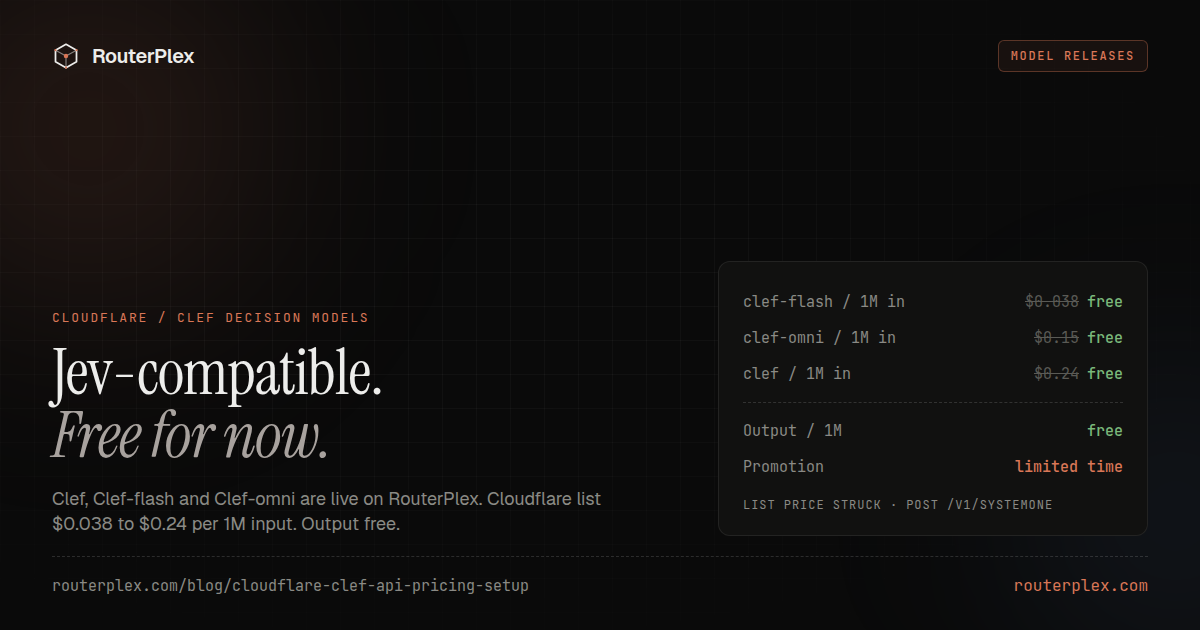
Clef is Cloudflare's family of decision models: Clef (27B), Clef-flash (9B) and Clef-omni (30B mixture-of-experts). They are the same kind of model as TypeSafe's Jev. You send a state and typed questions. You get back a probability for every allowed answer and a confidence. No chat text to parse.
As of 18 October 2026 all three are live on RouterPlex as clef, clef-flash and clef-omni, and they are free for a limited time, the same promotion that covers Jev. Cloudflare's list prices, which is what you pay when the promotion ends, are $0.24, $0.038 and $0.15 per 1M input tokens. Output is free either way. The endpoint is POST https://api.routerplex.com/v1/systemone, the same one Jev uses, so switching is a one-word change.
A call still needs a RouterPlex account with an active balance. A used-up balance returns 402, even at $0. These are not chat models. Do not put clef in Cursor or Claude Code.
Three Clef routes, one request shape #
| Model ID | Page | Params | Context | List input / 1M | During the promotion |
|---|---|---|---|---|---|
clef | Clef | 27B | 65,536 | $0.24 | Free |
clef-flash | Clef Flash | 9B | 24,576 | $0.038 | Free |
clef-omni | Clef Omni | 30B MoE, 3B active | 64,000 | $0.15 | Free |
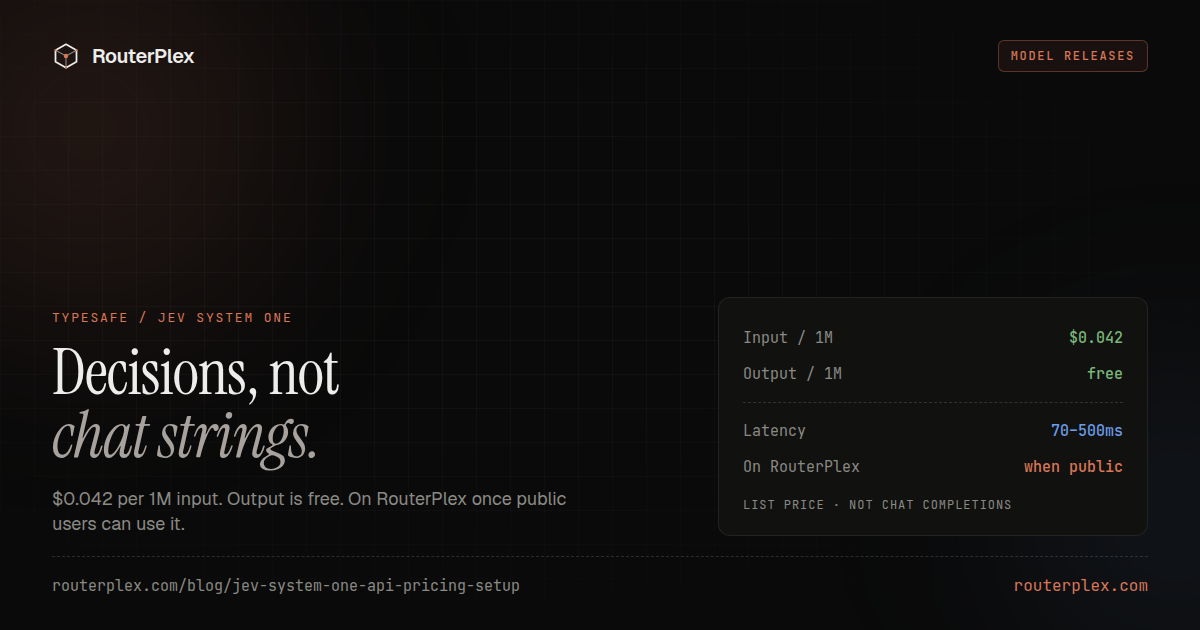
jev-latest | Jev (latest) | undisclosed | 64,000 | $0.042 | Free |
Cloudflare shipped Clef and Clef-flash on 1 October 2026 as the first models trained by its Workers AI team, with the weights on Hugging Face under Apache 2.0. On 9 October it added Clef-omni, cut Clef-flash from $0.09 to $0.038 per 1M input, and said Clef itself got up to 2x faster. The context windows above are what Cloudflare's model catalog reported on 18 October. Clef-flash's 24,576 is smaller than the 64K that the launch post printed, so trust the smaller number when you size a state.
There is no end date on the promotion. The struck-through rates on the model index are the list prices for the day it ends. Output stays free. Field-level request docs are in the decision model docs.
Sources: Cloudflare's Clef launch note (1 October 2026), the Clef-omni note (9 October), the Workers AI pricing page (updated 15 October), the Clef, Clef-flash and Clef-omni model pages, and the Hugging Face model card. Benchmarks and latencies in this post are Cloudflare's own runs unless the text says RouterPlex measured them.
Clef vs Jev: what Cloudflare claims #
Cloudflare built Clef to be drop-in compatible with Jev and then published numbers against it. Across 43 benchmark runs, Cloudflare puts Clef at 2.5x faster than Jev at the median and Clef-flash at 13x.
| Latency (Cloudflare's runs) | Clef | Clef-flash | Jev |
|---|---|---|---|
| Median | 209.3 ms | 38.8 ms | 524.1 ms |
| p95 | 238.6 ms | 122.4 ms | 536.0 ms |
Across 10 decision benchmarks, Cloudflare says a Clef model scores highest on 7. The four it highlighted:
| Benchmark | Clef | Clef-flash | Jev |
|---|---|---|---|
| BFCL (case exact) | 98.47 | 98.76 | 95.75 |
| BANKING77 (macro-F1) | 94.20 | 90.93 | 79.74 |
| CLINC150+OOS (macro-F1) | 97.43 | 66.77 | 89.27 |
| Home appliances (case exact) | 82.95 | 97.73 | 52.27 |
Two things to read out of that table before you believe it. Clef-flash collapses on CLINC150, a 150-intent classification task with an out-of-scope class. A 9B model that is 13x faster is not free. And these are the vendor's runs. Cloudflare also says Clef beats Jev on 3 of TypeSafe's 4 published workflow evals (invoice processing, customer service, security incidents), which is the same harness the Jev post describes. Neither side has published a third-party number yet.
The structural differences are easier to verify:
| Clef family | Jev | |
|---|---|---|
| Weights | Open, Apache 2.0, on Hugging Face | Hosted only |
| Hosting | Cloudflare Workers AI (GPUs across Cloudflare's network) | TypeSafe, US West |
| Modalities | Text, JSON, images; Clef-omni adds audio and video | Text and JSON |
| Request window | 24,576 to 65,536 tokens by model | 64,000 tokens |
| Cheapest member | $0.038 / 1M input (Clef-flash) | $0.042 / 1M input |
| Fine-tuning | Cloudflare RL fine-tuning service, design partners | Not offered |
| On RouterPlex | clef, clef-flash, clef-omni | jev-latest, jev-preview, jev-1.13.0 |
Image, audio and video state is a Clef extension to the System One API. RouterPlex forwards text and JSON state only, so through RouterPlex the Clef models answer the same inputs Jev does. If you need to score a screenshot, call Workers AI directly.
One ticket, four decision models #
Benchmarks are the vendor's. This is ours. On 18 October 2026 we sent the same support ticket, with the same two questions, to all four routes through api.routerplex.com with an ordinary RouterPlex key.
The state: *"Customer says their API key stopped working after a crypto top-up an hour ago; dashboard shows the balance but every request returns 402."* The questions: a noul asking whether it is urgent, and a choice between billing, technical and abuse.
| Model | Urgent (noul) | Team | P(technical) | P(billing) | Confidence | Round trip |
|---|---|---|---|---|---|---|
clef-flash | 0.84 | technical | 0.95 | 0.02 | 0.86 | 1.2 s |
clef | 0.94 | technical | 0.57 | 0.40 | 0.23 | 1.2 s |
clef-omni | 0.93 | technical | 0.88 | 0.10 | 0.67 | 0.5 s |
jev-latest (answered as jev-1.13.0) | 0.79 | technical | 0.56 | 0.44 | 0.34 | 0.4 s |
Three observations, and none of them is "Clef wins".
First, the ticket is genuinely ambiguous. A balance that shows but does not spend is a billing problem that looks like an outage. The two largest models, Clef and Jev, both returned a near coin flip between technical and billing and a low confidence. The two smaller Clef models were sure it was technical. If your code gates on confidence, Clef and Jev would have sent this ticket to a person. Clef-flash would have auto-routed it. That is the behaviour the confidence field exists for, and it is worth more than a benchmark row.
Second, the round trips are not a latency benchmark. They are single, cold, first-ever requests measured end to end from the RouterPlex origin, including our hop. Cloudflare's 38.8 ms median for Clef-flash was measured inside Cloudflare. Run your own loop before you pick a model for a hot path.
Third, input tokens differed: 262 for each Clef model and 371 for Jev on the identical request. Tokenizers differ, so the per-token price is not the whole cost. At list price this request would have billed $0.0000100 on Clef-flash, $0.0000156 on Jev, $0.0000387 on Clef-omni and $0.0000629 on Clef. All four billed $0.
Clef API pricing in practice #
List prices from Cloudflare, and the RouterPlex bill today:
| Per 1M input tokens | Cloudflare list | RouterPlex now |
|---|---|---|
| Clef-flash | $0.038 | $0 for a limited time |
| Clef-omni | $0.15 | $0 for a limited time |
| Clef | $0.24 | $0 for a limited time |
| Jev (TypeSafe list) | $0.042 | $0 for a limited time |
| Output, every decision model | $0 | $0 |
What that means per decision, at list price, for a 300-token request like the one above:
| Clef-flash | Jev | Clef-omni | Clef | |
|---|---|---|---|---|
| One decision | $0.0000114 | $0.0000126 | $0.000045 | $0.000072 |
| One million decisions | $11.40 | $12.60 | $45.00 | $72.00 |
| A 10,000-token state | $0.00038 | $0.00042 | $0.0015 | $0.0024 |
Clef-flash is the cheapest decision model on the catalog since Cloudflare's 9 October cut. Clef is about 5.7x Jev. Whether that is worth it depends on whether your questions look like BANKING77 (Clef leads by 14 points) or like BFCL (all three within 3 points). Output is free on every row, so ask the extra speculative questions in the same call; they cost nothing.
When the promotion ends, the billed rate is the live catalog row, at list price, with no per-token markup. Prepaid balance. Hard per-key budget. The request stops at $0. Decision models are not on the chat rate card in the OpenRouter comparison; the same prepaid key applies.
Call Clef on RouterPlex #
Swap the model string. Everything else is the Jev call. This curl uses a RouterPlex key; create one after you sign up and fund the account.
curl https://api.routerplex.com/v1/systemone \-H "Authorization: Bearer $ROUTERPLEX_API_KEY" \-H "Content-Type: application/json" \-d '{"model": "clef-flash","state": "Customer says their API key stopped working after a crypto top-up an hour ago; dashboard shows the balance but every request returns 402.","questions": {"urgent": {"type": "noul", "instructions": "Is this support request urgent?"},"team": {"type": "choice","instructions": "Which team should handle this?","criteria": {"billing": "Payments, invoices, refunds", "technical": "Outages, errors", "abuse": "Fraud, farms"}},"severity": {"type": "score","instructions": "How severe is the customer impact?","criteria": ["No impact", "Minor", "Major", "Critical"]}}}'
This is the real response from that call on 18 October 2026, unedited. One answer per question id, probabilities, a confidence on choice and score answers, and usage with input tokens and the billed cost. Note the severity: Clef-flash split Major and Critical almost evenly and said so with a 0.27 confidence. That is the field to gate on.
{"model": "clef-flash","answers": {"urgent": {"type": "noul", "noul": 0.8154},"team": {"type": "choice", "choice": "technical", "confidence": 0.849,"probabilities": {"billing": 0.0232, "technical": 0.9476, "abuse": 0.0292}},"severity": {"type": "score", "score": 2.2416, "confidence": 0.2691,"legend": {"0": "No impact", "1": "Minor", "2": "Major", "3": "Critical"},"probabilities": {"0": 0.0316, "1": 0.0468, "2": 0.5701, "3": 0.3515}}},"usage": {"input_tokens": 360, "output_tokens": 0, "cost": 0.0}}
The TypeSafe Python SDK (tested with typesafe-sdk 0.7.2) works against Clef too, because the wire format is identical. Set base_url="https://api.routerplex.com" (the SDK adds /v1), pass the RouterPlex key, and use model="clef".
import osfrom typesafe_sdk import Choice, Noul, TypeSafeClientclient = TypeSafeClient(base_url="https://api.routerplex.com",api_key=os.environ["ROUTERPLEX_API_KEY"],)result = client.system_one(model="clef",state="I was charged twice this month and nobody answers my emails.",questions={"billing": Noul(instructions="Is this a billing problem?"),"team": Choice(instructions="Which team?",criteria={"billing": "Payments", "technical": "Bugs"},),},)answer = result.answers["team"]if answer.confidence < 0.6:escalate_to_human(answer.probabilities)
| Status | Meaning |
|---|---|
| 400 | Malformed request: unknown model, missing state, or an invalid question. The message names the field. |
| 401 | Missing or invalid API key. |
| 402 | The balance is used up. Top up on the billing page. |
| 429 | Rate limited. Retry with backoff. |
| 502 / 503 / 504 | Workers AI failed or is overloaded. Retry shortly. |
Which Clef to pick #
Start with clef-flash if the decision sits in a request path: spam gates, tool-call routing, "is this urgent". It is the cheapest route on the catalog and Cloudflare's fastest. Move a question to clef when the options are many and close together, which is where its BANKING77 and CLINC150 leads come from, and when a wrong answer costs more than $0.24 per million tokens saves. clef-omni is the middle: most of Clef's confidence on the ticket above at Clef-flash's price class, and the only one with audio and video on Workers AI if you later go direct.
Keep Jev in the loop. The same request runs on both, so the cheapest A/B test you will ever run is sending every tenth decision to the other family and comparing confidence. Pin jev-1.13.0 and a Clef ID once thresholds are tuned.
For anything that needs a sentence, you still need a chat model. Gemini 3.8 Flash is the cheap classification route you have to parse; Gemini 4 Argon is the frontier judgment at $2/$10. Both are on the same key.
Create a RouterPlex account and call clef-flash from its model page. The promotion is free for a limited time. The list price is on that page for the day it ends.
Common questions
Frequently asked questions
How much does the Cloudflare Clef API cost?
Cloudflare's Workers AI list prices are $0.24 per 1M input tokens for Clef, $0.038 for Clef-flash, and $0.15 for Clef-omni. Output tokens are free on all three. On RouterPlex the same three IDs (clef, clef-flash, clef-omni) are free for a limited time, and bill at those list prices with no markup when the promotion ends.
Is Clef cheaper than Jev?
Clef-flash is. Cloudflare cut it to $0.038 per 1M input on 9 October 2026, under Jev's $0.042 list. Clef is about 5.7x Jev at $0.24, and Clef-omni is about 3.6x at $0.15. Output is free on every decision model. On RouterPlex all of them are $0 input during the current promotion.
Is Clef compatible with Jev?
Yes. Clef follows the System One API, so a Jev integration becomes a Clef integration by changing the model string. On RouterPlex that is the model field in POST /v1/systemone: send clef, clef-flash, or clef-omni instead of jev-latest. The state, the three question types, and the answer fields are the same.
What is the difference between Clef, Clef-flash and Clef-omni?
Clef is the 27B model for precision, with a 65,536-token request window. Clef-flash is the 9B model for the hot path: Cloudflare measured a 38.8 ms median, and its window is 24,576 tokens. Clef-omni is a 30B mixture-of-experts model (3B active) that also accepts audio and video on Workers AI, with a 64,000-token window. Through RouterPlex all three take text or JSON state.
Is Clef open source?
Yes. Cloudflare published the weights of Clef, Clef-flash and Clef-omni on Hugging Face under the Apache 2.0 license. Jev is a hosted model from TypeSafe with no public weights. If you need to self-host a decision model later, Clef is the family that allows it.
Can I call Clef with the OpenAI chat completions endpoint?
No. Clef is a decision model, not a chat model. Call POST https://api.routerplex.com/v1/systemone with a state and a map of typed questions (noul, choice, score). It returns probabilities and a confidence, not generated text. The TypeSafe Python SDK works with a RouterPlex key once base_url is set to https://api.routerplex.com.
Do I need a Cloudflare account to use Clef on RouterPlex?
No. RouterPlex runs Clef on Workers AI under its own Cloudflare account. You use the same RouterPlex key and balance that work for the chat models. A used-up balance returns 402 even while the promotion price is $0.
Run the smallest paid test.
Add $5, cap the key, and verify the result with your own workload. No subscription, and credit never expires — a first top-up of $25+ is matched with $25 extra.