TypeSafe Jev System One: Pricing, Typed Decisions and Setup
Jev System One API pricing is $0.042 per 1M input, free output, 70-500ms. Typed decisions, not chat. On RouterPlex once public users can use it.
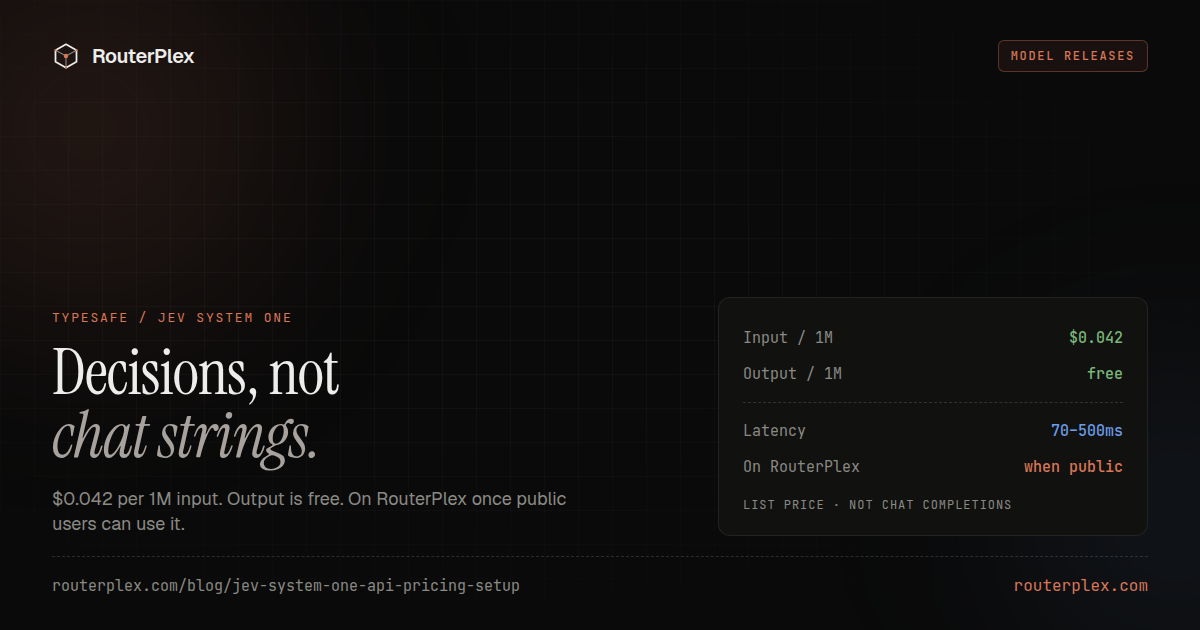
TypeSafe AI opened Jev, the first public System One model, on 16 September 2026. It is not a chat model. You send state and typed questions; it returns typed answers with probabilities. Founder Diogo Almeida's line: unstructured state in, typed probabilistic decisions out.
The TypeSafe model ID is jev-latest. Input is $0.042 per 1M tokens ($42 per billion). Output tokens are free. End-to-end latency is listed at 70–500ms. The HTTP contract is POST /v1/systemone, not chat completions.
Jev is early access on TypeSafe today. It is not on RouterPlex yet. It will be live on this catalog once it is available for public users, at TypeSafe list rates, 0% markup, on the same prepaid key as the rest of the lineup. Until then there is no RouterPlex ID to paste into Cursor.
Sources: TypeSafe's announcement (16 September 2026, Diogo Almeida), the homepage speed/cost claims, docs: introduction, System One, quick start, API, primitives, confidence, the AI primer, workflow evals, and the system-one-adapter, checked 16 September 2026.
Not a smaller LLM #
TypeSafe spent two years in stealth on a new architecture, a parallel sampler, and a training method they call Reinforcement Learning for Calibrated Decisions (RLCD). The AI primer puts that next to RLHF (chat) and RLVR (verifiable reasoning). Almeida helped build the instruction-following work behind ChatGPT; the docs call him a co-inventor of RLHF. The bet here is the opposite product: machine-to-machine decisions, not a better chatbot.
| Existing LLMs | System One + Jev | |
|---|---|---|
| Training | RLHF / RLVR | RLCD |
| Optimizes for | Preferred writeups, or verifiable rewards | Calibrated probabilities on System One tasks |
| Input | Sequential messages | Structured program state |
| Output | Strings you parse | Typed values you defined in advance |
| Sampling | One token after another | All answers in one parallel query |
| Input price | $0.20–$10 / 1M | $0.042 / 1M |
| Output price | ~5× input | Free (TypeSafe: too cheap to meter) |
| Latency | Seconds to minutes on frontier chat | 70–500ms |
| Confidence | Often overconfident if you ask | Always returned; higher confidence, higher accuracy, per TypeSafe |
The names are on purpose. System One is Kahneman's fast System 1. Jev is Jevons: cheaper intelligence should increase demand, not just the margin.
It is also a narrower tool. Jev does not write replies, produce code, or explain its reasoning. If you needed a paragraph, you still need a chat model. If you needed a branch in code, this is the shape.
Three primitives #
Every call is the same shape: a state (string, object, or array) plus a map of named questions. Questions are evaluated in parallel and in isolation against that state. Adding questions barely changes latency. TypeSafe's docs: keep each question to a snap judgment a knowledgeable person could make in a few seconds. Compose the rest in code.
| Question | Job | Returns |
|---|---|---|
| Choice | One option from a set you define (up to 255) | choice, probabilities, confidence |
| Score | A position on ordered levels you write | score (can land between levels), legend, probabilities, confidence |
| Noul | Is this statement true? | noul in [0, 1]. No separate confidence field |
A Noul near 0.5 is "I don't know," not "medium." Use a Score if you wanted a spectrum. Choice and Score confidence is a collapse of the probability distribution: peaked means sure, flat means escalate. TypeSafe's starting split is high / medium / low confidence → act / confirm / don't. The 0.5 floor is the "genuinely uncertain" cut; destructive actions sit higher.
The request token budget is about 32,000 tokens for state plus questions together. That is not a 1M chat window. Pack the state. Don't dump a repo.
JSON mode on GPT or Claude is not this. Those models still sample a string. You parse it, retry on schema errors, and hope the next turn doesn't invent a key. TypeSafe's system-one-adapter exists to force LLMs into this question/answer shape so you can compare cost and quality. The adapter is the LLM pretending to be TypeSafe, not Jev pretending to be ChatGPT.
Jev API pricing #
TypeSafe's published list, 16 September 2026:
| Rate | |
|---|---|
| Input | $0.042 / 1M tokens ($42 / billion) |
| Output | $0 |
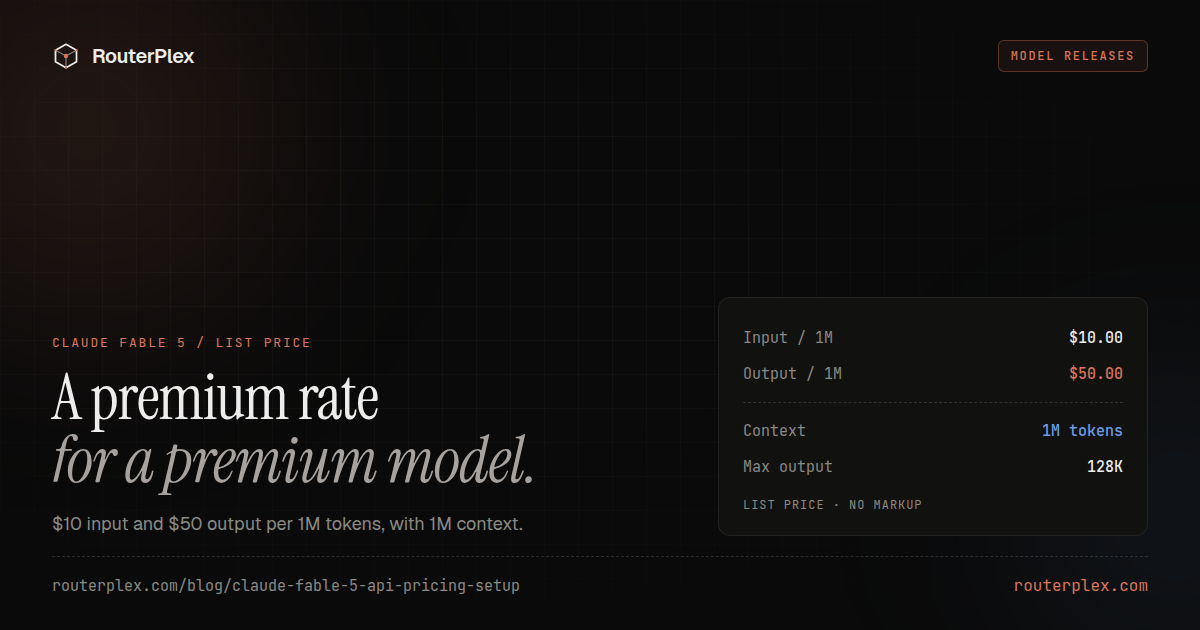
The homepage also prints 238× lower input than Claude Fable 5.1. At $10 / 1M that arithmetic is exact ($10 / $0.042 ≈ 238). We serve Claude Fable 5 at $10 / $50, not Fable 5.1. Don't treat 5 and 5.1 as the same row.
TypeSafe's own caveats, from the announcement: they cannot prove the price isn't subsidized; they expect it to go down, not up; published latency numbers were generally run from West Coast laptops, which is where the service currently sits.
A 10,000-token state costs $0.00042 of input. Output does not add a line. That is why "ask extra speculative questions in the same call" is their default: the parallel-questions cookbook says batching 13 questions is about 12× cheaper and 10× faster than 13 separate calls, with the same answers.
When this ID lands on RouterPlex, the billed rate is the live catalog row, not a screenshot in this post. No per-token markup. Prepaid balance. Hard per-key budget. The request stops at $0.
Workflow evals, not MMLU #
TypeSafe did not lead with public chat benchmarks. They built workflow evals: assume a correct compute graph in code, ask the same narrow questions of every model, and score against a reference of GPT-6 Astra + Claude Fable 5.1 at high thinking. Four published workflows: security incidents, agent-trace observability, invoice processing, customer service.
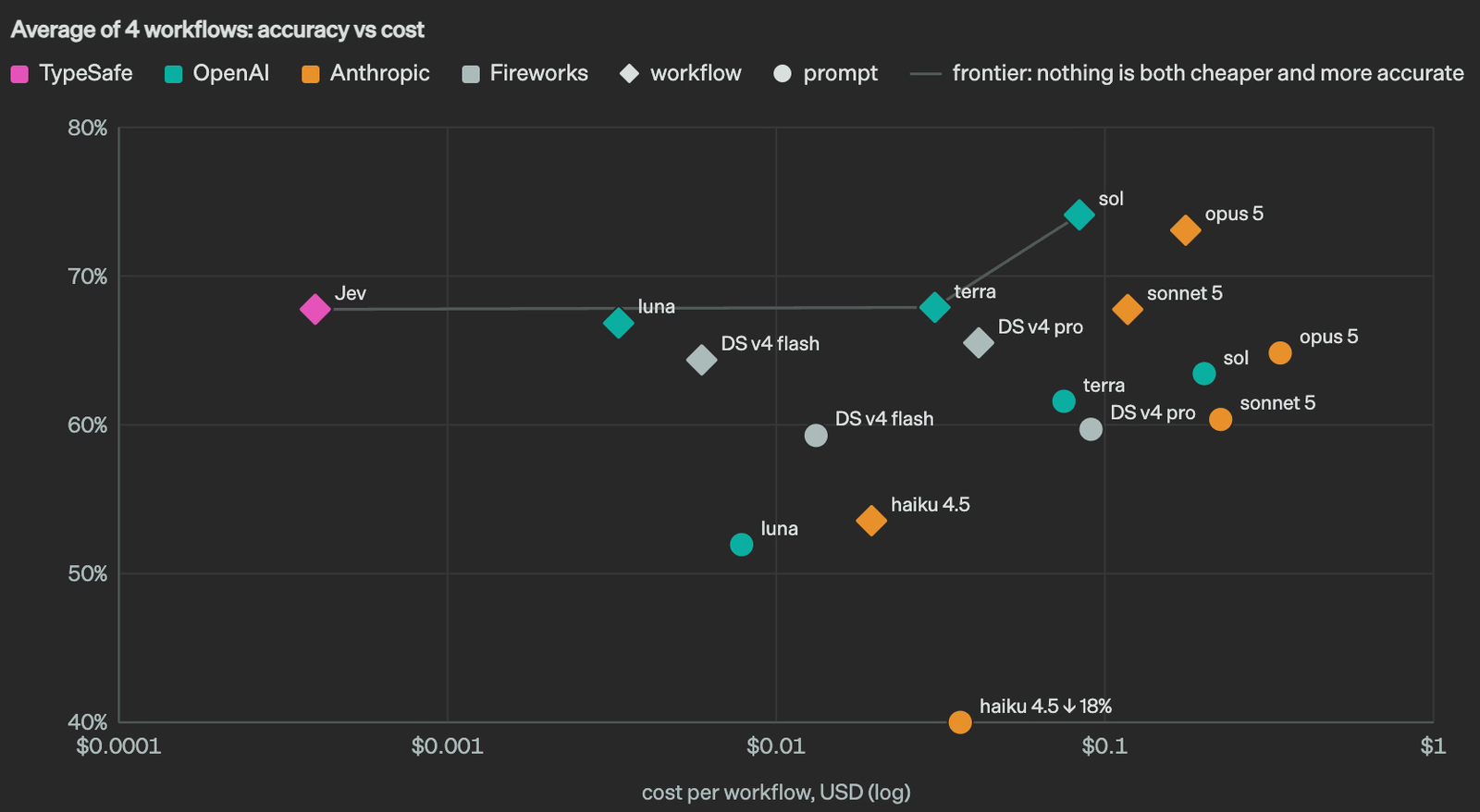
Jev sits on the cheap side of that Pareto. The homepage's 193.6× faster / 444.6× cheaper figures come from this harness. TypeSafe says those numbers are on the higher end of real-world gains. The workflows were not in the training distribution, but they were written by TypeSafe's model-capabilities people, so some bias is possible. Using Astra and Fable 5.1 as the reference also pulls the target toward OpenAI and Anthropic.
Prompting the whole policy as one chain-of-thought, instead of the workflow, is worse for every model they plotted. Structure is the product.
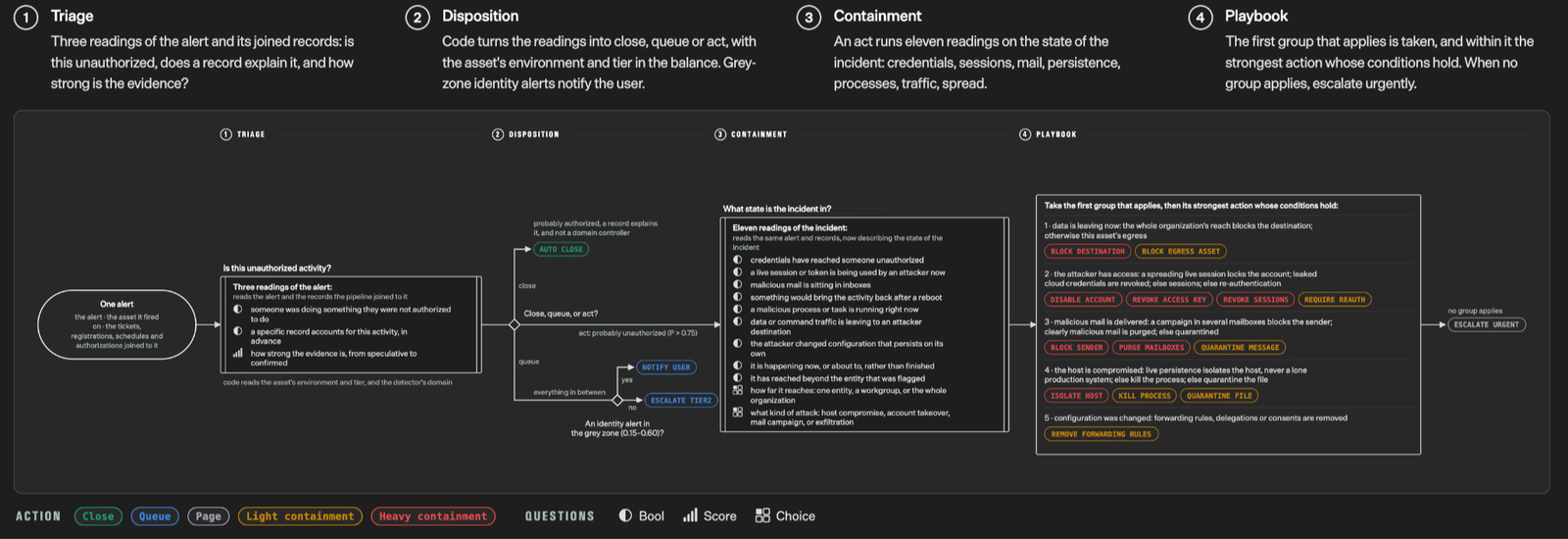
That diagram is the point. Code owns close / queue / act. The model owns the readings. Grey-zone identity alerts notify a person. If you wanted Jev to "handle security," you would be using it wrong.
Type errors vs wrong answers #
TypeSafe plots structured-output error rate and tool-call error rate at 0% for Jev. That 0% is not measured. Schema match is guaranteed, so they put a zero on the chart. LLM numbers in the same figure come from OpenRouter traffic, which they flag as biased toward harder queries on stronger models.
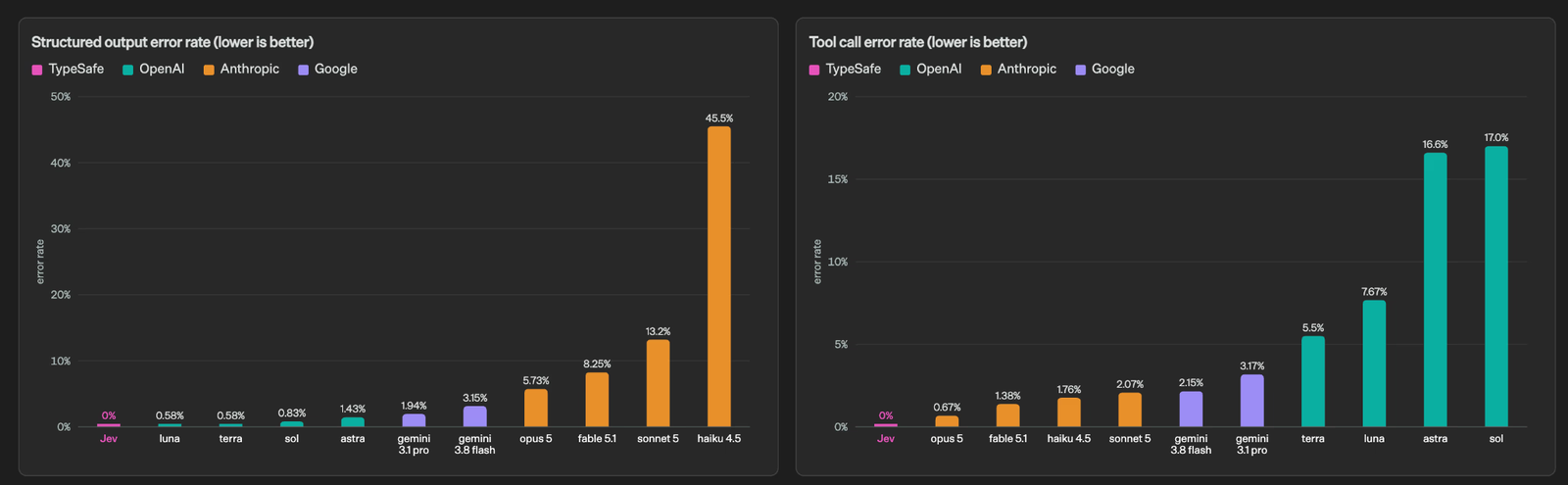
Read that chart as "it will not invent a key," not "it will not pick the wrong team." A Choice still returns one of your options. A Noul still returns a float. Calibration says that across many 0.8s, about 80% should be right. It does not certify the next ticket. Wire the confidence field (or the Noul itself) before you auto-close anything.
Jev specifications #
| Capability | Jev (TypeSafe, 16 Sep 2026) |
|---|---|
| Model ID | jev-latest |
| Provider | TypeSafe AI |
| Class | System One (first public) |
| Protocol | POST https://api.typesafe.ai/v1/systemone |
| Chat completions | No |
| Inputs | String or structured state |
| Outputs | Choice / Score / Noul answers, probabilities, usage |
| Choice cardinality | Up to 255 options (higher: two-stage score then choose) |
| Token budget | ~32K for state + questions |
| Input / 1M | $0.042 |
| Output / 1M | $0 |
| Latency | 70–500ms (TypeSafe) |
| Early access | Yes, waitlist |
| On RouterPlex | When public users can use it |
Side demos TypeSafe published: a Doom bot on structured state (not pixels), ~10 queries/s, ~$7/hour by their estimate; Wikiracing with high-cardinality link choice. Fun, not a product spec.
Call shape (TypeSafe early access, not RouterPlex) #
This curl talks to TypeSafe. It will not work on api.routerplex.com today. You need a TypeSafe key from console.typesafe.ai.
curl -X POST https://api.typesafe.ai/v1/systemone \-H "Authorization: Bearer $TYPESAFE_API_KEY" \-H "Content-Type: application/json" \-d '{"state": "Hi, I have been trying to connect my Stripe account for 3 days and it keeps failing. I am losing sales. Please help ASAP.","model": "jev-latest","questions": {"department": {"type": "choice","instructions": "Which team should handle this","criteria": {"billing": "Payment or subscription issues","technical": "Bugs or integration problems","sales": "Pricing or account questions"}},"frustration": {"type": "score","instructions": "How frustrated the customer appears","criteria": ["Calm, just stating facts","Frustrated but civil","Very angry, strong language"]},"is_urgent": {"type": "noul","instructions": "The message conveys urgency or time-sensitivity"}}}'
Python is pip install typesafe-sdk / uv add typesafe-sdk, then TypeSafeClient().system_one(...) with Choice, Score, and Noul. The client reads TYPESAFE_API_KEY and defaults to jev-latest. Errors you will actually see: 401 bad key, 422 bad question, 429 rate limit, 529 overloaded.
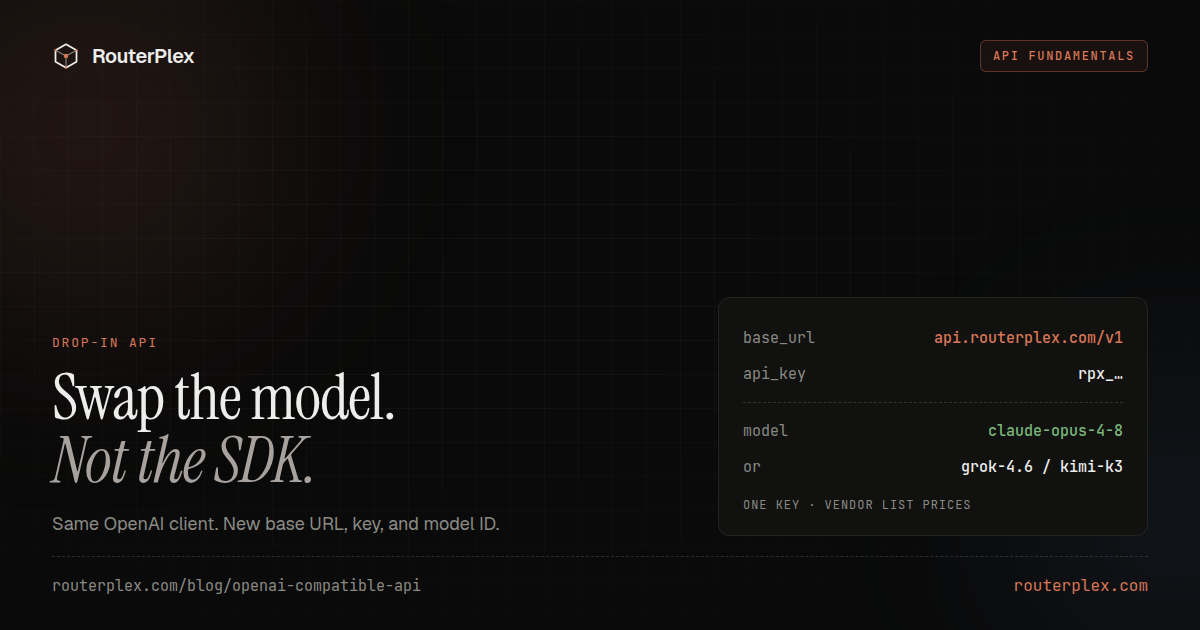
Do not point the OpenAI SDK at this host and send messages. There is no chat adapter to fall through to.
On RouterPlex, once it is public #
RouterPlex: Jev will be live here once it is available for public users. Early access on TypeSafe is not that bar. We are not publishing a catalog ID, a playground route, or a /v1/chat/completions example for a model we cannot sell yet.
When the row exists it will be TypeSafe list price, 0% markup, prepaid, hard per-key budget. It will still be a System One call, not a drop-in for the OpenAI-compatible API. Do not paste jev-latest into Cursor or Claude Code and expect a coding agent.
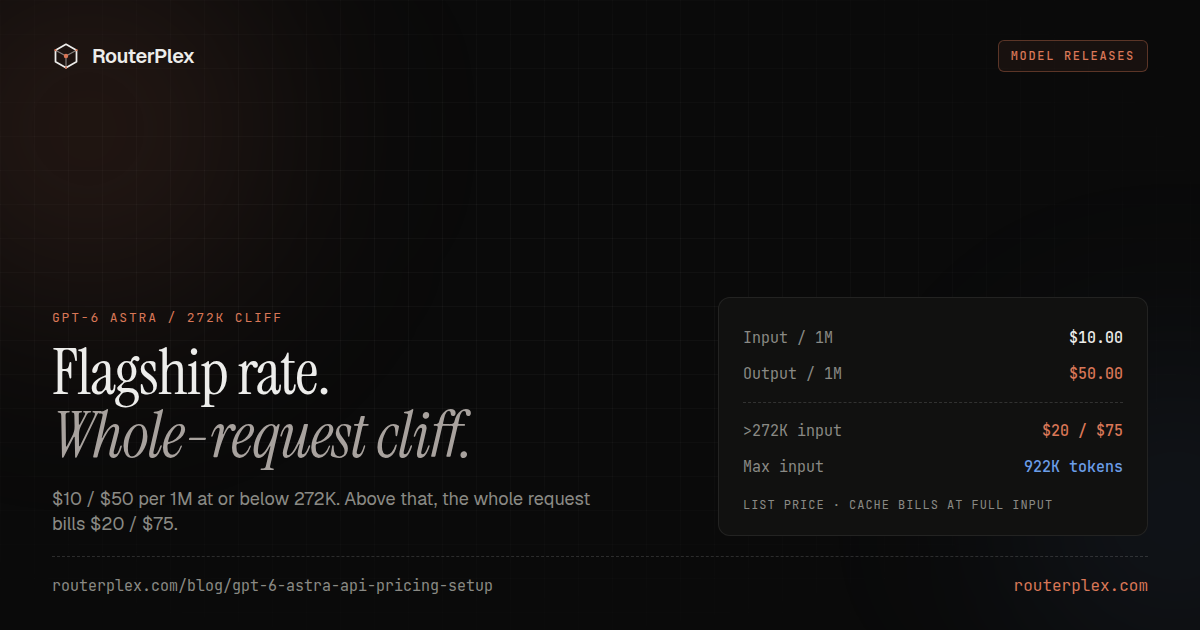
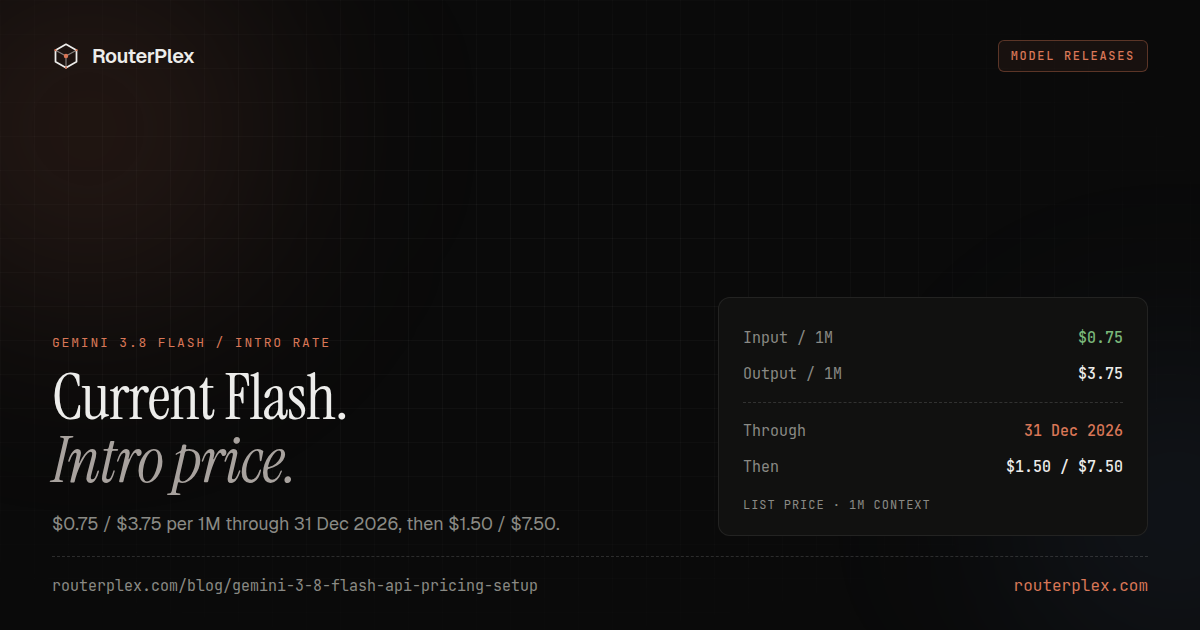
Until then, the cheap classification and routing models already on this key are still chat models: Gemini 3.8 Flash at the intro $0.75 / $3.75, or Claude Fable 5 when the judgment is expensive enough to pay $10 / $50. GPT-6 Astra is the flagship TypeSafe used as an eval reference, not a System One substitute. Volume chat routes, ranked by agent-turn cost, live on the cheapest models ledger.
Create a RouterPlex account if you want the prepaid key ready. Join TypeSafe's early access if you want Jev this week. This page will name the RouterPlex route the day public access lands.
Common questions
Frequently asked questions
How much does the TypeSafe Jev API cost?
TypeSafe lists Jev at $0.042 per 1M input tokens ($42 per billion) and free output tokens. They call output too cheap to meter, and they say they cannot prove the rate is not subsidized. When Jev lands on RouterPlex it will bill TypeSafe list rates with no markup.
What is a System One model?
A System One model takes unstructured state plus typed questions and returns typed answers with probabilities. It does not generate chat strings. TypeSafe's first public System One model is Jev. The three question types are Choice, Score, and Noul (yes/no probability).
Is Jev on RouterPlex?
Not yet. TypeSafe opened Jev in early access on 16 September 2026 and is still taking people off a waitlist. Jev will be live on RouterPlex once it is available for public users. There is no catalog row and no RouterPlex model ID to call today.
Can I call Jev with the OpenAI SDK chat completions endpoint?
No. Jev is POST /v1/systemone with a state object and a map of typed questions, not POST /v1/chat/completions. Pointing an OpenAI chat client at jev-latest will not start a System One evaluation. JSON mode on an LLM is a different contract: the model still generates a string that you then parse.
Does Jev hallucinate?
TypeSafe says Jev cannot emit a value outside the schema you defined, so type errors are not an empirical rate. That is not the same as always being correct. A Choice can still pick the wrong option. Calibration is measured over groups of predictions. Use confidence (Choice and Score) or the Noul value itself to decide when to act and when to escalate.
What is Jev good for?
Classify, route, score, extract, or branch inside software: support triage, invoice checks, agent-trace review, guardrails on other model output. It is not a chatbot, a code generator, or a drop-in replacement for GPT-6 Astra. Decompose the job into narrow questions and keep the workflow in your code.
Run the smallest paid test.
Add $5, cap the key, and verify the result with your own workload. No subscription, and credit never expires — a first top-up of $25+ is matched with $25 extra.