GPT-6 Luna API: Pricing, the 272K Cliff and Setup
GPT-6 Luna API pricing is $0.10/$0.50 per 1M at or below 272K. Above that the whole request bills $0.20/$0.75. Cache reads are $0.014. ID gpt-6-luna.
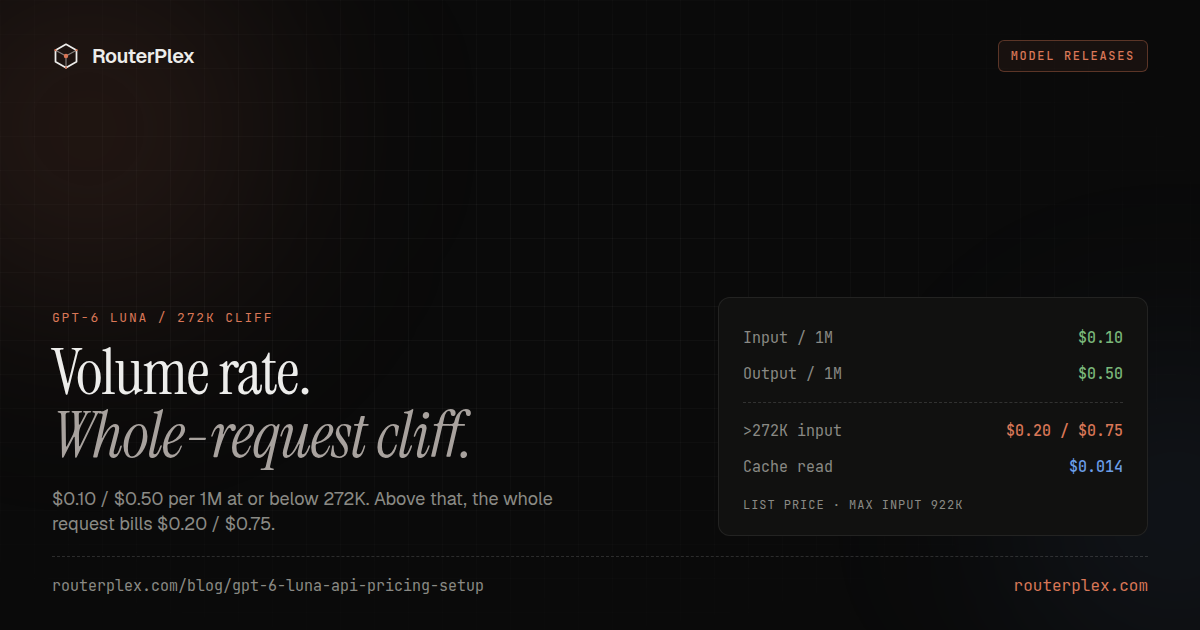
GPT-6 Luna is OpenAI's efficient model for focused, high-volume work, live on RouterPlex as gpt-6-luna. GPT-6 Luna API pricing is $0.10 per 1M input tokens and $0.50 per 1M output tokens at or below 272,000 input tokens. Cross that line and the whole request bills $0.20 input and $0.75 output per 1M.
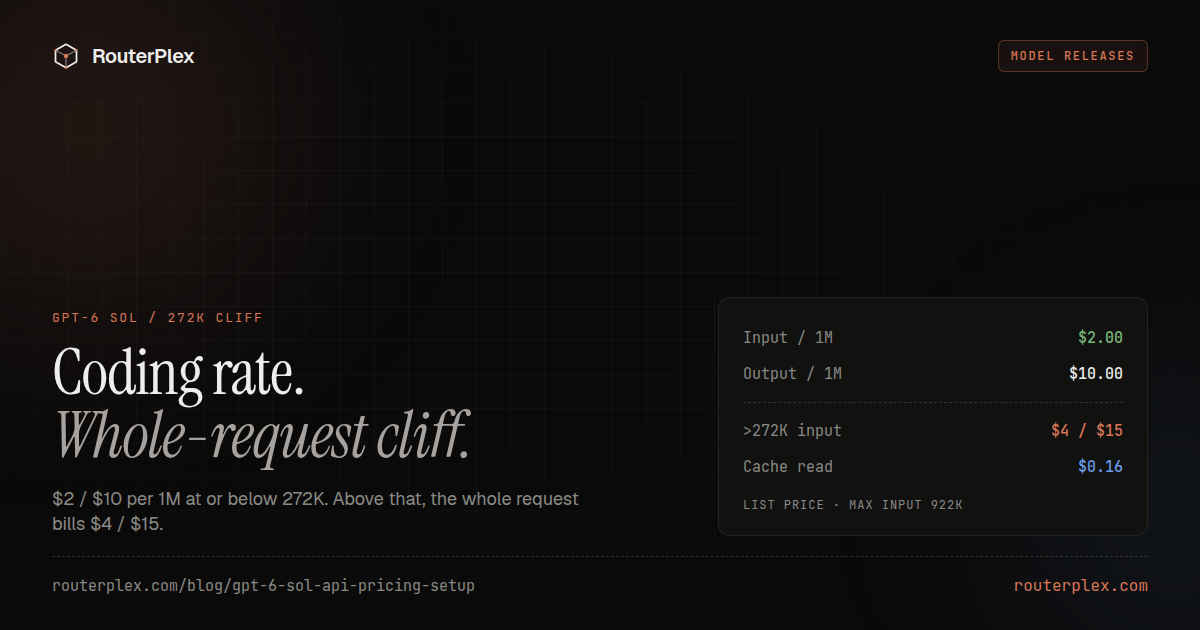
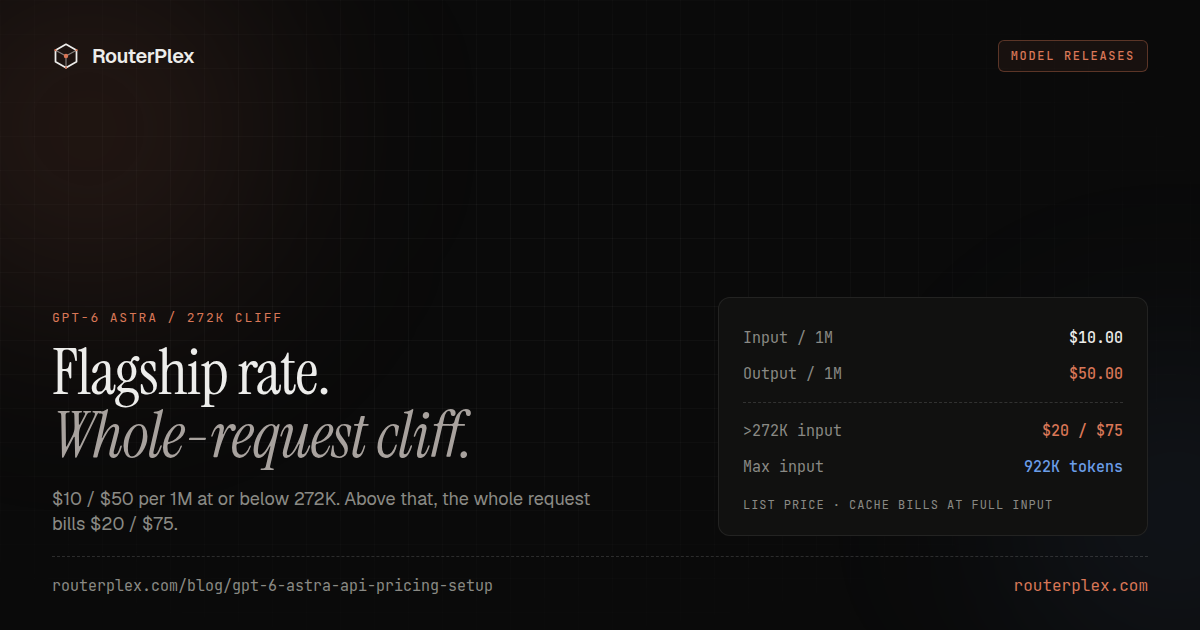
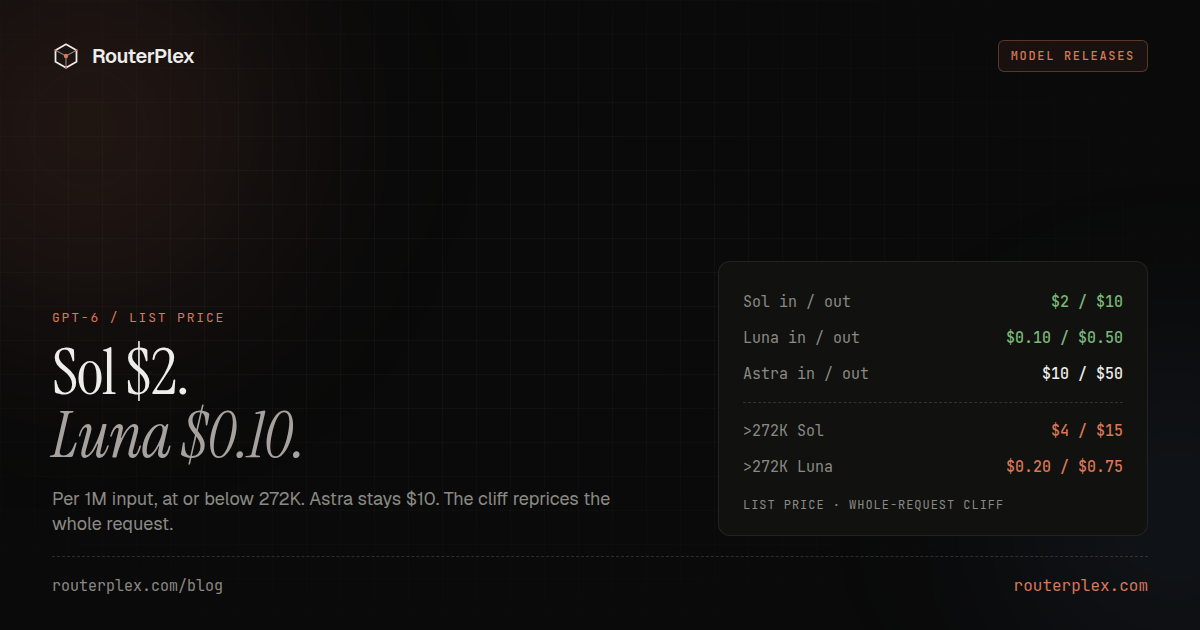
That is the lowest GPT-6 list price on this catalog. GPT-6 Sol is $2 / $10. GPT-6 Astra is $10 / $50. OpenAI shipped Sol and Luna together on 23 September 2026 and kept Astra as the flagship.

Sources: OpenAI's Introducing GPT-6 Sol and Luna (23 September 2026), the GPT-6 Luna model card, and the live RouterPlex catalog, checked 23 September 2026. Scores below are OpenAI's reported results. Rates change. Confirm the GPT-6 Luna price page before you lock a budget.
GPT-6 Luna API pricing #
USD per 1M tokens. The first two rows are what RouterPlex bills.
| Tier | Input | Output | Cache read |
|---|---|---|---|
| Standard (≤272K input) | $0.10 | $0.50 | $0.014 |
| Long context (>272K input) | $0.20 | $0.75 | $0.028 |
OpenAI's model card lists a different cache sheet on the same input and output stickers:
| OpenAI line | Per 1M |
|---|---|
| Input | $0.10 |
| Cached input | $0.01 |
| Cache writes | $0.125 |
| Output | $0.50 |
RouterPlex bills cache reads at $0.014 per 1M ($0.028 above 272K). That is higher than OpenAI's published $0.01 cached-input rate. Price a cache-heavy Luna loop at $0.014, and confirm the live model page if the row moves. RouterPlex does not publish a separate cache-write price. OpenAI's card prices Batch and Flex at 50% of Standard, Fast at 2×, and regional processing at a 10% uplift where that processing is available. This key bills the standard list rate.
A 40,000-in / 2,000-out turn with no cache costs $0.005. The same turn is $0.10 on Sol and $0.50 on Astra.
A $5 prepaid balance covers 50 million Luna input tokens, or 10 million Luna output tokens, if a workload used only one side. Real requests mix both. Reasoning tokens bill as output, so a high reasoning_effort on a cheap input price can still dominate the bill.
The 272K cliff still applies #
The cheap sticker has the same shape as Sol and Astra. Past 272,000 input tokens, the higher rate covers the whole request.
271,000-token prompt on gpt-6-luna → 271,000 × $0.10/1M = $0.0271273,000-token prompt on gpt-6-luna → 273,000 × $0.20/1M = $0.0546
The dollar jump is small next to Sol, and it is still a doubling of the input rate plus a move from $0.50 to $0.75 on output. A volume job that silently grows its prefix across 272K will pay the long-context rate on every token, including the ones that used to be cheap.
GPT-6 Luna vs Sol, Astra, and GPT-5.6 Luna #
| Model | Input | Output | Cache read | 40K / 2K turn | Max input here |
|---|---|---|---|---|---|
gpt-6-luna | $0.10 | $0.50 | $0.014 | $0.0050 | 922K |
gpt-5.6-luna | $0.20 | $1.20 | $0.016 | $0.0104 | 258K |
gpt-6-sol | $2.00 | $10.00 | $0.16 | $0.1000 | 922K |
gpt-6-astra | $10.00 | $50.00 | $0.80 | $0.5000 | 922K |
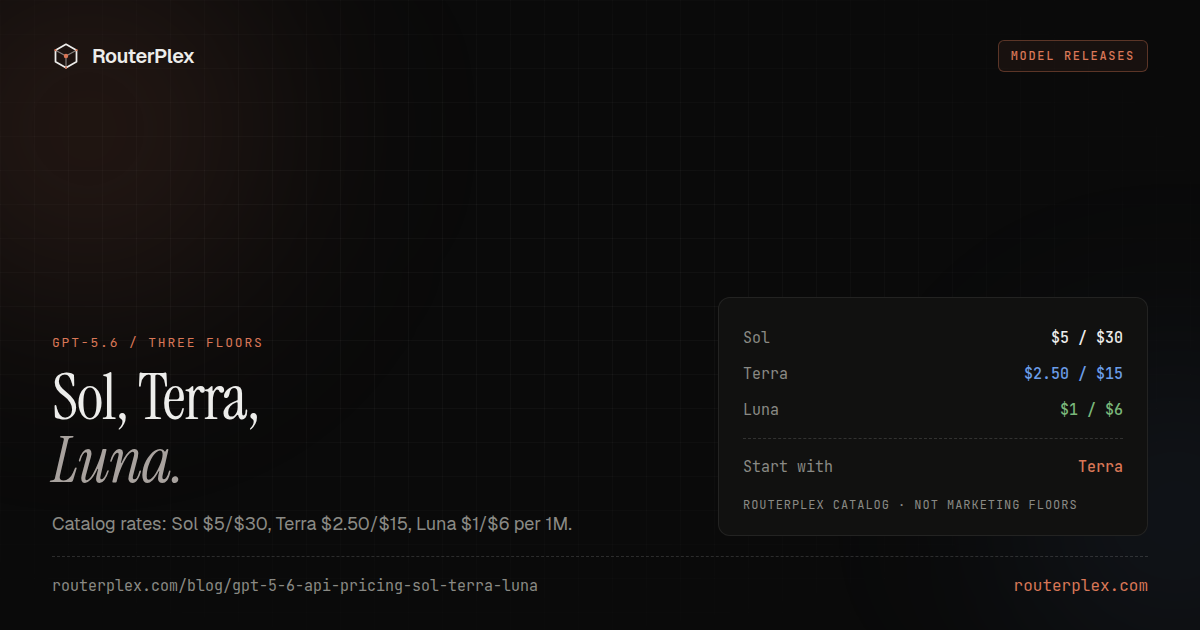
OpenAI's launch table shows GPT-5.6 Luna at $0.20 / $1.20 moving to GPT-6 Luna at $0.10 / $0.50, and labels the row a 50% reduction versus GPT-5.6 promotional pricing. Input is exactly half. Output goes from $1.20 to $0.50. RouterPlex bills both of those catalog rates: the new Luna list, and the older Luna list at $0.20 / $1.20. The older family's full comparison is GPT-5.6 Sol vs Terra vs Luna.
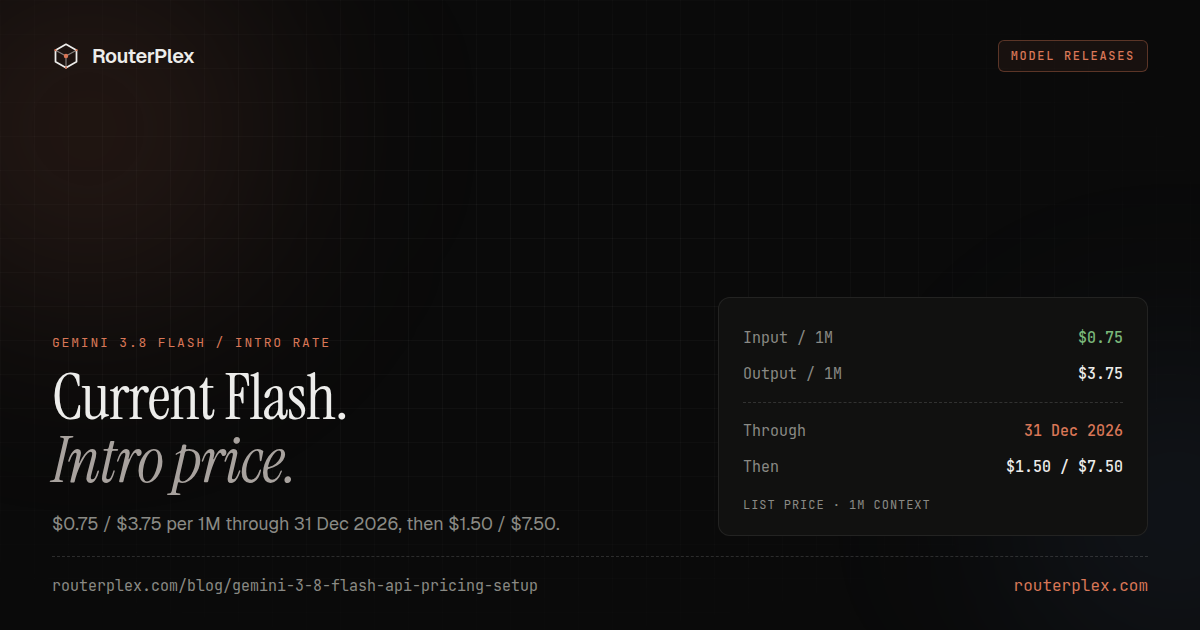
Luna is twenty times cheaper than Sol on input and on output. Use that gap when you actually have volume. A coding agent that fails twice on Luna and succeeds once on Sol has not saved money. The OpenAI hub and the cheapest models ledger are the wider price boards. Gemini 3.8 Flash is another volume route, at the introductory $0.75 / $3.75 through 31 December 2026.
What OpenAI measured #
Vendor-reported, from the 23 September 2026 announcement, at the effort OpenAI names. RouterPlex has not re-run these.
| Eval | What OpenAI reports for Luna |
|---|---|
| DeepSWE v1.1 | 66.6% at max effort. OpenAI calls that comparable to Opus 5 and Fable 5 at medium effort, at 93% lower cost per task than Opus 5 and 96% lower than Fable 5 |
| AutomationBench 1.0.6 | High effort is 5.4 percentage points above Luna's predecessor, at 58% lower cost per task. The post does not print Luna's absolute score |
| OSWorld 2.0 offline | Max effort exceeds GPT-5.6 Sol at medium effort, at one tenth the cost. Astra remains the computer-use leader in OpenAI's write-up. The post does not print Luna's absolute score |
| Internal factuality | At higher effort, matches GPT-5.6 Sol at about one hundredth the cost. The set is error-inducing de-identified chats, not typical usage, and the scores are not length-controlled |
Sol's AutomationBench 33.2%, DeepSWE 68.8%, and OSWorld 60.5% are on the GPT-6 Sol pricing guide. OpenAI also says both new models improve on GPT-5.6 alignment, including lower coding-deception rates on deliberately hard cases. Those results are in the GPT-6 Astra system card, and OpenAI says they are not typical failure rates.
What the model card documents #
| Capability | GPT-6 Luna |
|---|---|
| Model ID | gpt-6-luna |
| Context window | 1,050,000 tokens |
| Max input | 922,000 tokens |
| Max output | 128,000 tokens |
| Knowledge cutoff | 18 May 2026 |
| Input / output | Text and image in, text out |
| Reasoning effort | none, low, medium (default), high, xhigh, max |
| On RouterPlex | Reasoning, vision, tool calling |
The Chat Completions caveat matches Sol. OpenAI says function calling on Chat Completions works only with reasoning_effort set to none, and points built-in tools at the Responses API. On RouterPlex, use Chat Completions at https://api.routerplex.com/v1 and set that effort when the request includes tools. Do not assume OpenAI hosted tools (computer use, code interpreter, web search, and the rest) ride along on this route.
OpenAI's card lists default rate limits of 500 RPM and 500K TPM at tier 1, and 30,000 RPM and 180M TPM at tier 5. Those are OpenAI's limits. The cap on this key is the hard budget you set.
ChatGPT availability is a separate product. OpenAI's post says Sol and Luna are in ChatGPT Work and Codex for Plus, Pro, Business, Enterprise, and Edu, that Free and Go get Luna in the desktop app, and that the models were not in Chat yet, with a gradual rollout. The API IDs are what this page bills.
Call GPT-6 Luna on RouterPlex #
One OpenAI-compatible key, prepaid, with a hard spend limit. The balance stops at $0. There is no per-token markup and no top-up fee.
curl https://api.routerplex.com/v1/chat/completions \-H "Authorization: Bearer $ROUTERPLEX_API_KEY" \-H "Content-Type: application/json" \-d '{"model": "gpt-6-luna","messages": [{"role": "user", "content": "Extract the invoice total, currency, and due date."}]}'
import osfrom openai import OpenAIclient = OpenAI(api_key=os.environ["ROUTERPLEX_API_KEY"],base_url="https://api.routerplex.com/v1",)response = client.chat.completions.create(model="gpt-6-luna",messages=[{"role": "user", "content": "Classify this ticket as billing, access, or other."}],)print(response.choices[0].message.content)
Claude Code uses ANTHROPIC_BASE_URL=https://api.routerplex.com and model gpt-6-luna. Setup is in the Claude Code guide. The same base-URL override works in Cursor.
Live prices: GPT-6 Luna, GPT-6 Sol, GPT-6 Astra.
When Luna is the right ID #
- Classification, extraction, triage, and short answers at volume. $0.005 a turn is the reason this ID exists. Put a hard budget on the key anyway, because a loop is still a loop.
- A step up from GPT-5.6 Luna when you want the newer weights, the 922K input window, and the lower sticker. Re-check quality on your own set. The old ID remains $0.20 / $1.20 here.
- Anything you would otherwise send to Sol by default. Try Luna first when a miss is cheap to retry. Move the misses to GPT-6 Sol.
- Work that has to be the flagship. That is GPT-6 Astra, at one hundred times Luna's input price.
Start a $5 RouterPlex test, put gpt-6-luna on a budgeted key, and send one live request. Funding fees at other gateways are compared on RouterPlex vs OpenRouter.
Common questions
Frequently asked questions
How much does the GPT-6 Luna API cost?
OpenAI lists GPT-6 Luna at $0.10 per 1M input tokens and $0.50 per 1M output tokens for prompts at or below 272,000 input tokens. Prompts above 272,000 bill $0.20 input and $0.75 output per 1M for the whole request. RouterPlex bills those list rates on model ID gpt-6-luna with no per-token markup.
Is GPT-6 Luna the cheapest GPT-6 model?
On this catalog, yes. Luna is $0.10 / $0.50 per 1M. GPT-6 Sol is $2 / $10. GPT-6 Astra is $10 / $50. A 40,000-in / 2,000-out turn with no cache is $0.005 on Luna, $0.10 on Sol, and $0.50 on Astra.
What is the GPT-6 Luna context window?
OpenAI documents a 1,050,000-token context window, 922,000 maximum input tokens, and 128,000 maximum output tokens. The RouterPlex catalog lists 922,000 input tokens and a 128,000 output cap. Knowledge cutoff is 18 May 2026.
How much does RouterPlex charge for GPT-6 Luna cached input?
The live catalog bills cache reads at $0.014 per 1M tokens, and $0.028 per 1M once the prompt crosses 272K. OpenAI's own sheet lists cached input at $0.01 and cache writes at $0.125. RouterPlex publishes the cache-read rate only, and it is higher than OpenAI's $0.01 cached-input line.
How does GPT-6 Luna compare with GPT-5.6 Luna?
GPT-6 Luna is $0.10 / $0.50. GPT-5.6 Luna on this catalog is $0.20 / $1.20. The same 40K / 2K turn is $0.005 versus $0.0104. OpenAI's 23 September 2026 table shows those two stickers and labels the new row a 50% reduction versus GPT-5.6 promotional pricing. Input is exactly half. Output goes from $1.20 to $0.50.
What did OpenAI report for GPT-6 Luna on DeepSWE?
OpenAI reports 66.6% for GPT-6 Luna at max effort on DeepSWE v1.1, and says that is comparable to Claude Opus 5 and Claude Fable 5 at medium effort, at 93% lower cost per task than Opus 5 and 96% lower than Fable 5. That is OpenAI's figure, not a RouterPlex eval.
Can I use GPT-6 Luna with the OpenAI SDK?
Yes. Point the OpenAI SDK at https://api.routerplex.com/v1 with model ID gpt-6-luna. Claude Code uses ANTHROPIC_BASE_URL=https://api.routerplex.com and the same model ID. OpenAI's model card says Chat Completions function calling on this model works only when reasoning_effort is none.
Run the smallest paid test.
Add $5, cap the key, and verify the result with your own workload. No subscription, and credit never expires — a first top-up of $25+ is matched with $25 extra.