Muse Wonder API: Meta's $4/$20 Pricing and Setup
Muse Wonder API pricing is $4/$20 per 1M tokens, cached input $0.20, 1M context. Not on RouterPlex yet. Sign up and use live Claude Opus 5.5.
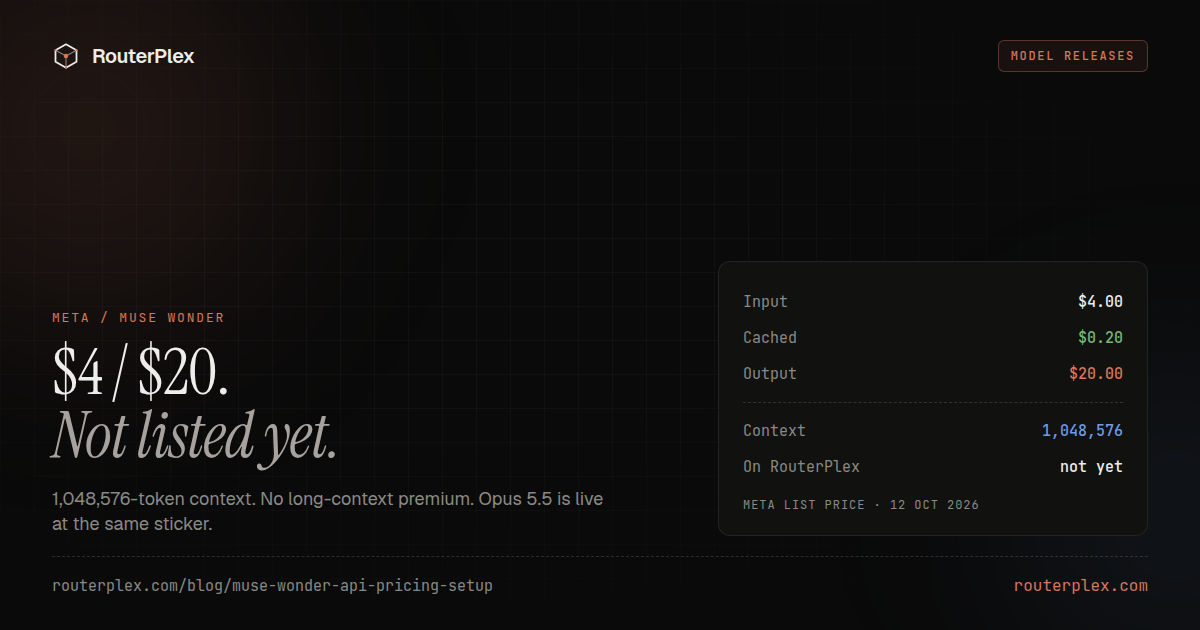
Meta published Muse Wonder on 12 October 2026. This page is that model API. The public id is muse-wonder-1.0. The bare phrase "Muse Wonder" also matches a rock band and an album, so every price below is the Meta model, checked the same day on dev.meta.ai/models/muse-wonder and the pricing page.
Muse Wonder API pricing is $4.00 per 1M input tokens and $20.00 per 1M output tokens. Cached input is $0.20 per 1M. The context window is 1,048,576 tokens, and Meta charges that rate whether the window is nearly empty or nearly full.
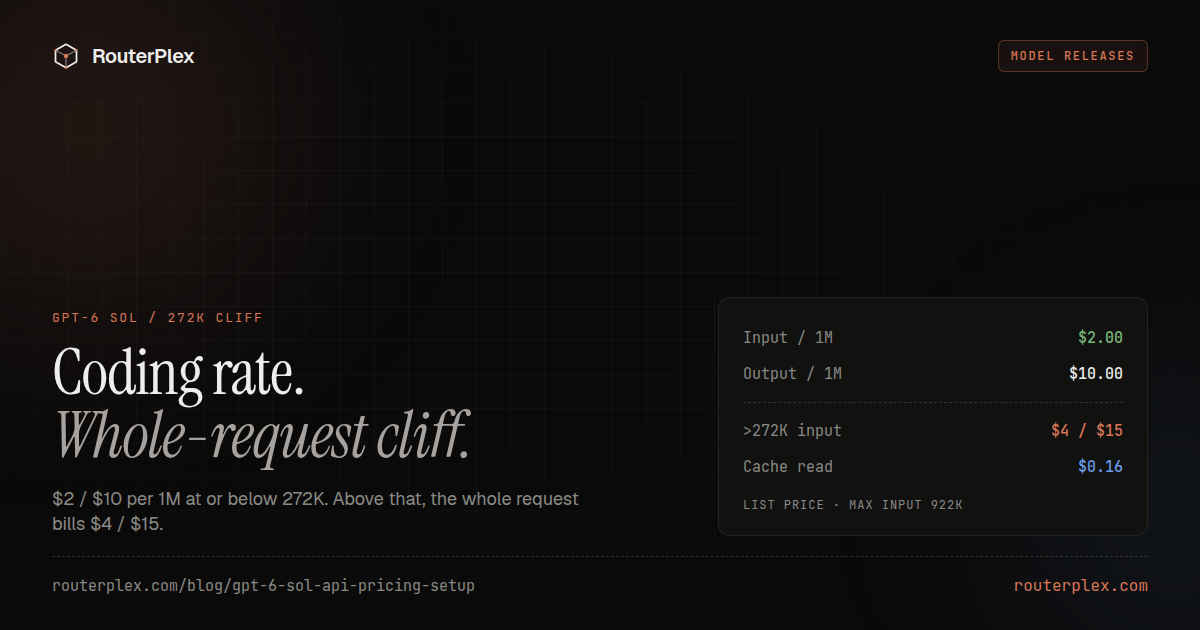
Muse Wonder is not on RouterPlex yet. Create a RouterPlex account and call a model that is already listed. Claude Opus 5.5 is live as claude-opus-5-5 at the same $4 / $20 vendor sticker. GPT-6 Sol is live at $2 / $10 per 1M when the prompt is at or below 272K tokens. When this catalog lists Muse Wonder, that same prepaid key calls muse-wonder-1.0 at vendor list price, 0% markup, a $0 top-up fee, and a hard spend limit.
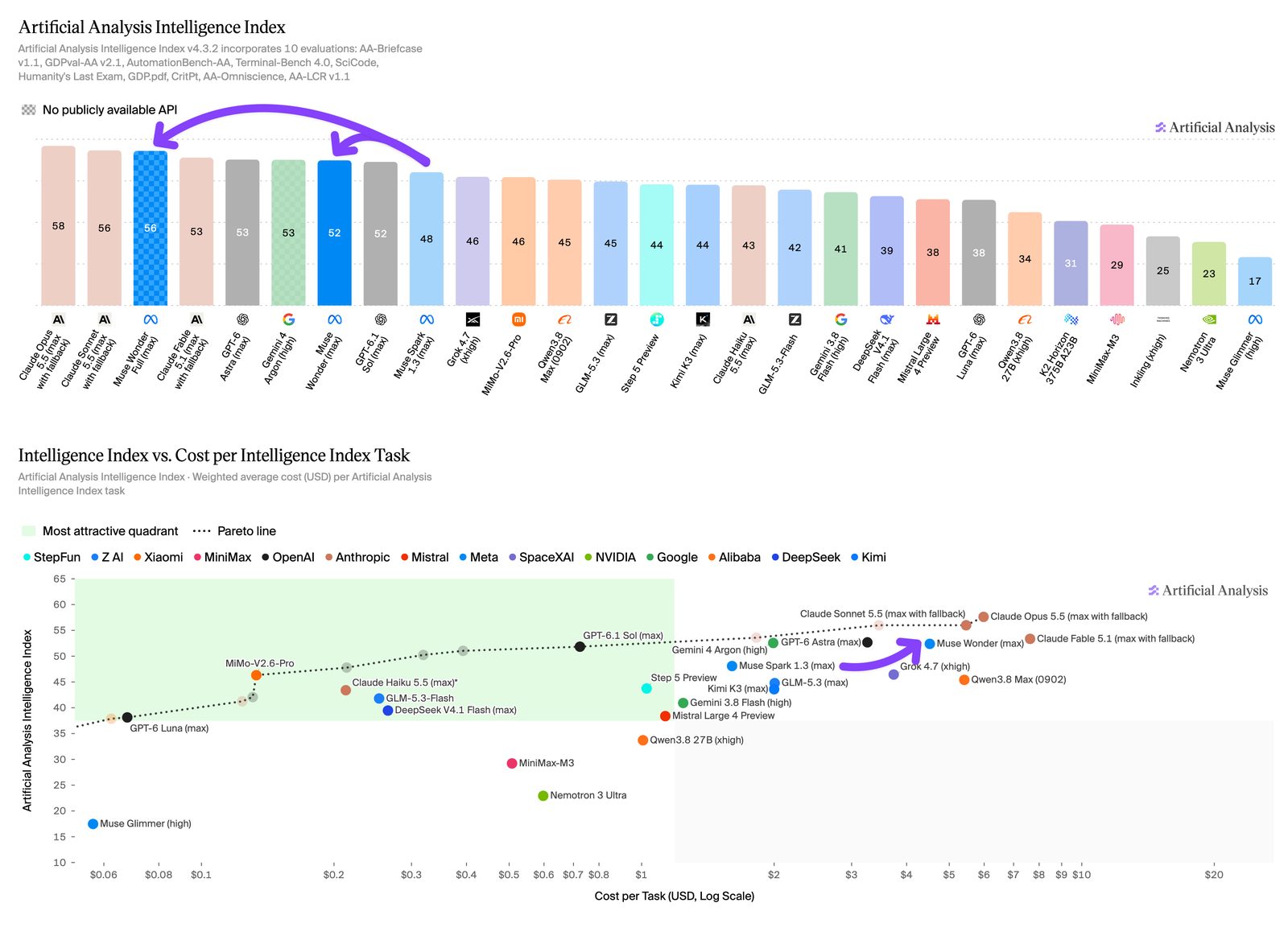
Sources, all checked 12 October 2026: Meta's Muse Wonder model page, models docs, pricing and rate limits, and the research post. Benchmark commentary is from Artificial Analysis, 12 October 2026. Scores are those publishers' figures. RouterPlex did not re-run them. Rates change. Confirm the vendor page before you lock a budget.
Muse Wonder API pricing #
USD per 1M tokens. The Muse Wonder column is Meta's list price. It is not a RouterPlex bill until the row exists. The other two columns are live catalog rates.
| Line | Muse Wonder, Meta list | Opus 5.5, live here | GPT-6 Sol, live, prompt at or below 272K |
|---|---|---|---|
| Input | $4.00 | $4.00 | $2.00 |
| Output | $20.00 | $20.00 | $10.00 |
| Cached input or cache read | $0.20 | $0.425 | $0.16 |
A 40,000-token input and a 2,000-token output, with no cache, is $0.16 + $0.04 = $0.20 on Meta's Wonder list and on Opus 5.5 here. The same shape on GPT-6 Sol, still under the 272K line, is $0.08 + $0.02 = $0.10. Above 272K, Sol bills the whole request at $4 input and $15 output per 1M. Wonder has no equivalent cliff.
If all 40,000 input tokens are a cache hit, Meta's Wonder math is $0.008 + $0.04 = $0.048. The same hit on Opus 5.5 here is $0.017 + $0.04 = $0.057, because this catalog bills Opus cache reads at $0.425 per 1M, while Anthropic's own cached-input rate is $0.20. Do not paste Meta's $0.20 into a RouterPlex Opus budget.
Web search grounding is $2.50 per 1,000 search queries, on top of tokens, for Meta's web_search tool on Wonder and Spark. Meta also says injected steering tokens are not billed. Both notes are Meta's invoice, not a line on this catalog.
What the $4.52 eval task costs #
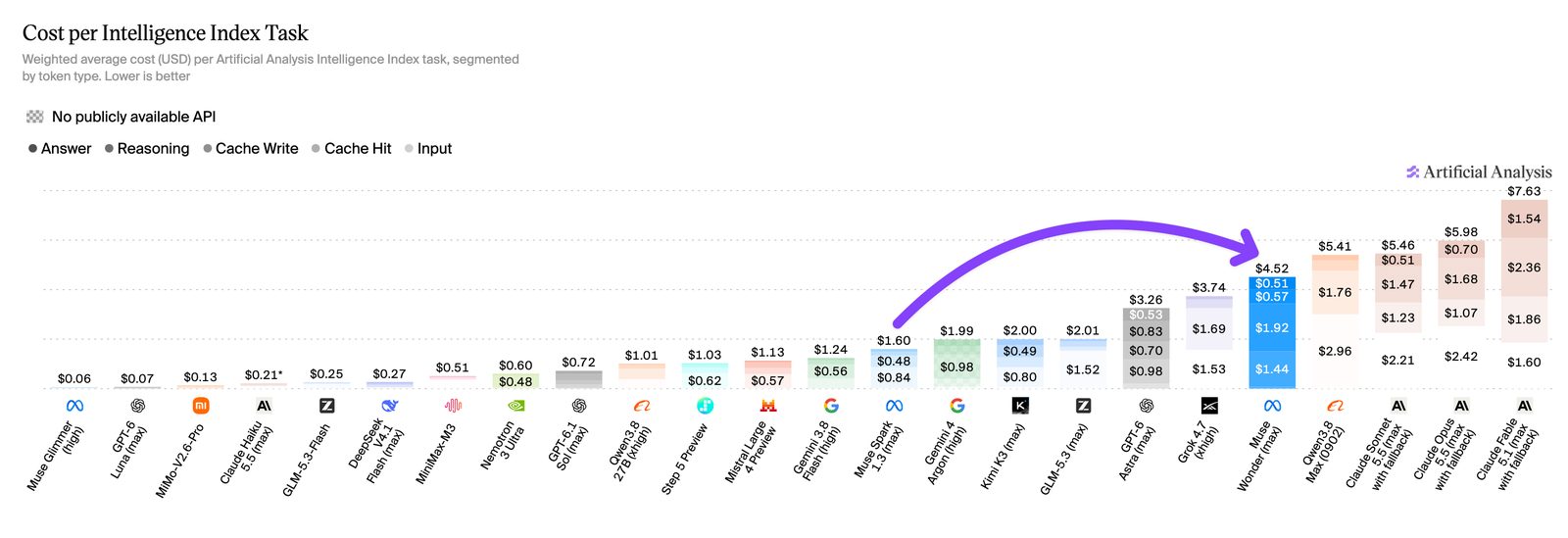
Artificial Analysis puts Wonder (max) at $4.52 per Intelligence Index task, 2.8 times Muse Spark 1.3 (max) at $1.60. Of that $4.52, input is $3.43: $1.92 cache writes, $1.44 cache hits, and $0.07 uncached. Output is about $1.08 from about 54k tokens. Lower than their figures for Fable 5.1 (max with fallback) at $7.63, Opus 5.5 (max with fallback) at $5.98, and Sonnet 5.5 (max with fallback) at $5.46. Higher than Astra (max) at $3.26, Gemini 4 Argon (high) at $1.99, GPT-6.1 Sol (max) at $0.72, and Spark 1.3 (max) at $1.60. Full has no per-token price, so they publish no cost per task. That trace is their eval at Meta's token prices. It is not what a 40,000-token RouterPlex call costs.
Muse Wonder vs Muse Spark #
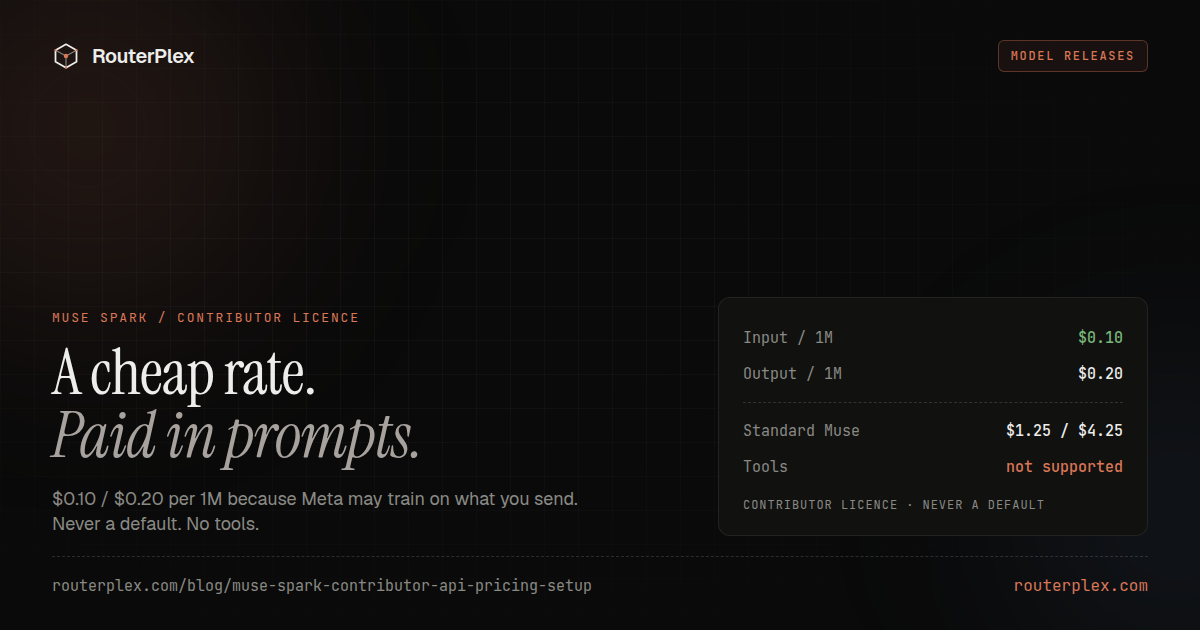
Meta still lists standard Muse Spark at $0.15 cached, $1.25 input, and $4.25 output per 1M. RouterPlex does not sell those standard ids. The Spark routes that are live here are Muse Spark Contributor, muse-spark-1.3-contributor and muse-spark-1.2-contributor, at $0.10 input and $0.20 output. The discount is a training licence. Meta may train on prompts and completions you send to those ids. Tools are off on this catalog. The id runs only when you name it. It is never a default.
Contributor mode is not available for Muse Wonder on the Model API. Standard mode on that API does not use your content to train Meta models. A 40,000-in / 2,000-out Contributor call is $0.004 + $0.0004 = $0.0044, and that number buys a different model plus the training licence. It does not buy Wonder.
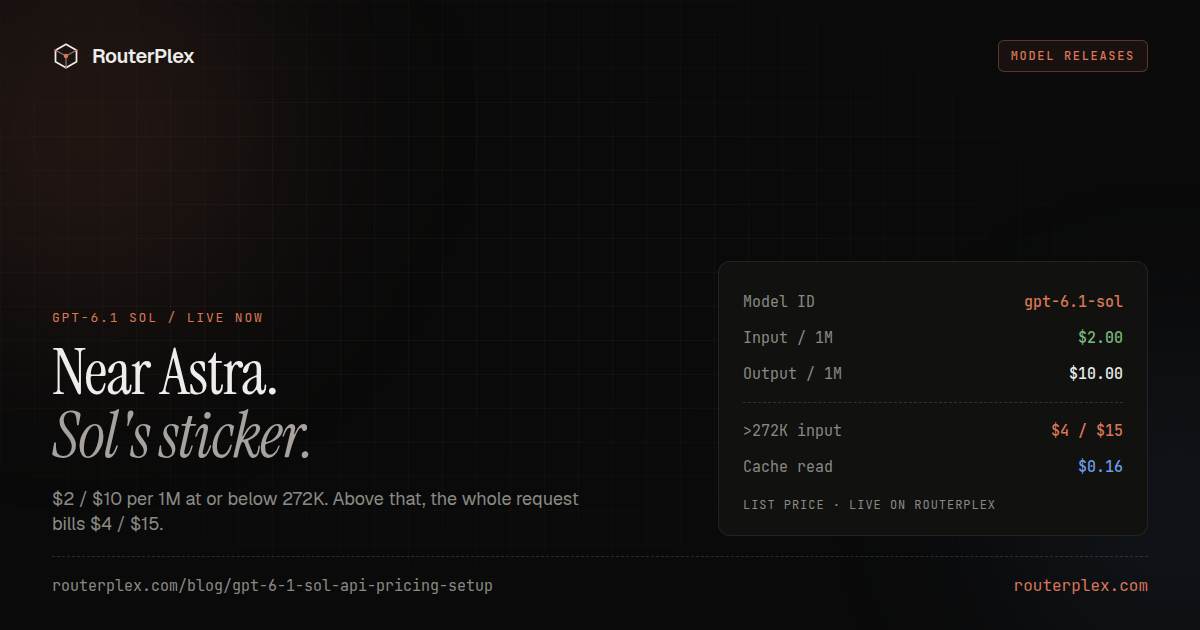
Use Opus 5.5 when you want the $4 / $20 class today. Use Sol, or GPT-6.1 Sol at the same sticker under 272K, when the bill matters more. Use Spark Contributor only when the prompts can be trained on and you do not need tools. Use muse-wonder-1.0 on this key once the catalog lists it. The model index and the cheapest-model ledger are the rows that bill today.
Muse Wonder Full is subscription-only #
Muse Wonder Full is a second model, id muse-wonder-full-1.0, context 1M, and it is not on the public token API. Meta prices it as a Muse Code subscription: Power Usage is $50 a month (20 times Everyday, and it includes Wonder Full) and Maximum Usage is $200 a month (80 times Everyday). The token-price cells are dashes, so there is no per-token Wonder Full bill to copy. Setting reasoning effort to max on muse-wonder-1.0 does not select Full.
Context, inputs, and limits #
Meta's docs say Muse Wonder takes text, image, video, audio, and PDF, and returns text. The context window is 1,048,576 tokens. Reasoning effort runs from minimal to max. The docs list chat completion, image understanding, video and audio understanding, tool calling, structured output, search grounding, and computer use. The same page says the model plans work, delegates to sub-agents, calls tools in parallel, and recovers from errors. Active Memory, in the research post, means carrying context across a conversation and pulling back the part the task needs.
The model page and the pricing page do not print a separate max-output cap. This post does not invent one.
Muse Wonder rate limits #
On Meta's Model API, limits are per team, not per key. muse-wonder-1.0 is 3,000 requests per minute and 4,000,000 tokens per minute. Background responses (background: true) add a cap of 600 new submissions per minute per team. Those are Meta's caps. They are not RouterPlex limits, and they do not apply to a model this catalog does not list.
The public endpoints Meta names are Responses, Chat Completions, and Messages. A gateway comparison, including the $0 top-up fee against a percentage fee, is on the OpenRouter alternative page. OpenRouter's model page is the gateway result showing for "Muse Wonder API" today. This page is the RouterPlex version of that query: vendor list price when the row exists, prepaid, hard spend limit, and the row does not exist yet.
Benchmarks Meta and Artificial Analysis published #
Artificial Analysis, 12 October 2026, scores Intelligence Index v4.3 at max reasoning as Wonder 52, Wonder Full 56, and Muse Spark 1.3 (max) 48. Full gains 8 points and improves on Spark across all ten index evals. The largest Spark-to-Full moves they name are Terminal-Bench 4.0 from 33% to 57%, GDPval-AA v2.1 from 1681 to 1857 Elo, and AA-Briefcase from 1581 to 1729 Elo. Wonder's moves versus Spark include Terminal-Bench 4.0 from 33% to 52%. Both models use about 54k output tokens per index task, about 10% under Spark's 60k. Full uses 16% fewer input tokens than Wonder (6.44M versus 7.69M).
On their Coding Agents Index, inside Muse Code, Full scores 68, Wonder 63, and Spark 1.3 (max) 54. They place Claude Code with Sonnet 5.5 (max) at 68 and Opus 5.5 (max) at 66. On AA-Omniscience, Full is 30 and Wonder is 25, level with Spark and under Opus 5.5 at 46. They also report Full's hallucination rate falling from 33% to 23%, with Wonder at 27%.
Meta's Muse Wonder benchmark table #
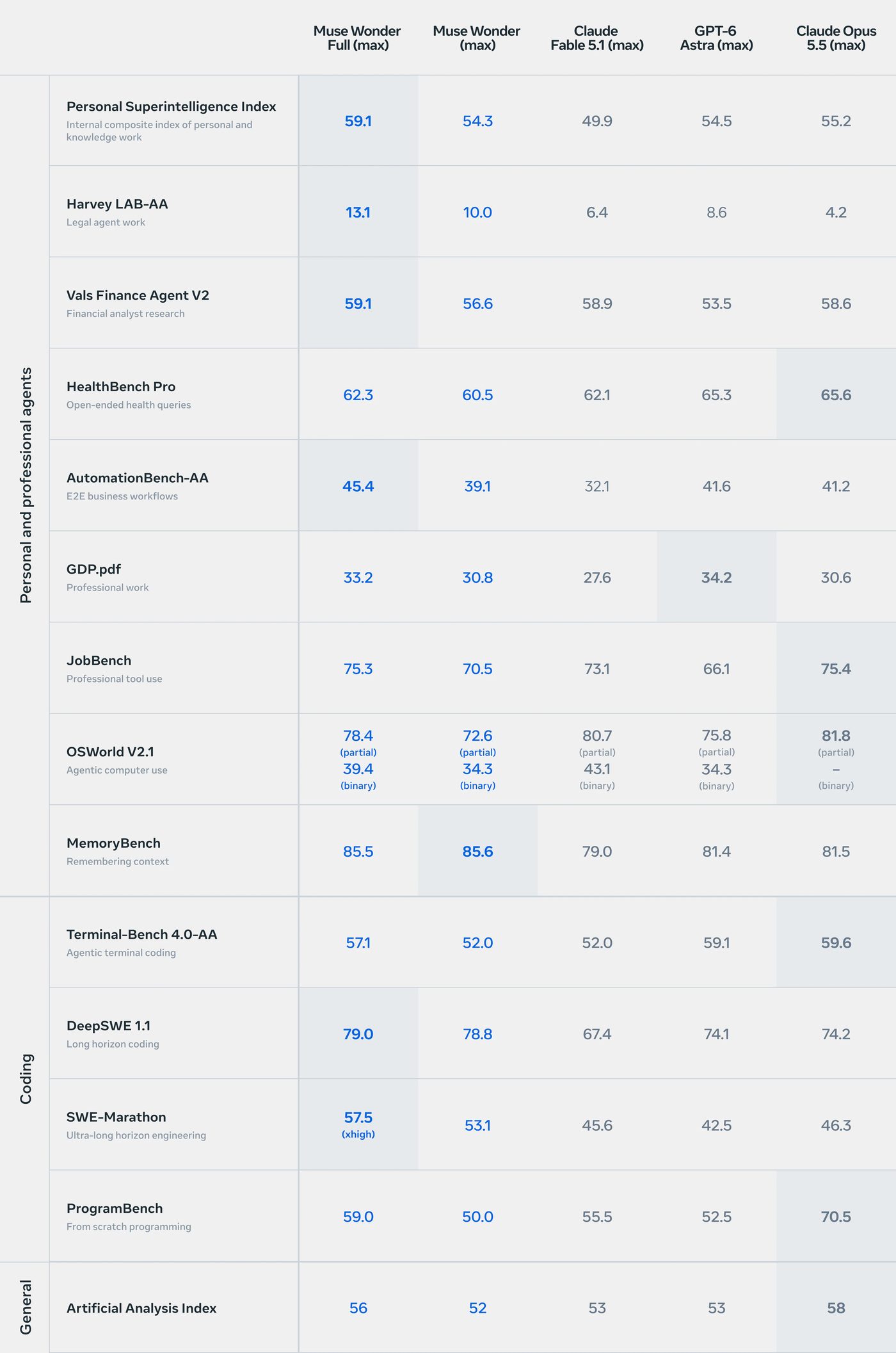
Meta's own model-page table, transcribed below and shown in the chart, does not crown Wonder overall. On the Artificial Analysis Index row, Opus 5.5 (max) is 58, Wonder Full is 56, and Wonder is 52. Astra (59.1) and Opus (59.6) beat Wonder (52.0) on Terminal-Bench 4.0-AA. Opus leads ProgramBench at 70.5 versus Wonder at 50.0. Wonder and Full lead that table on Harvey LAB-AA, MemoryBench, DeepSWE 1.1, SWE-Marathon, and the Personal Superintelligence Index against Fable 5.1, Astra, and Opus 5.5.
One naming trap: Artificial Analysis writes AutomationBench-AA as 68% for Wonder and 71% for Full. Meta's table prints 39.1 and 45.4. Those are different reported figures. Quote the page you are reading.
| Benchmark | Wonder Full (max) | Wonder (max) | Fable 5.1 (max) | GPT-6 Astra (max) | Opus 5.5 (max) |
|---|---|---|---|---|---|
| Personal Superintelligence Index | 59.1 | 54.3 | 49.9 | 54.5 | 55.2 |
| Harvey LAB-AA | 13.1 | 10.0 | 6.4 | 8.6 | 4.2 |
| Vals Finance Agent V2 | 59.1 | 56.6 | 58.9 | 53.5 | 58.6 |
| HealthBench Pro | 62.3 | 60.5 | 62.1 | 65.3 | 65.6 |
| AutomationBench-AA | 45.4 | 39.1 | 32.1 | 41.6 | 41.2 |
| GDP.pdf | 33.2 | 30.8 | 27.6 | 34.2 | 30.6 |
| JobBench | 75.3 | 70.5 | 73.1 | 66.1 | 75.4 |
| OSWorld V2.1 partial / binary | 78.4 / 39.4 | 72.6 / 34.3 | 80.7 / 43.1 | 75.8 / 34.3 | 81.8 / — |
| MemoryBench | 85.5 | 85.6 | 79.0 | 81.4 | 81.5 |
| Terminal-Bench 4.0-AA | 57.1 | 52.0 | 52.0 | 59.1 | 59.6 |
| DeepSWE 1.1 | 79.0 | 78.8 | 67.4 | 74.1 | 74.2 |
| SWE-Marathon | 57.5 (xhigh) | 53.1 | 45.6 | 42.5 | 46.3 |
| ProgramBench | 59.0 | 50.0 | 55.5 | 52.5 | 70.5 |
| Artificial Analysis Index | 56 | 52 | 53 | 53 | 58 |
SWE-Marathon's Full cell is marked xhigh on Meta's page. Opus 5.5's OSWorld binary cell is a dash. The model card is linked from that page. This table is the grid on the model page, not a re-score.
Call Claude Opus 5.5 today #
claude-opus-5-5 is the live model at Wonder's sticker. The call below is Opus 5.5. It is not Muse Wonder.
curl https://api.routerplex.com/v1/chat/completions \-H "Authorization: Bearer $ROUTERPLEX_API_KEY" \-H "Content-Type: application/json" \-d '{"model": "claude-opus-5-5","messages": [{"role": "user", "content": "Price a 40,000-token input and a 2,000-token output at $4 and $20 per million tokens."}]}'
That request bills $4 / $20 per 1M on this catalog, with cache reads at $0.425 per 1M. The OpenAI-compatible API covers the models the catalog actually lists. muse-wonder-1.0 is not one of them today, so do not send that id to api.routerplex.com yet.
On RouterPlex, once Muse Wonder is listed #
The id to watch is muse-wonder-1.0. When the row exists, change model from claude-opus-5-5 to that id on the same base URL and the same key. Price will be Meta's list price, 0% markup, prepaid, with a hard per-key spend limit. Create a RouterPlex account for the models that bill today, and for Muse Wonder when it is one of them. An account opened now is the account that can call it first.
Common questions
Frequently asked questions
How much does the Muse Wonder API cost?
Meta lists muse-wonder-1.0 at $4 per 1M input tokens, $0.20 per 1M cached input, and $20 per 1M output tokens. There is no long-context premium. Web search grounding is an extra $2.50 per 1,000 search queries on Meta's web_search tool. Checked 12 October 2026 on dev.meta.ai. RouterPlex does not bill Muse Wonder yet.
What is the Muse Wonder model ID?
muse-wonder-1.0 on Meta's Model API and in Muse Code. Muse Wonder Full is muse-wonder-full-1.0 and is not on the public token API. There is no RouterPlex model ID until the catalog lists it.
Is Muse Wonder on RouterPlex?
Not yet. Create an account and use the live catalog. Claude Opus 5.5 is live as claude-opus-5-5 at the same $4/$20 sticker. GPT-6 Sol is live as gpt-6-sol at $2/$10 for prompts at or below 272K tokens. Muse Wonder can be called on the same prepaid key once the catalog lists muse-wonder-1.0.
What is the Muse Wonder context window?
Meta documents 1,048,576 tokens. Inputs are text, image, video, audio, and PDF. Output is text. Reasoning effort runs from minimal to max. The model page and the pricing page do not print a separate max-output cap.
How does Muse Wonder compare with Muse Spark on price?
Standard Muse Spark is $1.25 input and $4.25 output per 1M. RouterPlex does not sell that edition. Muse Spark Contributor is live here at $0.10/$0.20 because Meta may train on those prompts, and tools are off. Contributor mode is not available for Muse Wonder on the Model API. Spark Contributor is not a substitute for Wonder.
Is Muse Wonder Full on the API?
No. Meta lists muse-wonder-full-1.0 as Muse Code only, on the Power Usage plan at $50 per month and the Maximum Usage plan at $200 per month. The token-price cells are dashes. Setting reasoning effort to max on muse-wonder-1.0 does not select Wonder Full.
Does Muse Wonder charge more for long context?
No. Meta's pricing notes say you pay the same rate whether the context window is mostly empty or almost full. GPT-6 Sol on RouterPlex is different: a prompt over 272K tokens bills the whole request at $4 input and $15 output per 1M.
Start from a model that is listed.
This release is not on RouterPlex yet. Open a live catalog row, or browse every listed model and its price.