Qwen3.8-Max API: Pricing, Context Window and Setup
Qwen3.8-Max API pricing is $2 per 1M input and $6 per 1M output tokens. See the 1M context window, image input, cost per agent turn, and setup.
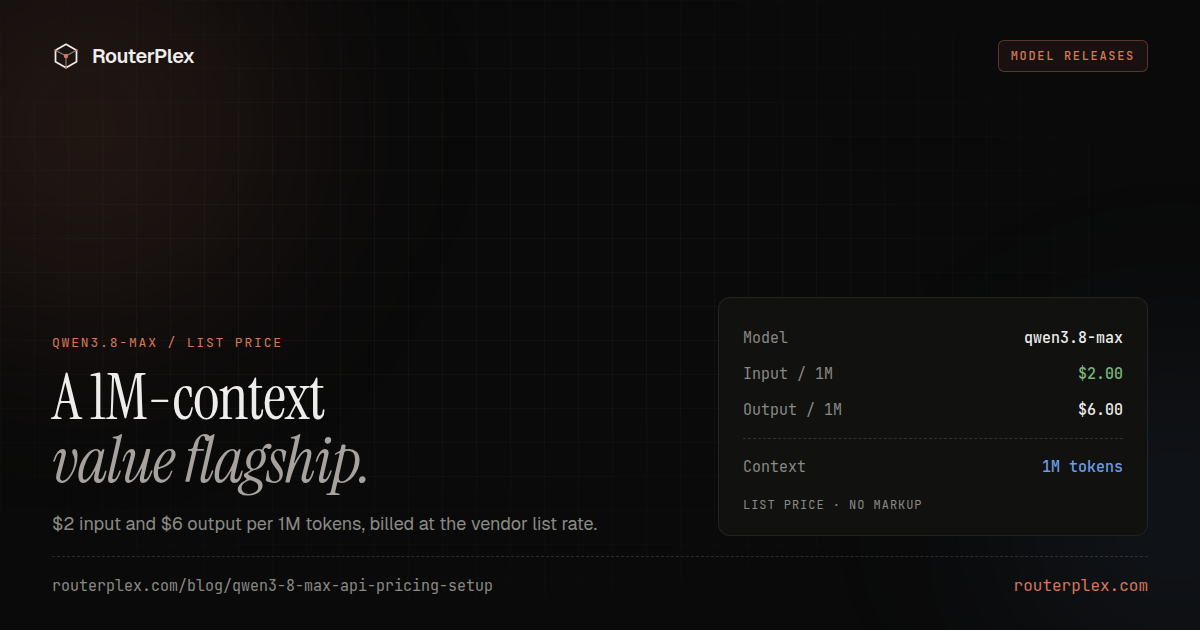
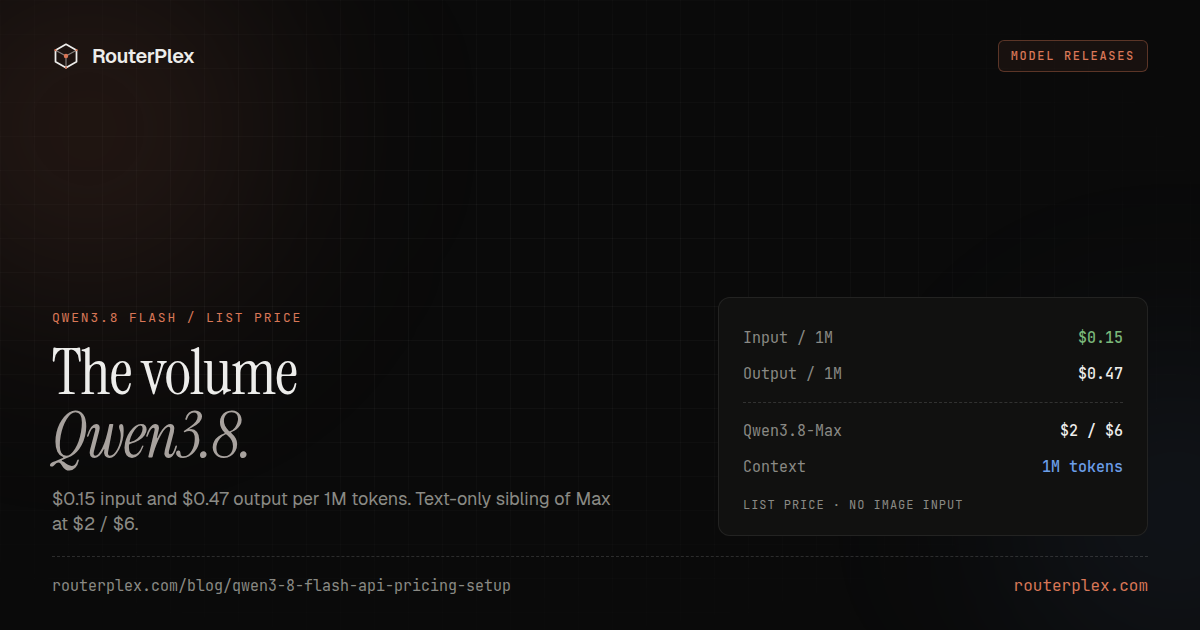
Qwen3.8-Max is Alibaba's new flagship model for software engineering, agent workloads, long-document work and image understanding. The API model ID is qwen3.8-max, the context window is 1,000,000 tokens, and the list price is $2 per 1M input tokens and $6 per 1M output tokens.
It is live on RouterPlex now, through the same OpenAI-compatible endpoint used for GPT, Claude, Gemini and the rest of the catalog — and through the Anthropic-compatible /v1/messages format, so Claude Code can point at it directly.
Sources: Alibaba's Qwen3.8-Max announcement and InfoWorld's launch coverage, checked August 4, 2026. Note that Alibaba Cloud's English Model Studio pricing page had not yet been updated with a Qwen3.8-Max row when this was written, and several third-party price trackers were still showing the July preview rates. The rate RouterPlex charges is always the one on our live Qwen3.8-Max price page.
Qwen3.8-Max API pricing #
| Token category | Price per 1M tokens |
|---|---|
| Input | $2.00 |
| Output | $6.00 |
A $5 prepaid balance buys roughly 2.5 million input tokens, or 833,333 output tokens, if a workload used only one category. Real requests mix both.
Two pricing details worth knowing before you budget:
- The preview rates are gone. Through July 2026 Qwen3.8-Max-Preview was available at promotional credit multipliers — some resellers advertised it around $0.17/$0.51 per 1M. Those were time-limited preview rates on a preview model. The generally available model bills at the standard $2/$6.
- Cache reads are billed at the standard input rate on RouterPlex. Alibaba publishes a discounted cache-read tier for this model. RouterPlex does not currently pass a separate cache tier through for
qwen3.8-max, so cached prompt tokens are billed at $2 per 1M like any other input token. If your workload leans hard on a stable cached prefix, price that in.
Qwen3.8-Max vs Claude Opus 4.8, GPT-5.6 Sol and Kimi K3 #
List prices per 1M tokens are hard to compare directly, so here is one agent turn — a 40,000-token prompt returning 2,000 tokens — priced across the frontier models RouterPlex carries:
| Model | Input / 1M | Output / 1M | Cost per turn | 1,000 turns |
|---|---|---|---|---|
| Qwen3.8-Max | $2.00 | $6.00 | $0.092 | $92.00 |
| Qwen3.7-Max | $2.50 | $7.50 | $0.115 | $115.00 |
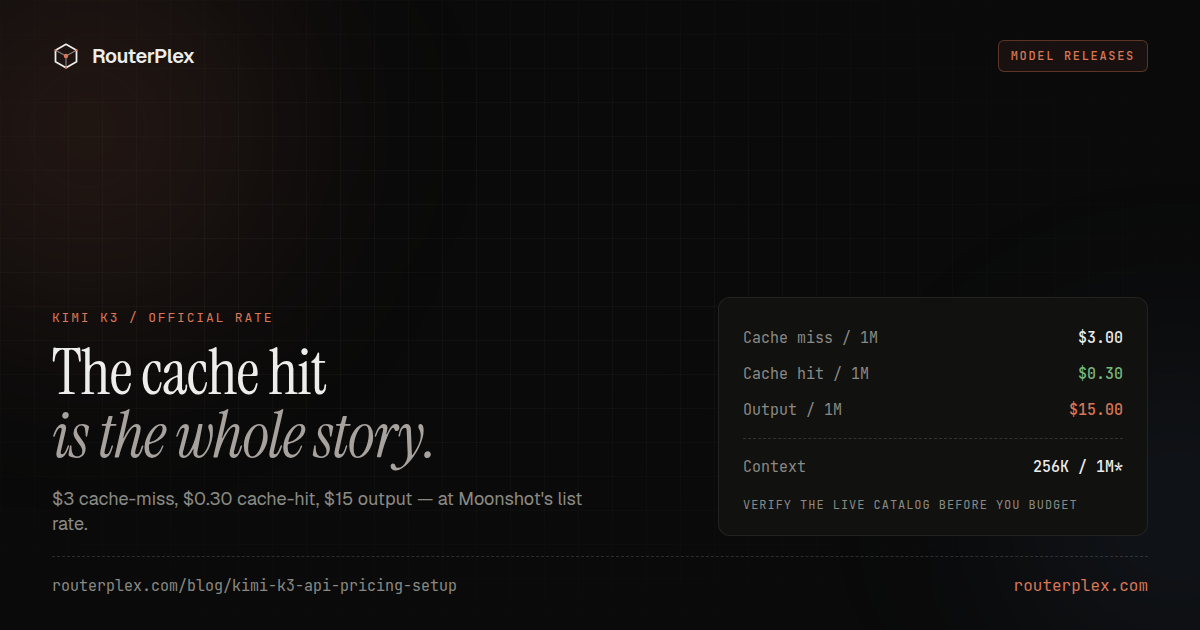
| Kimi K3 | $3.00 | $15.00 | $0.150 | $150.00 |
| Claude Opus 4.8 | $5.00 | $25.00 | $0.250 | $250.00 |
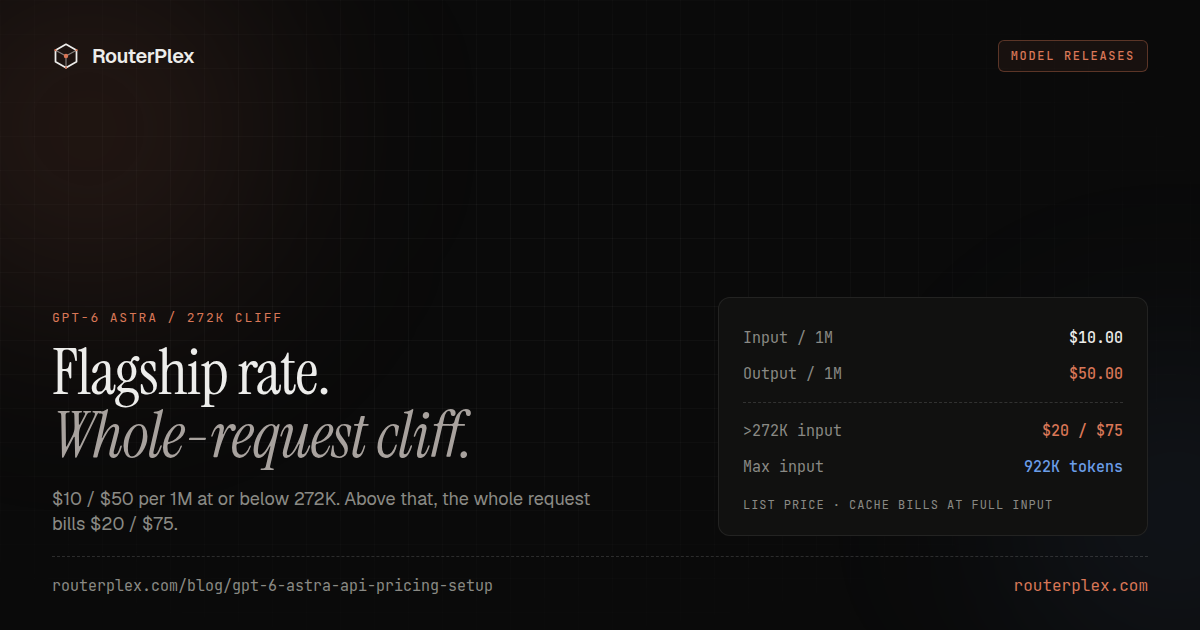
| GPT-5.6 Sol | $5.00 | $30.00 | $0.260 | $260.00 |
The arithmetic for the Qwen3.8-Max row:
40,000 input tokens × $2.00/1M = $0.0802,000 output tokens × $6.00/1M = $0.012total = $0.092
The gap widens as output grows. Qwen3.8-Max output is a quarter the price of Claude Opus 4.8 output and a fifth of GPT-5.6 Sol output, so reasoning-heavy and long-generation workloads — where the model emits thousands of tokens per turn — are where the price difference actually lands. On short, input-dominated calls the difference is smaller.
Every price in that table is the vendor's own list price, which is also what RouterPlex charges. You can check each one on its live price page: Qwen3.8-Max, Qwen3.7-Max, Kimi K3, Claude Opus 4.8, GPT-5.6 Sol.
Qwen3.8-Max specifications #
| Capability | Qwen3.8-Max |
|---|---|
| Model ID | qwen3.8-max |
| Provider | Alibaba Cloud / Qwen |
| Context window | 1,000,000 tokens |
| Max output per request | 128,000 tokens |
| Input | Text and images |
| Reasoning | Supported |
| Tool calling | Supported |
| Streaming | Supported |
| OpenAI-compatible chat API | Yes |
Anthropic-compatible /v1/messages | Yes |
Alibaba describes Qwen3.8-Max as a 2.4-trillion-parameter mixture-of-experts model activating roughly 95 billion parameters per token, and positions it against Claude Opus 4.8, Claude Fable 5 and GPT-5.6 Sol on coding evaluations. Treat vendor-run benchmarks as vendor claims: they were produced by Alibaba, on tasks Alibaba chose. RouterPlex's benchmark pages are built from LMArena snapshots and do not yet include Qwen3.8-Max — we do not publish a score until it appears in the source data.
The operationally useful facts are the ones in the table above: a million tokens of context, image input, tool calling, and both API formats.
Call Qwen3.8-Max with RouterPlex #
Create a RouterPlex key, give it a hard budget, and send a standard chat-completions request:
curl https://api.routerplex.com/v1/chat/completions \-H "Authorization: Bearer $ROUTERPLEX_API_KEY" \-H "Content-Type: application/json" \-d '{"model": "qwen3.8-max","messages": [{"role": "user", "content": "Review this migration plan and name the riskiest assumption."}]}'
The Python version uses the regular OpenAI client — only the base URL, key and model ID change:
import osfrom openai import OpenAIclient = OpenAI(api_key=os.environ["ROUTERPLEX_API_KEY"],base_url="https://api.routerplex.com/v1",)response = client.chat.completions.create(model="qwen3.8-max",messages=[{"role": "user", "content": "Design a rollback-safe deployment plan."}],)print(response.choices[0].message.content)
Image input uses the standard OpenAI content-block shape:
response = client.chat.completions.create(model="qwen3.8-max",messages=[{"role": "user","content": [{"type": "text", "text": "What is wrong with this dashboard layout?"},{"type": "image_url", "image_url": {"url": "https://example.com/dashboard.png"}},],}],)
Qwen3.8-Max in Claude Code #
Qwen3.8-Max is served on the Anthropic-compatible /v1/messages format too, so Claude Code can use it without a wrapper:
export ANTHROPIC_BASE_URL="https://api.routerplex.com"export ANTHROPIC_AUTH_TOKEN="$ROUTERPLEX_API_KEY"export ANTHROPIC_MODEL="qwen3.8-max"claude
That puts a $2/$6 model behind the Claude Code harness on a prepaid balance with a hard per-key budget. See the Claude Code with RouterPlex docs for the full walkthrough, including per-key model allowlists.
Where Qwen3.8-Max fits #
Reach for it when the task is large, long-running, or generation-heavy:
- Repository-scale code review and refactor planning across many files.
- Long-horizon agents that call tools over many turns, where output tokens accumulate.
- Large document sets, contracts or logs that need the full million-token window.
- Screenshots, diagrams and UI review mixed into technical reasoning.
It is the cheapest frontier-class option in the RouterPlex catalog on a per-turn basis, which makes it a natural first thing to A/B against a Claude or GPT workload you are already paying for. Qwen3.7-Max stays available as qwen3.7-max if you have runs pinned to it.
Run a controlled test #
Take one narrow workload, create a dedicated key with a hard lifetime budget, and compare answer quality, latency and total cost against whatever you run today. The budget cap means the experiment cannot overrun, whatever the agent does.
Create a RouterPlex account, add the $5 minimum balance, and select qwen3.8-max. You can compare it with Kimi K3, Claude Opus 5 and GPT-5.6 through the same endpoint and the same balance.
Common questions
Frequently asked questions
How much does the Qwen3.8-Max API cost?
Alibaba lists Qwen3.8-Max at $2 per 1M input tokens and $6 per 1M output tokens. RouterPlex bills the same list rates with no markup on the per-token price.
What is the Qwen3.8-Max context window?
Qwen3.8-Max supports a 1,000,000-token context window. On RouterPlex the per-request output cap is 128,000 tokens.
Does Qwen3.8-Max support image input?
Yes. Qwen3.8-Max is multimodal and accepts images in chat messages alongside text, using the standard OpenAI image_url content block.
Can I use Qwen3.8-Max with the OpenAI SDK?
Yes. Point the OpenAI SDK at https://api.routerplex.com/v1 and use model ID qwen3.8-max. The Anthropic SDK and Claude Code also work against https://api.routerplex.com via /v1/messages.
Is Qwen3.8-Max cheaper than Claude Opus 4.8 or GPT-5.6 Sol?
On list price, yes. Qwen3.8-Max is $2/$6 per 1M input/output tokens against $5/$25 for Claude Opus 4.8 and $5/$30 for GPT-5.6 Sol. On a 40K-in / 2K-out agent turn that is $0.092 versus $0.250 and $0.260.
Is Qwen3.8-Max the same as Qwen3.8-Max-Preview?
No. The preview ran on heavily discounted promotional credit rates during July 2026. The generally available Qwen3.8-Max is billed at the standard $2/$6 list price, and that is the model RouterPlex serves as qwen3.8-max.
Run the smallest paid test.
Add $5, cap the key, and verify the result with your own workload. No subscription, and credit never expires — a first top-up of $25+ is matched with $25 extra.