Gemini 3.8 Flash-Lite TTS API: Pricing and Setup
Gemini 3.8 Flash-Lite TTS is $0.50 text in and $6 audio out per 1M through 31 Dec 2026. Not on RouterPlex yet. Register for 60+ models.
Gemini 3.8 Flash-Lite TTS is Google's high-throughput speech model, published with Gemini 3.8 Flash TTS on 23 September 2026. The API id is gemini-3.8-flash-lite-tts. Standard paid pricing through 31 December 2026 is $0.50 per 1M text input tokens and $6.00 per 1M audio output tokens.
Flash-Lite TTS is not on RouterPlex yet. Register and use the current 60+ models now. The new speech model is on this marketplace once the row is live. The same prepaid key, 0% markup, $0 top-up fee, and hard spend limit apply to listed models today.
Sources: Google's 23 September 2026 TTS post, the Flash TTS docs comparison table, and Gemini API pricing, checked 28 September 2026.
Gemini 3.8 Flash-Lite TTS API pricing #
Audio tokens are 25 per second. $6.00 × 250 / 1,000,000 = $0.0015 per 10 seconds, which is the equivalent Google prints for the 2026 standard rate.
| Tier | Through 31 Dec 2026 | From 1 Jan 2027 |
|---|---|---|
| Standard input, text | $0.50 | $1.00 |
| Standard output, audio | $6.00 | $12.00 |
| Standard, per 10 seconds | $0.0015 | $0.003 |
| Standard cache, input | $0.125 | $0.25 |
| Batch or Flex input | $0.25 | $0.50 |
| Batch or Flex output | $3.00 | $6.00 |
| Batch or Flex, per 10 seconds | $0.00075 | $0.0015 |
| Priority input | $0.90 | $1.80 |
| Priority output | $10.80 | $21.60 |
| Priority, per 10 seconds | $0.0027 | $0.0054 |
Input matches Flash TTS. Output is the discount: $6 versus $9 on standard through 31 December 2026. Cache storage is $0.50 per 1M tokens per hour through that date, then $1.00, same as Flash. Flex cache input is $0.025 then $0.05. Batch cache input is $0.0625 then $0.125. Priority cache input is $0.225 then $0.45.
Google's standard free tier is free of charge and marked used to improve Google's products. Paid is marked not used that way. That free tier is not a RouterPlex credit.
Flash TTS versus Flash-Lite TTS #
| Flash TTS | Flash-Lite TTS | |
|---|---|---|
| Model id | gemini-3.8-flash-tts | gemini-3.8-flash-lite-tts |
| Google's job | Maximum fidelity, acting, dialects | Throughput, latency, cost |
| Languages on the comparison table | 130 | 101 |
| Replaces | New creative tier | gemini-3.1-flash-tts-preview |
| Standard audio out, through 31 Dec 2026 | $9 / 1M | $6 / 1M |
| Token caps copied here | 8,192 in / 16,384 out | Not copied from Flash |
The comparison table is the source for the 101-language count and the shared schema. Check Lite's own model page for its token limits rather than assuming Flash's.
Both models return WAV with a RIFF header on unary requests by default. Both want style and speaker in speech_metadata. Point events stay in the transcript: a laugh, a sigh, a short pause. Function calling, thinking, and the Live API are unsupported on the Flash TTS model card. Lite uses the same schema. Gemini 3.8 Live is the separate live-audio product.
Google's blog says Flash-Lite is the high-volume tier for dubbing, audio content, and voice agents, and that the pair took the number 1 and number 2 spots on Hume's Overall Quality Index. The Voice Design chart on that post is Flash TTS versus ElevenLabs Voice Design v3 and Inworld, not a Lite column. Those numbers are on the Flash TTS guide.
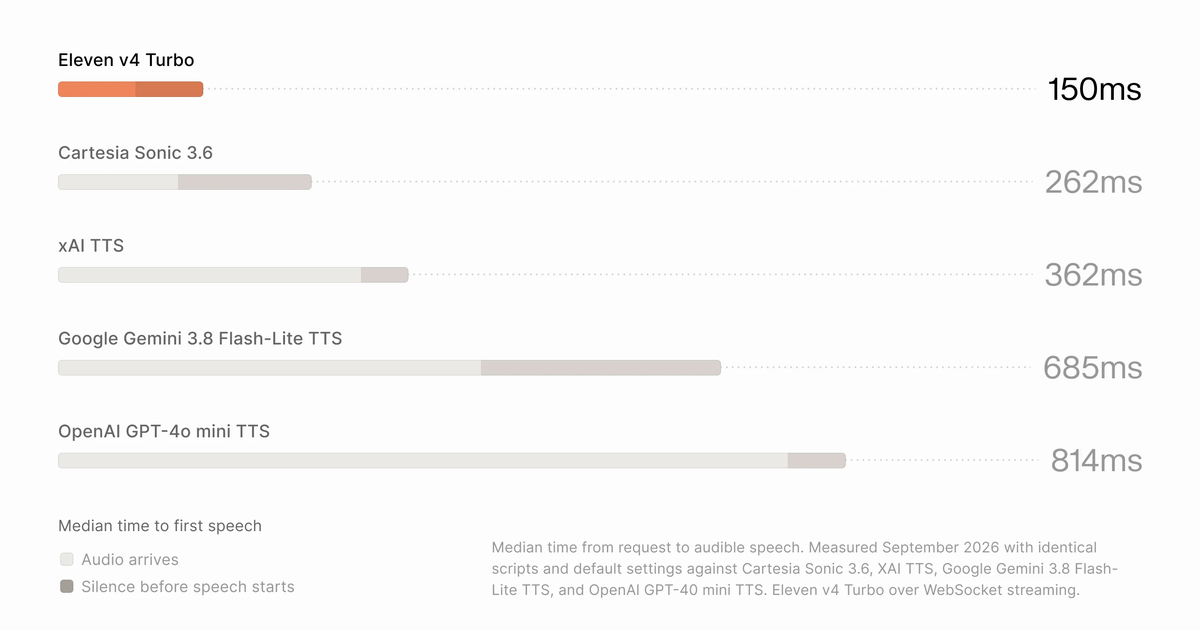
ElevenLabs' latency chart puts a 685 ms median time to first speech on Gemini 3.8 Flash-Lite TTS, against 150 ms for Eleven v4 Turbo. That is ElevenLabs' September 2026 measurement, WebSocket for Turbo, network removed in their footnote. It is not a Google latency spec.
Call a live model today #
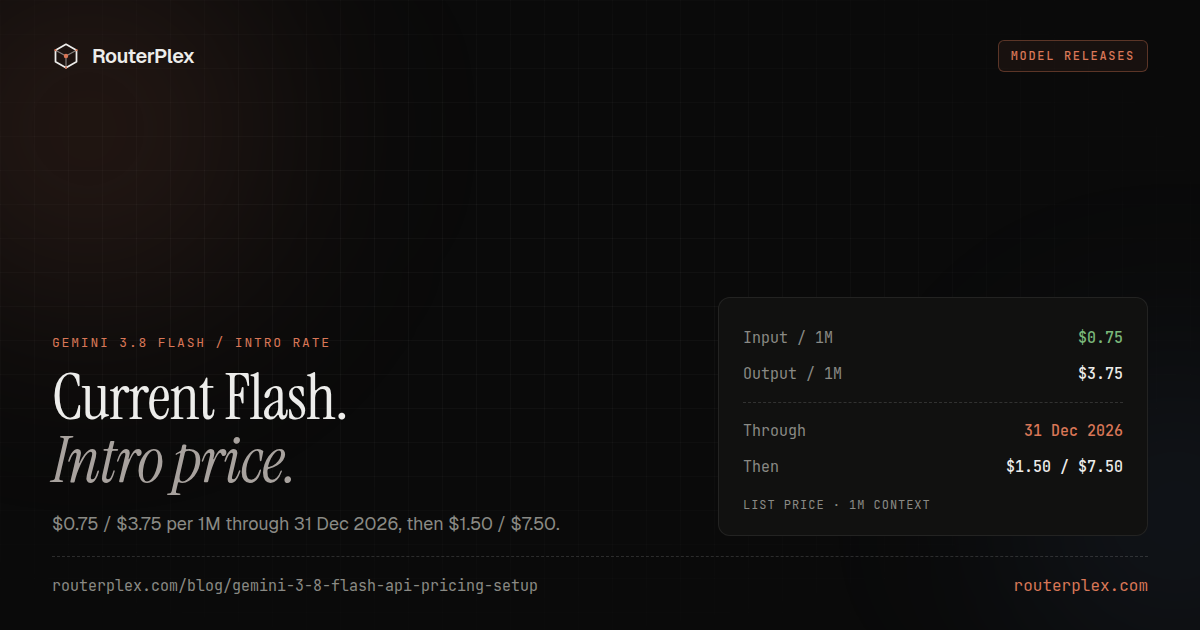
gemini-3.8-flash is the chat model at $0.75 / $3.75 per 1M. It will not synthesize this script.
curl https://api.routerplex.com/v1/chat/completions \-H "Authorization: Bearer $ROUTERPLEX_API_KEY" \-H "Content-Type: application/json" \-d '{"model": "gemini-3.8-flash","messages": [{"role": "user", "content": "Rewrite this support reply in one spoken sentence."}]}'
On RouterPlex, once it is listed #
The route will be named on the catalog the day it exists, at vendor list price with 0% markup. The balance is prepaid and the key has a hard spend limit. Create an account for the 60+ models already live, and add gemini-3.8-flash-lite-tts when this marketplace carries it. The OpenAI-compatible API is how listed chat models are called today.
Common questions
Frequently asked questions
How much does Gemini 3.8 Flash-Lite TTS cost?
Google's standard paid rate through 31 December 2026 is $0.50 per 1M text input tokens and $6.00 per 1M audio output tokens, then $1.00 and $12.00 from 1 January 2027. The page equates 2026 audio output to $0.0015 per 10 seconds. RouterPlex does not bill this model.
What is the model ID?
gemini-3.8-flash-lite-tts. Google recommends it as the replacement for gemini-3.1-flash-tts-preview. It shares the Flash TTS request schema. Check the Lite model page for its token limits; they can differ from Flash's 8,192 input and 16,384 output tokens.
Is Flash-Lite TTS on RouterPlex?
Not yet. Register for the current 60+ models. The live gemini-3.8-flash chat route is $0.75/$3.75 and does not return audio. Flash-Lite TTS is available here once the marketplace lists it.
How many languages does Flash-Lite TTS support?
Google's comparison table says 101 languages, against 130 for Gemini 3.8 Flash TTS. The shared schema, WAV default, and speech_metadata rules apply to both.
When should I pick Flash-Lite TTS instead of Flash TTS?
Google's table assigns Flash-Lite to high throughput, low latency, and cost: high-volume production, voice-agent cascades, read-aloud, and everyday single-speaker lines. Flash TTS is the creative tier. Standard audio output is $6 per 1M tokens versus $9 through 31 December 2026.
Run the smallest paid test.
Add $5, cap the key, and verify the result with your own workload. No subscription, and credit never expires — a first top-up of $25+ is matched with $25 extra.