Gemini 4 Carbon: Benchmarks, API Pricing and Access
Gemini 4 Carbon costs $2/$10 per 1M tokens at launch, then $4/$20. Google's full benchmark table, cyber results, and who can use it now.
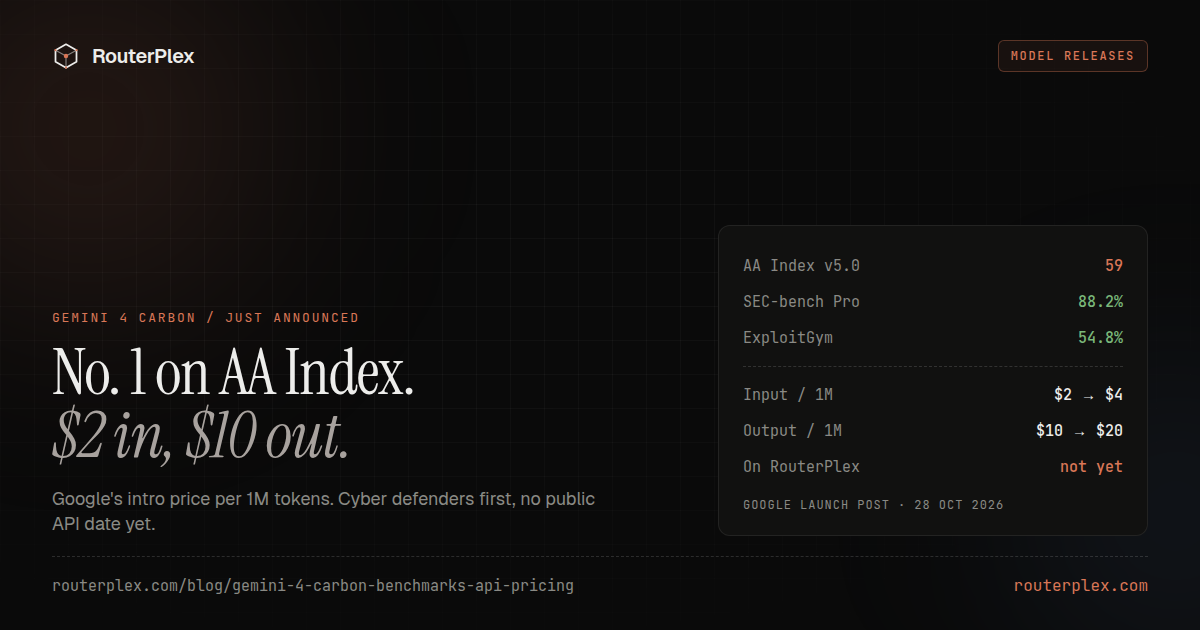
Google announced Gemini 4 Carbon on 28 October 2026. Google calls it its strongest model, with a focus on cybersecurity and long, multi-day coding tasks. Carbon ranks first on the Artificial Analysis Intelligence Index v5.0 with a score of 59. The introductory API price is $2 per 1M input tokens and $10 per 1M output tokens, the same as Gemini 4 Argon. Later it rises to $4 / $20.
You cannot call it yet. Google is giving Carbon first to a small group of cyber defenders through its Fairwind Program. Developers, businesses and consumers come later, with no date. Gemini 4 Carbon is not on RouterPlex yet. If you need a model for authorized security work today, RouterPlex hosts three abliterated models that answer the security questions stock models often refuse.

Checked 28 October 2026: Google's Gemini 4 Carbon announcement by Koray Kavukcuoglu, Google DeepMind's Carbon evaluation methodology, the Fairwind Program page, and the live RouterPlex catalog. Every score here is Google's. The images are Google's launch graphics. RouterPlex has not re-run these evals.
Gemini 4 Carbon at a glance #
| Gemini 4 Carbon | |
|---|---|
| Announced | 28 October 2026 |
| Maker | Google DeepMind |
| Who can use it now | A subset of cyber defenders, via the Fairwind Program |
| Public API | Not yet. Google says "as soon as possible", no date |
| Model ID | Not published |
| Intro API price | $2 input / $10 output per 1M tokens |
| Price after the intro period | $4 input / $20 output per 1M tokens |
| Cached input | 95% off input ($0.10 per 1M at the intro rate) |
| Context window | Not published |
| On RouterPlex | Not on RouterPlex yet |
The intro period has no published end date. For Argon, the intro rate ran to 30 November 2026. Carbon may or may not share that date.
Gemini 4 Carbon API pricing #
Google lists the same intro price as Argon: $2 per 1M input tokens and $10 per 1M output tokens. A footnote says the rates are temporary. After the intro period they become $4 input and $20 output per 1M.
Cached input (prompt tokens the provider has seen recently) costs 95% less than fresh input. At the intro rate that is $0.10 per 1M. The cached rate after the intro period is not published yet. On Argon it was $0.20.
Here is what one call would cost at the list price. A turn with 40,000 input tokens and 2,000 output tokens costs $0.10 at the intro rate and $0.20 after it. Thinking tokens bill as output on Gemini models, so a high thinking setting raises the output side. Google ran its own benchmarks at the highest thinking setting.
Nobody can buy Carbon on the public Gemini API yet, so these prices only matter once access opens.
Gemini 4 Carbon benchmarks #
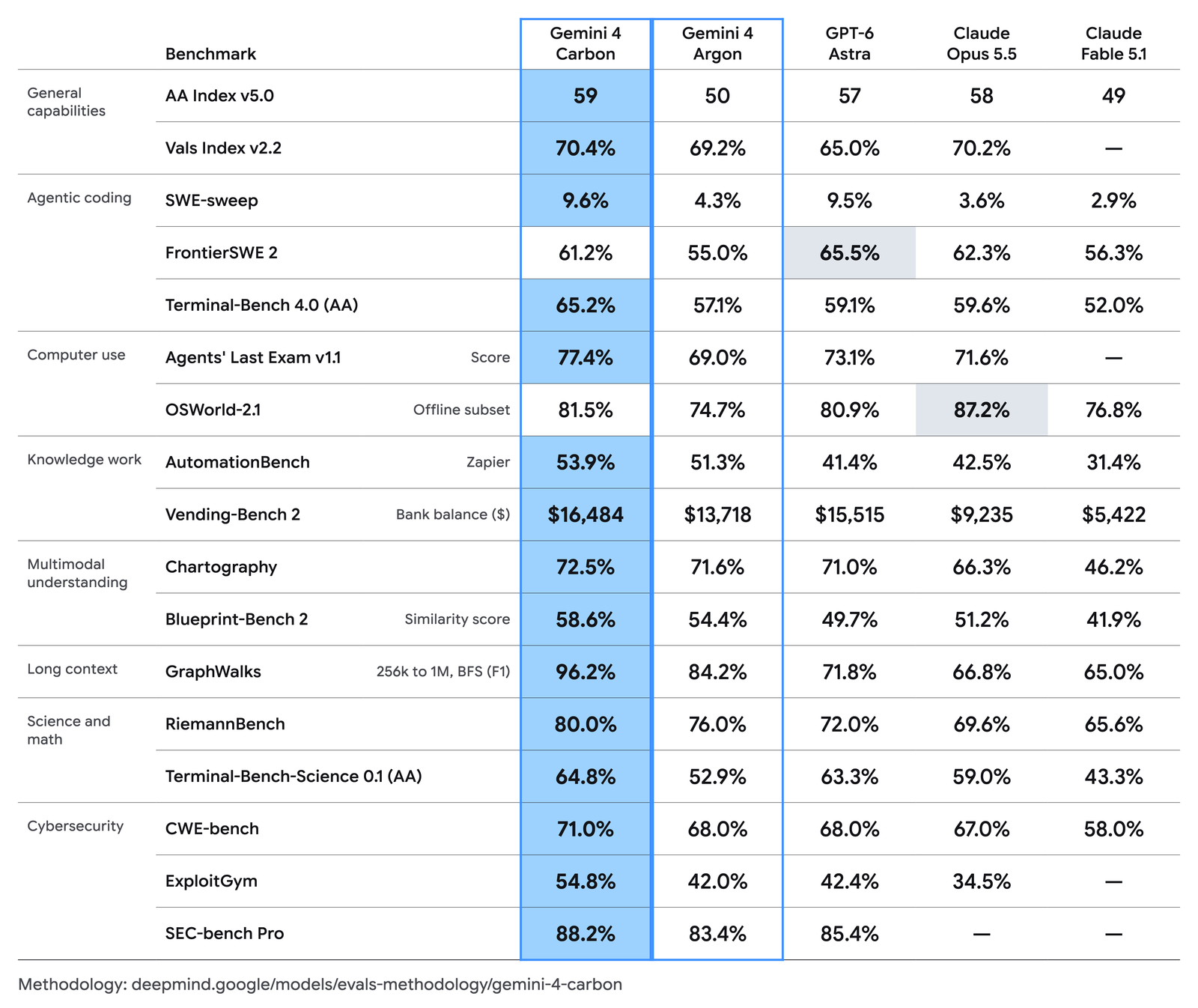
This is Google's full launch table. Blue cells mark Carbon as the best score. Grey cells mark another model's lead.
The same numbers as text, so you can search and copy them:
| Benchmark | Gemini 4 Carbon | Gemini 4 Argon | GPT-6 Astra | Claude Opus 5.5 | Claude Fable 5.1 |
|---|---|---|---|---|---|
| AA Index v5.0 | 59 | 50 | 57 | 58 | 49 |
| Vals Index v2.2 | 70.4% | 69.2% | 65.0% | 70.2% | n/a |
| SWE-sweep | 9.6% | 4.3% | 9.5% | 3.6% | 2.9% |
| FrontierSWE 2 | 61.2% | 55.0% | 65.5% | 62.3% | 56.3% |
| Terminal-Bench 4.0 (AA) | 65.2% | 57.1% | 59.1% | 59.6% | 52.0% |
| Agents' Last Exam v1.1 | 77.4% | 69.0% | 73.1% | 71.6% | n/a |
| OSWorld-2.1 (offline subset) | 81.5% | 74.7% | 80.9% | 87.2% | 76.8% |
| AutomationBench | 53.9% | 51.3% | 41.4% | 42.5% | 31.4% |
| Vending-Bench 2 (bank balance) | $16,484 | $13,718 | $15,515 | $9,235 | $5,422 |
| Chartography | 72.5% | 71.6% | 71.0% | 66.3% | 46.2% |
| Blueprint-Bench 2 | 58.6% | 54.4% | 49.7% | 51.2% | 41.9% |
| GraphWalks 256K to 1M (BFS F1) | 96.2% | 84.2% | 71.8% | 66.8% | 65.0% |
| RiemannBench | 80.0% | 76.0% | 72.0% | 69.6% | 65.6% |
| Terminal-Bench Science 0.1 (AA) | 64.8% | 52.9% | 63.3% | 59.0% | 43.3% |
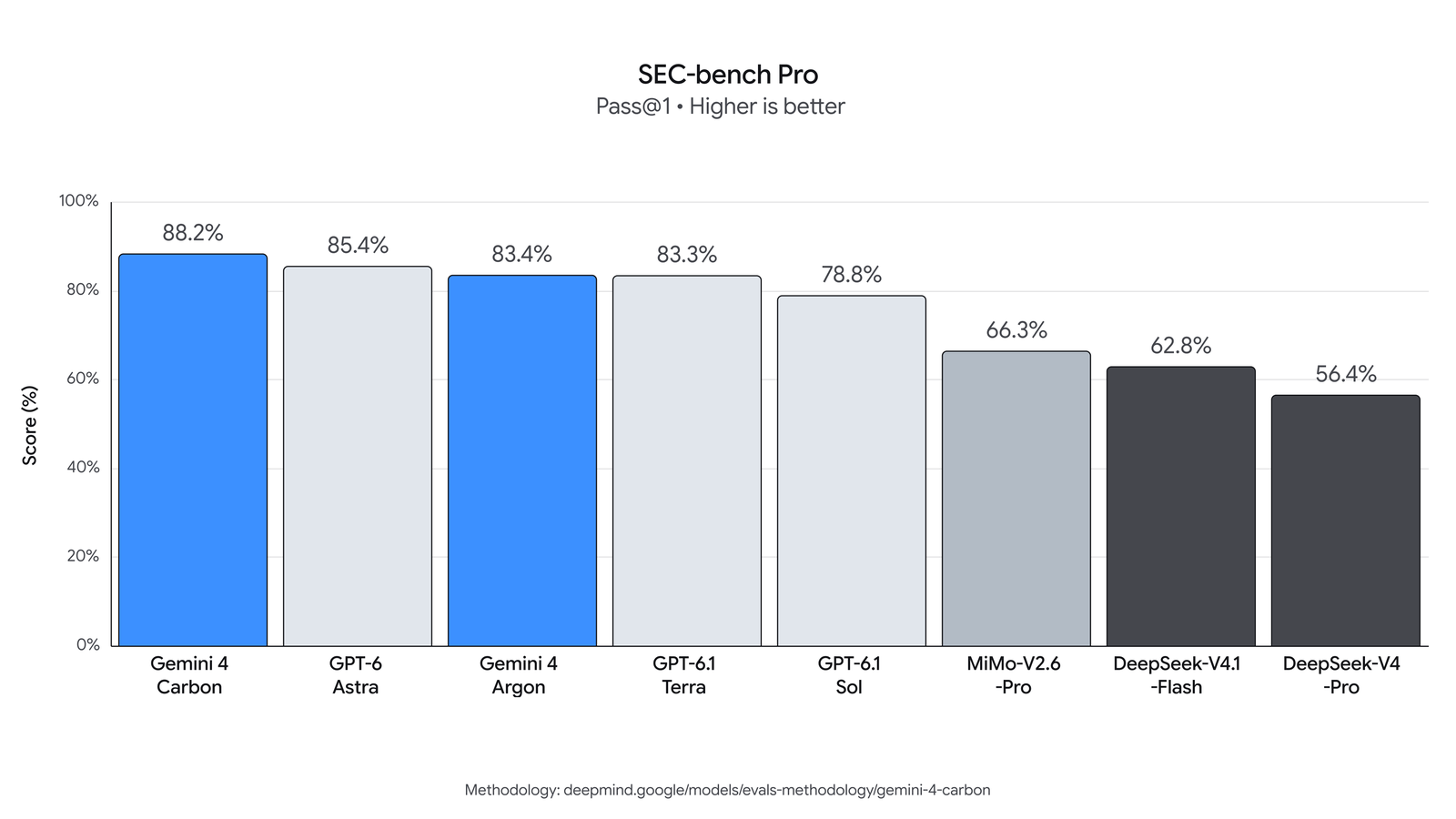
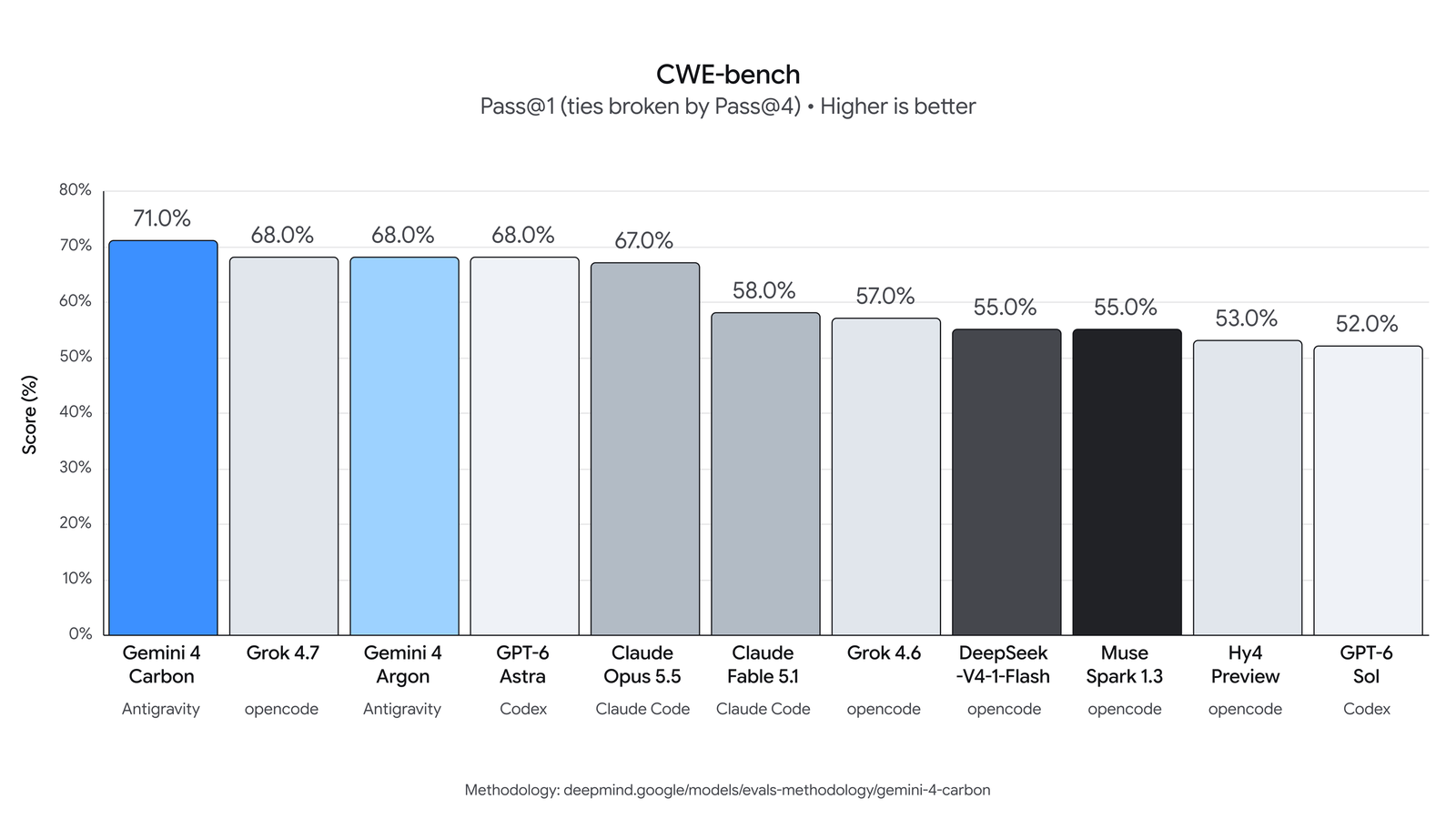
| CWE-bench | 71.0% | 68.0% | 68.0% | 67.0% | 58.0% |
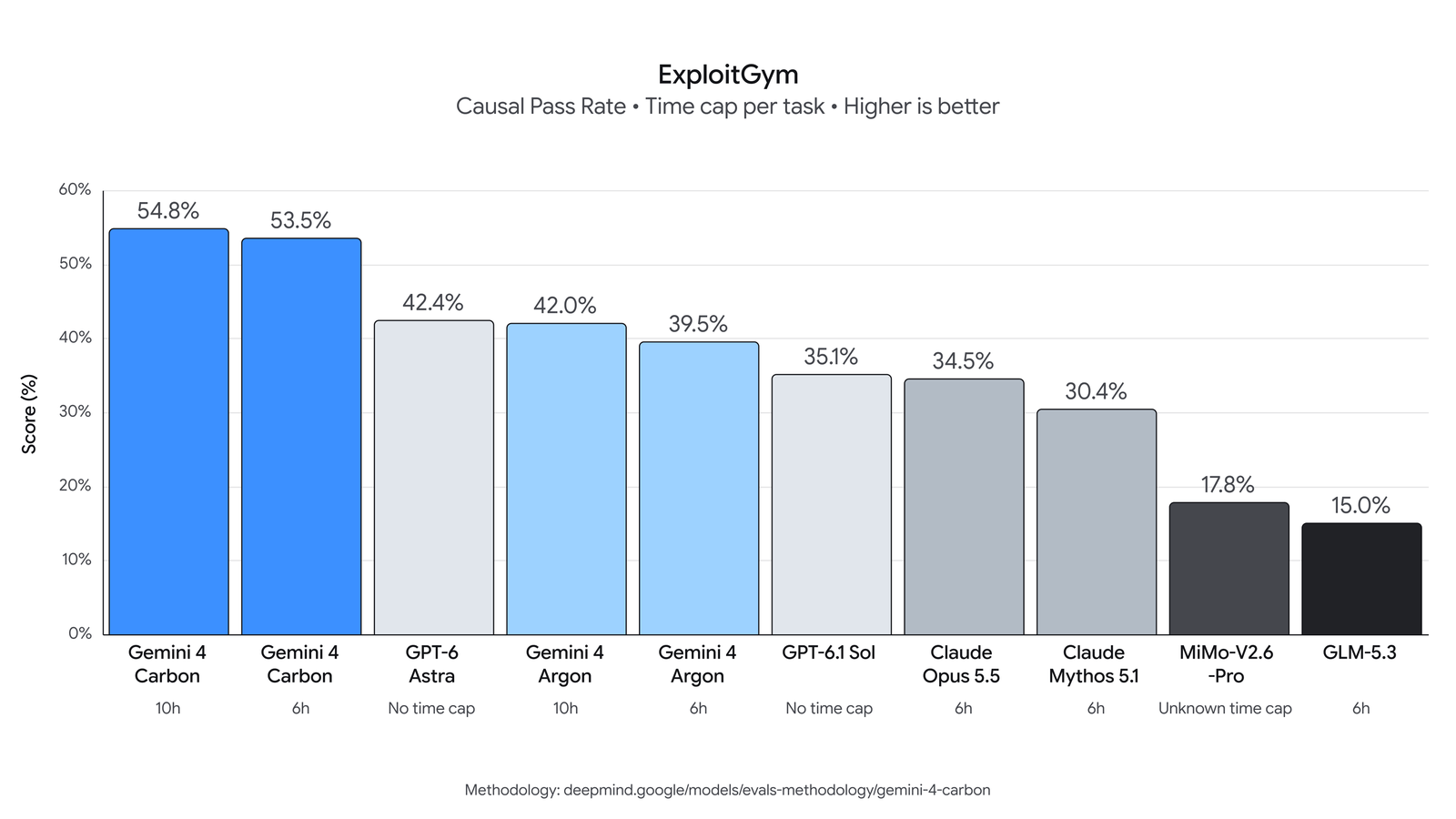
| ExploitGym | 54.8% | 42.0% | 42.4% | 34.5% | n/a |
| SEC-bench Pro | 88.2% | 83.4% | 85.4% | n/a | n/a |
Carbon leads 15 of 17 rows. It trails on FrontierSWE 2, where GPT-6 Astra scores 65.5%. It also trails on OSWorld-2.1, where Claude Opus 5.5 scores 87.2%. The biggest jump over Argon is long context. On GraphWalks between 256K and 1M tokens, Carbon scores 96.2% against Argon's 84.2%.
Google computed many of the Gemini scores itself and took rival scores from vendor reports and public leaderboards. The methodology page lists the source for each row.
Gemini 4 Carbon cybersecurity results #
Google built Carbon to find, check and fix security bugs. The three security charts cover each step.
Finding bugs: SEC-bench Pro
SEC-bench Pro asks a model to write a proof of concept that crashes a vulnerable build of a JavaScript engine. Carbon passes 88.2% of the 183 tasks. GPT-6 Astra scores 85.4% and Argon 83.4%.
Exploiting bugs: ExploitGym
On ExploitGym a task counts only when the exploit captures the target flag. Google ran it with mitigations off and no internet. Carbon solves 54.8% with a 10-hour cap and 53.5% with 6 hours. GPT-6 Astra scores 42.4%.
Fixing bugs: CWE-bench
CWE-bench measures patches for known weakness types. Carbon scores 71.0%. Grok 4.7, Argon and GPT-6 Astra tie at 68.0%.
Google also reports more than 2x better secure code generation than Argon on internal tests. The Chrome team reports over 10x more high-quality patches than another lab's frontier model. Those two claims come with no public numbers.
Prompt injection: the Gray Swan result #
Prompt injection is when a web page, file or email hides instructions that hijack an agent. Gray Swan's indirect prompt injection test counts how often an attack works within 15 tries. Lower is better.
Carbon scores 0%, the only zero on the chart. Argon allows 0.7%, Claude Opus 5.5 1.0%, and GPT-6.1 Sol 8.6%. Open models do much worse here. GLM 5.3 allows 31.5% and Kimi K3 52.7%.
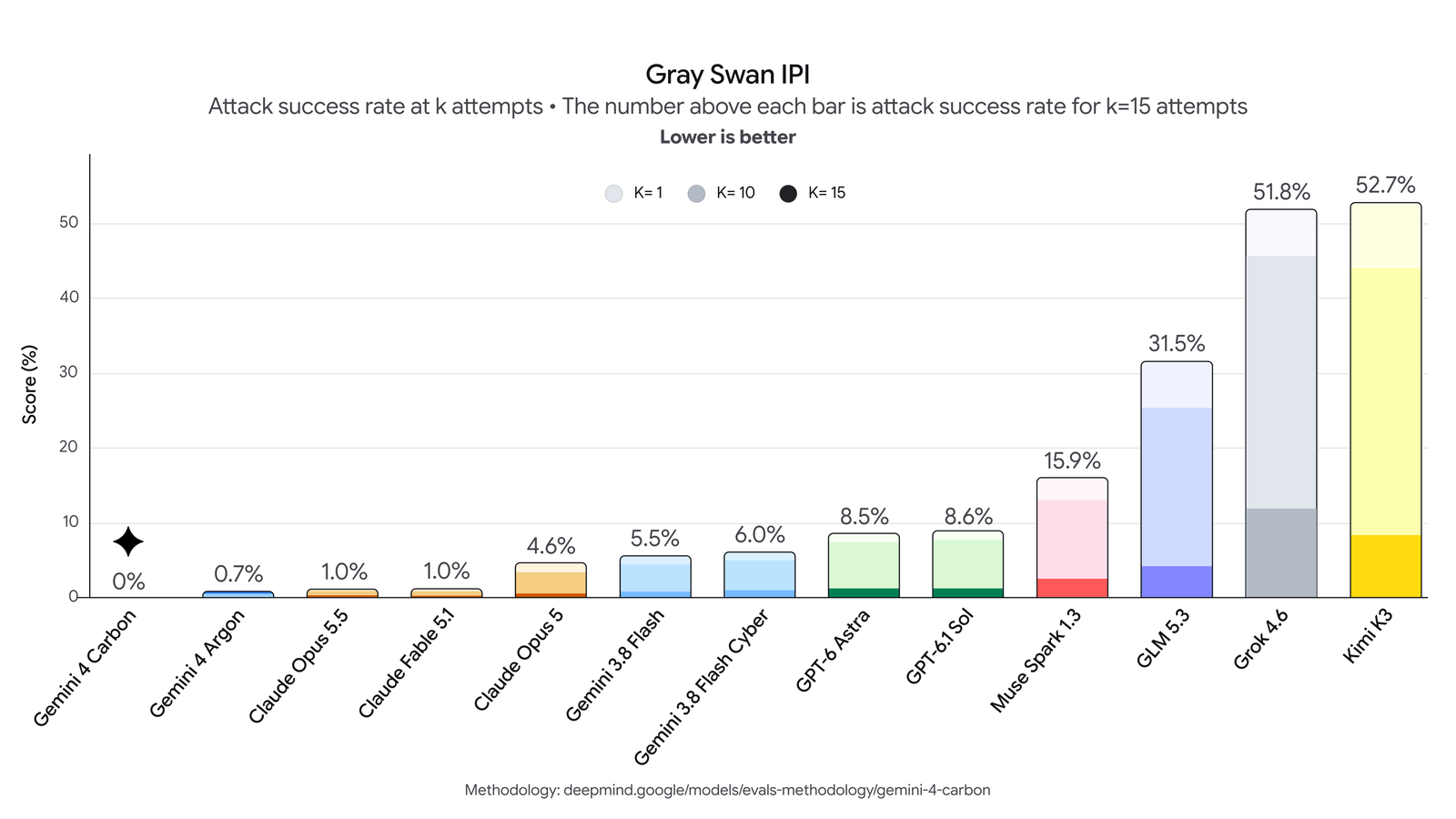
That matters if your agent reads untrusted pages or repos. Keep agents built on open models in a sandbox, and give them no secrets they do not need.
Gemini 4 Carbon release date and access #
Google gave no public release date. Access comes in stages.
- Now, a subset of cyber defenders, starting the week of 28 October 2026.
- Next, more trusted partners through the Fairwind Program.
- Later, developers, businesses and consumers, "as soon as possible" after more feedback and guardrail work.
Fairwind is for approved partners only. Google names governments, national cyber agencies, critical infrastructure operators and core tech platforms first. Academic labs doing defensive benchmarks can apply. Partners go through background checks. Only security, incident response and pentest teams may use the access, and it cannot be resold.
So an indie researcher or a small security shop should not plan around Carbon this quarter. Argon took 13 days to move from announcement to the paid Gemini API. There is no promise of the same pace for Carbon.
Can I use Gemini 4 Carbon on RouterPlex? #
No. Gemini 4 Carbon is not on RouterPlex yet, because Google has not opened a public API. Separately, Gemini routes on RouterPlex are paused until further notice, as the models page states. Every other model works normally.
We will update this post if either changes. Until then, the honest answer for security work is the abliterated routes below.
Abliterated models for security work today #
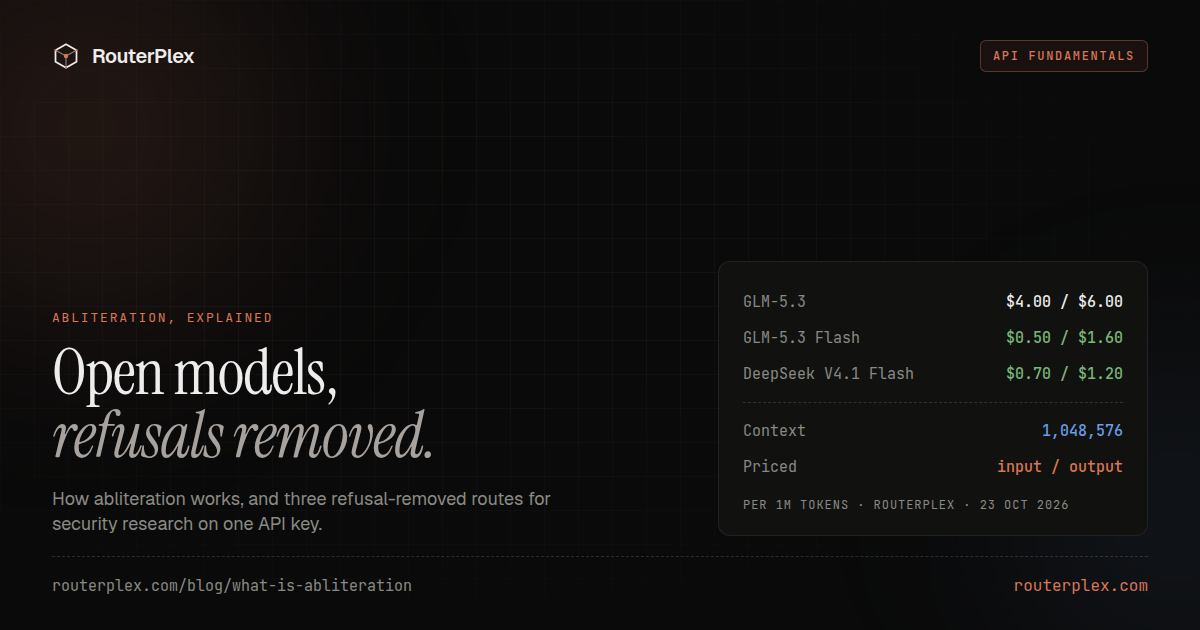
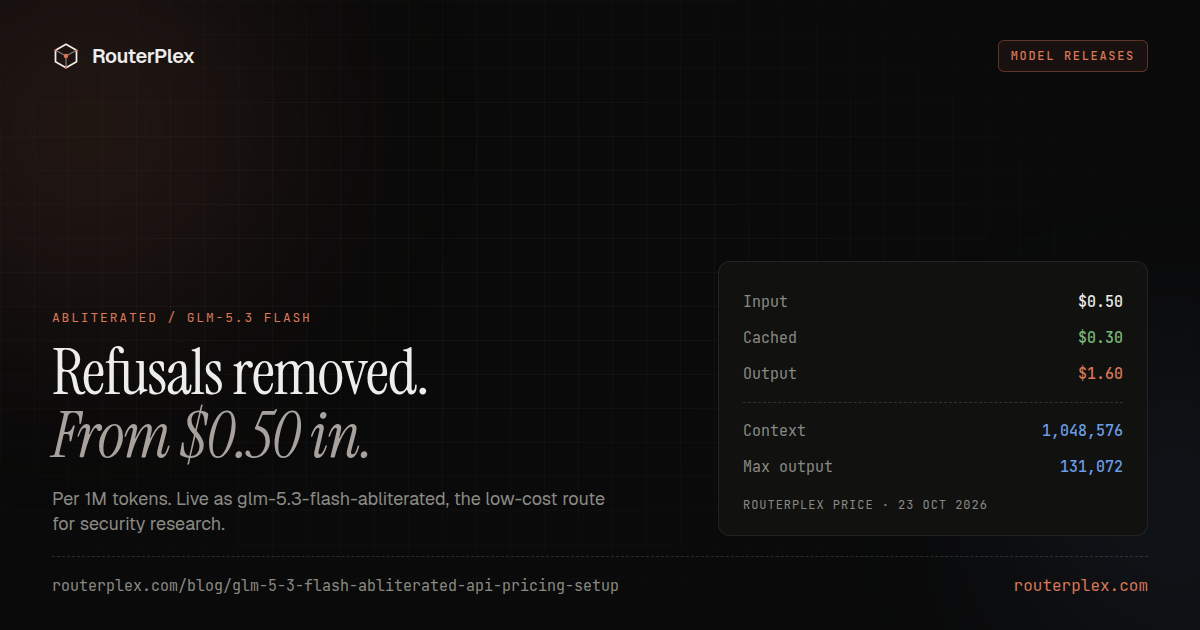
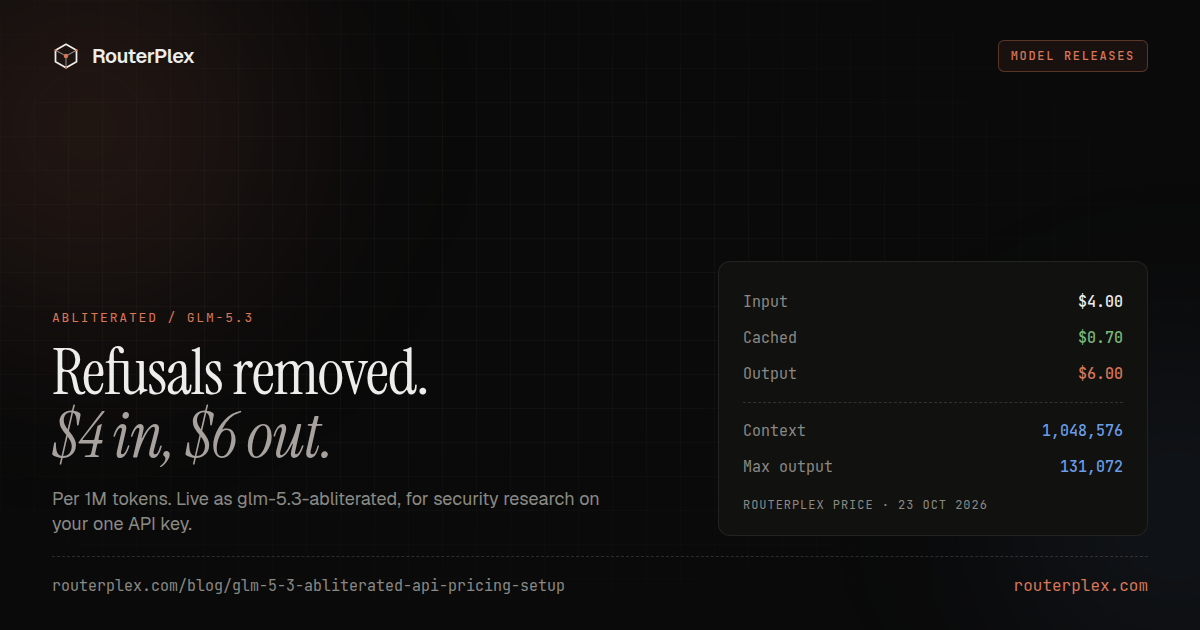
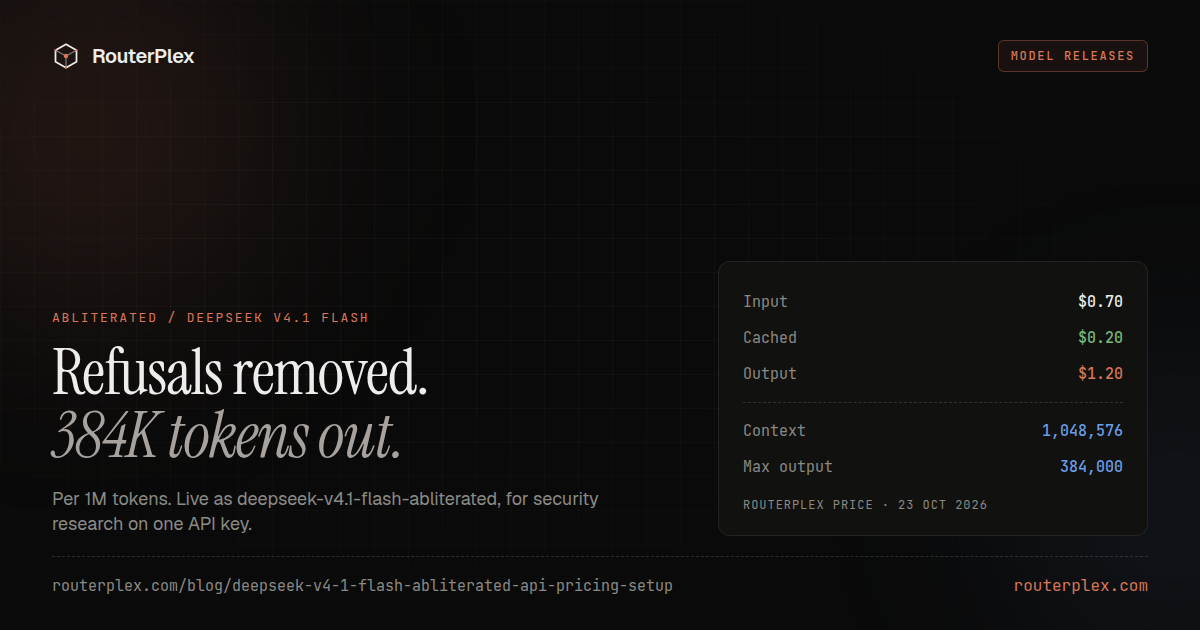
Abliteration is a weight edit that removes a model's refusal behaviour. The model then answers security questions that stock models often decline. RouterPlex hosts three abliterated routes. USD per 1M tokens, from the RouterPlex catalog, checked 28 October 2026.
| Model id | Input | Cache read | Output | Max output | Page |
|---|---|---|---|---|---|
glm-5.3-abliterated | $4.00 | $0.70 | $6.00 | 131,072 | page |
glm-5.3-flash-abliterated | $0.50 | $0.30 | $1.60 | 131,072 | page |
deepseek-v4.1-flash-abliterated | $0.70 | $0.20 | $1.20 | 384,000 | page |
Each route has a 1M-token context, tool calling and image input. RouterPlex sets these prices. They are not a vendor list price.
Security teams use them for work they are authorized to do.
- Red-teaming their own LLM apps with real attack prompts.
- Drafting pentest plans and reports for systems in scope.
- Reading how a disclosed CVE works, then writing detection rules and patches.
- Triage of suspicious scripts, logs and malware samples during incident response.
- Practice on CTF challenges.
Be clear about the gap. Abliteration removes refusals. It does not add skill. On Google's own ExploitGym chart, stock GLM-5.3 solves 15.0% against Carbon's 54.8%. On SEC-bench Pro, stock DeepSeek-V4.1-Flash scores 62.8% against 88.2%. What you get today is a capable model that answers the question, at a price you can see.
Call an abliterated model with the API #
Set ROUTERPLEX_API_KEY in your environment. Never paste a key into code. This call uses the cheapest route. Swap the model id for either of the other two.
curl https://api.routerplex.com/v1/chat/completions \-H "Authorization: Bearer $ROUTERPLEX_API_KEY" \-H "Content-Type: application/json" \-d '{"model": "glm-5.3-flash-abliterated","messages": [{"role": "system", "content": "You assist an authorized penetration test. Scope: staging.example.com only."},{"role": "user", "content": "Explain how CVE-2021-44228 works and write a Sigma rule that detects exploitation attempts in web server logs."}]}'
The same key works with the OpenAI SDK at https://api.routerplex.com/v1 and the Anthropic SDK at https://api.routerplex.com. That means you can point Claude Code, Codex CLI or OpenCode at an abliterated route and keep your agent setup.
Where it goes wrong #
HTTP 503 on a Gemini model id
Gemini routes on RouterPlex are paused. Use a model from the catalog that is live.
HTTP 402 on an abliterated route
Abliterated routes bill from paid top-up credit only. Bonus and match credit do not cover them, and neither does the $1 trial. Add a top-up and retry.
HTTP 402 on any route
Your balance hit $0, or your key hit its spend cap. The balance never goes negative. Top up or raise the cap.
Slow replies on DeepSeek
deepseek-v4.1-flash-abliterated can take 18 to 60 seconds. Raise your client timeout.
Model not found
Use the exact id, with the dot: glm-5.3-flash-abliterated.
Next step #
Create a RouterPlex account, add a $5 top-up with a $0 fee, set a hard spend cap on the key, and call glm-5.3-flash-abliterated. The same key reaches the rest of the model catalog. The terms apply to every request, and you are responsible for staying in scope.
Common questions
Frequently asked questions
What is Gemini 4 Carbon?
Gemini 4 Carbon is Google DeepMind's new frontier model, announced on 28 October 2026 by Koray Kavukcuoglu. Google calls it its strongest model, with a focus on cybersecurity and long coding tasks that can run for days. It ranks first on the Artificial Analysis Intelligence Index v5.0 with 59 points, ahead of Claude Opus 5.5 at 58 and GPT-6 Astra at 57.
How much does the Gemini 4 Carbon API cost?
Google's introductory price is $2 per 1M input tokens and $10 per 1M output tokens, the same as Gemini 4 Argon. Cached input is 95% off, or $0.10 per 1M at the intro rate. After the intro period the price becomes $4 input and $20 output per 1M. Google has not said when the intro period ends. Checked 28 October 2026.
When is the Gemini 4 Carbon release date for developers?
Google has not given one. Since 28 October 2026 a subset of cyber defenders can use Carbon, and more trusted partners join through the Fairwind Program. Developers, businesses and consumers come later, which Google describes only as as soon as possible. For comparison, Gemini 4 Argon reached the paid Gemini API 13 days after its announcement.
How good is Gemini 4 Carbon at cybersecurity?
In Google's own tests, Carbon scores 88.2% on SEC-bench Pro for finding bugs, 54.8% on ExploitGym for exploiting them, and 71.0% on CWE-bench for patching them. Each is the top score on Google's charts. Google ran the security evals without guardrails. RouterPlex has not re-run them.
Is Gemini 4 Carbon on RouterPlex?
No. Gemini 4 Carbon is not on RouterPlex yet, because Google has not opened a public API. Gemini routes on RouterPlex are also paused until further notice. For authorized security work today, RouterPlex hosts three abliterated models: glm-5.3-abliterated, glm-5.3-flash-abliterated and deepseek-v4.1-flash-abliterated.
What can I use instead of Gemini 4 Carbon for security research?
On RouterPlex, the abliterated routes answer security questions that stock models often refuse, such as red-teaming your own apps, CVE analysis, and pentest reports for systems you are allowed to test. glm-5.3-flash-abliterated costs $0.50 input and $1.60 output per 1M tokens. They are weaker than Carbon on Google's charts, and they bill from paid top-up credit only.
Start from a model that is listed.
This release is not on RouterPlex yet. Open a live catalog row, or browse every listed model and its price.