OpenRouter Pricing: What You Pay Beyond the Token Price
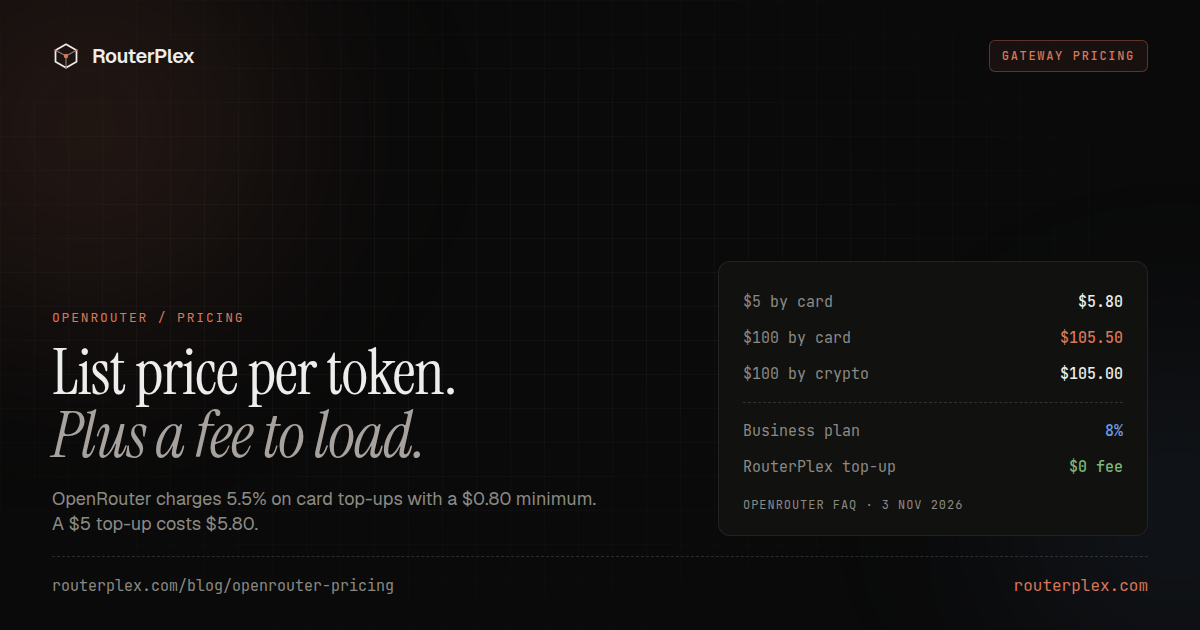
OpenRouter charges list price per token plus 5.5% on card top-ups ($0.80 minimum), 5% on crypto, 8% on Business. A $5 top-up costs $5.80.
Gateway pricing·Published ·By RouterPlex·6 min
On this page
Key facts
As of November 3, 2026
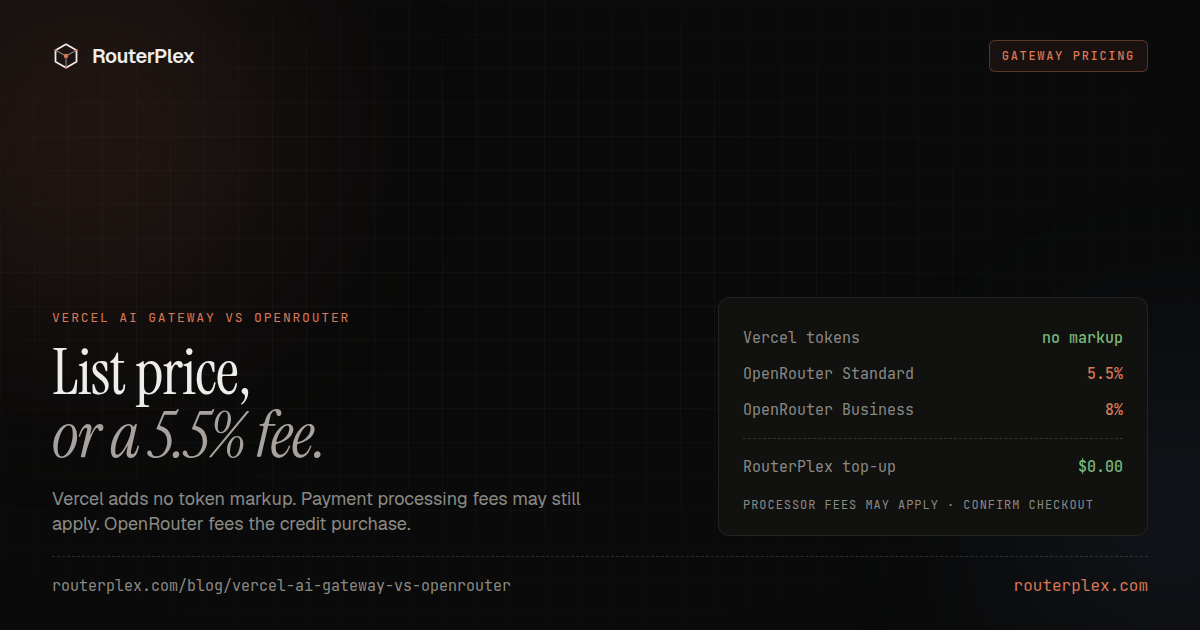
- OpenRouter charges provider list price per token, plus a credit fee: 5.5% by card ($0.80 minimum), 5% by crypto, 8% on Business.
- A $5 card top-up costs $5.80, a 16% effective fee. The $0.80 floor stops mattering at about $14.55.
- BYOK is fee-free up to $25,000 a month at list price, then 5% is deducted from OpenRouter credits.
- Free models allow 20 requests per minute, and 50 per day under $10 of credits ever bought, 1,000 per day from $10.
- On RouterPlex, $100 by card costs $100.00: vendor list price, $0 top-up fee, balance stops at $0, credit never expires.
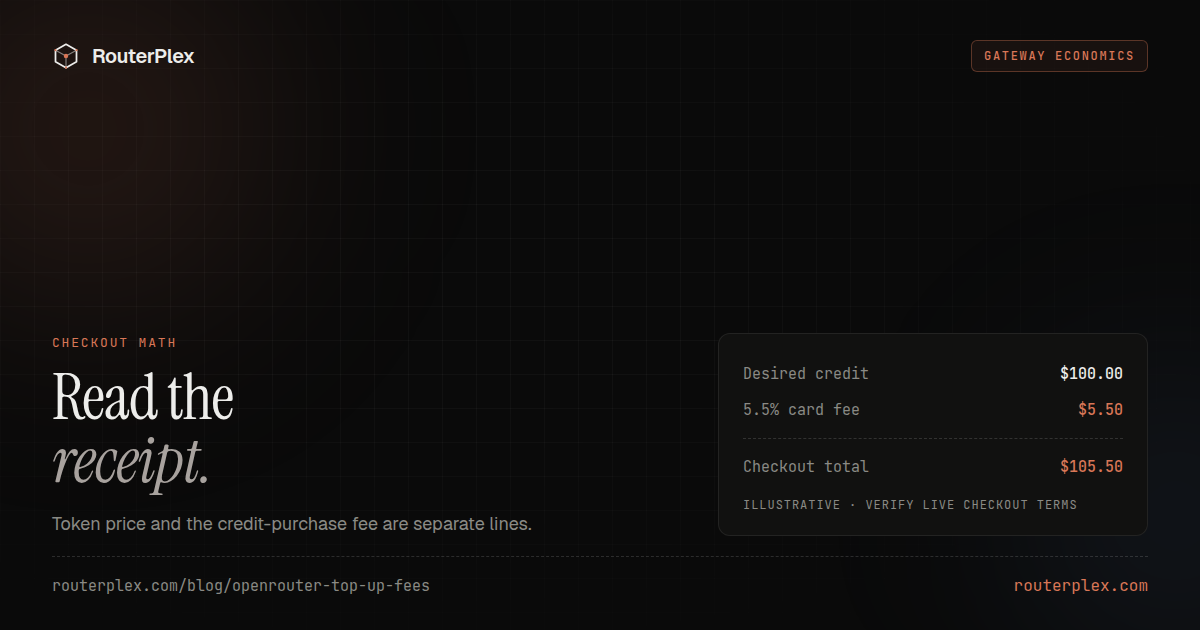
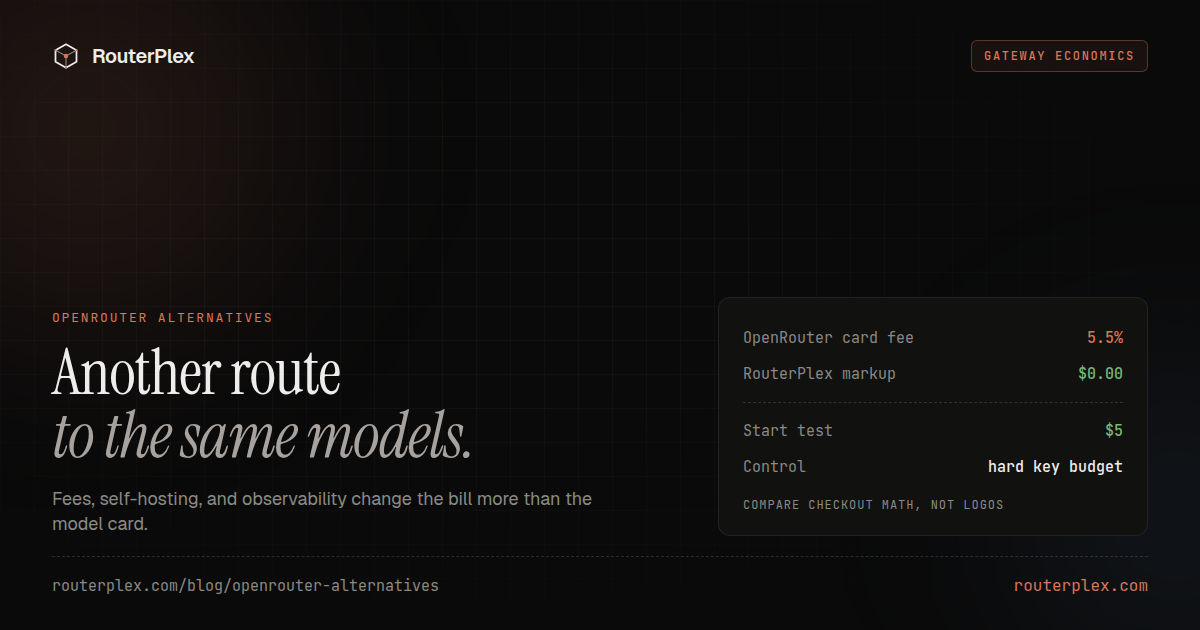
OpenRouter pricing, checked 3 November 2026, has two parts. Tokens cost the provider's list price with no markup. Buying credits costs extra: 5.5% by card with a $0.80 minimum fee, 5% flat by crypto, and 8% on the Business plan. So a $5 card top-up costs $5.80 and a $100 top-up costs $105.50. RouterPlex, which publishes this page, charges the same vendor list prices with a $0 top-up fee.
Disclosure: RouterPlex publishes this comparison and sells the prepaid wallet described below.
Checked 3 November 2026: OpenRouter FAQ, OpenRouter pricing, platform fee announcement, terms section 4 and limits. RouterPlex figures are from the pricing page and the live catalog. Rates change. Read the checkout before a large purchase.
What OpenRouter pricing includes
OpenRouter bills four things, and only one of them is the token price.
- Tokens. The FAQ says OpenRouter passes through provider pricing with "no markup on inference pricing". A model listed at $2 per 1M input tokens costs $2 per 1M on OpenRouter.
- The credit fee. You pay it when you buy credits, never per request. The pricing page lists 5.5% on Standard (pay as you go) and 8% on Business. The FAQ adds a $0.80 minimum on card payments and a 5% fee on crypto.
- The BYOK fee. Bring your own key (BYOK) means you route through OpenRouter with your own provider key. Pay as you go includes $25,000 a month of list-price usage with no BYOK fee. Above that, OpenRouter takes 5% of what the request would cost on OpenRouter.
- Plans. Enterprise has "fee discounts available" by contract. OpenRouter does not discount inference itself.
OpenRouter fees on every top-up size
The table uses OpenRouter's own fee rules. The $5, $10, $25 and $100 card fees match the examples OpenRouter printed in its fee announcement.
| Credits bought | Card fee (Standard) | You pay by card | Effective card fee | Crypto fee (5%) | Business fee (8%) |
|---|---|---|---|---|---|
| $5 | $0.80 | $5.80 | 16.0% | $0.25 | Not stated |
| $10 | $0.80 | $10.80 | 8.0% | $0.50 | $0.80 |
| $25 | $1.38 | $26.38 | 5.5% | $1.25 | $2.00 |
| $50 | $2.75 | $52.75 | 5.5% | $2.50 | $4.00 |
| $100 | $5.50 | $105.50 | 5.5% | $5.00 | $8.00 |
| $500 | $27.50 | $527.50 | 5.5% | $25.00 | $40.00 |
| $1,000 | $55.00 | $1,055.00 | 5.5% | $50.00 | $80.00 |
The minimum purchase is $5 and the maximum is $25,000 per transaction, per the terms. The Business column at $5 says "Not stated" because OpenRouter does not say whether the $0.80 floor applies there. At $10 and above, 8% is already $0.80 or more, so the floor does not matter.
Why small OpenRouter top-ups cost more
The $0.80 minimum is a floor on the card fee. Below about $14.55, the fee stays at $0.80 no matter how little you buy. That is the break-even point, because 5.5% of $14.55 is $0.80.
So the effective rate climbs as the top-up shrinks. A $5 card purchase pays 16%. A $10 purchase pays 8%. From $14.55 up, every card purchase pays the plain 5.5%.
Crypto has no floor. OpenRouter's announcement says "5.0% flat, no minimum fee", so a $5 crypto top-up costs $5.25. Crypto is cheaper for small amounts. The terms also say "Cryptocurrency payments are never refundable."
If you top up $5 at a time, five card purchases of $5 cost $4.00 in fees. One $25 purchase costs $1.38. Batch your top-ups if you stay on OpenRouter.
OpenRouter BYOK pricing
Pay as you go includes $25,000 a month of BYOK usage with no fee, measured at list price. That allowance is large. A solo developer or small team will rarely pass it.
Above $25,000, the FAQ says the fee is "5% of what the same model and provider would normally cost on OpenRouter". OpenRouter deducts it from your OpenRouter credits. So a BYOK account still needs a credit balance once it is past the allowance.
BYOK makes sense when you already hold provider contracts, rate limits or discounts. You keep the provider bill and use OpenRouter for routing and one interface. If you do not hold those contracts, BYOK adds a second bill without saving money.
OpenRouter free models and their limits
Free models cost $0 per token, but they have request caps. The limits page sets them by how many credits you have ever bought.
| Credits purchased (all time) | Requests per minute | Requests per day |
|---|---|---|
| Less than $10 | 20 | 50 |
| At least $10 | 20 | 1,000 |
A negative balance blocks free models too. The FAQ says "a negative balance blocks free models until you add credits." Free models are useful for tests. They are not a production lane.
Refunds, expiry and negative balances
These three rules decide what happens to money you have already paid.
Refunds have a 24-hour window. You can ask for unused credits back within 24 hours of the purchase. The platform fee is not refunded, and crypto payments are never refunded.
Expiry is a reserved right. The terms reserve the right "to expire unused credits three hundred sixty-five (365) days after purchase". Its COO said on Hacker News that OpenRouter does not expire them in practice. Our credit expiry guide has the full quote and the refund steps.
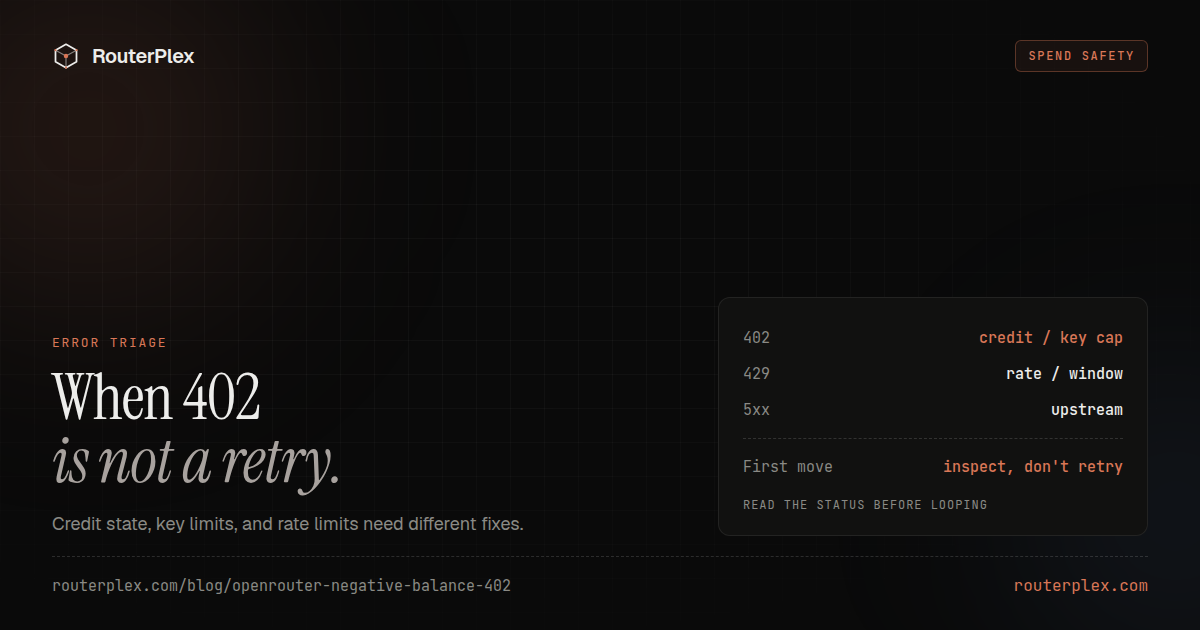
A balance can go negative. Requests then fail with a 402 error until you top up. The limits page also documents an in-flight budget 402 that can fire while your balance is still positive. The 402 guide covers both.
OpenRouter vs RouterPlex on the same $100
Both wallets charge the provider's list price for tokens. The difference is the money going in and what happens at zero.
| $100 of credit | OpenRouter (Standard) | RouterPlex |
|---|---|---|
| Paid by card | $105.50 | $100.00 |
| Paid by crypto | $105.00 (USDC) | $100.00 ($15 minimum, USDT and other coins) |
| Token prices | Provider list price | Vendor list price |
| Balance at zero | Can go negative, then 402 | Stops at $0 |
| Per-key limit | Optional credit limit per key | Hard lifetime USD cap per key |
| Unused credit | May expire after 365 days | Never expires |
| Models | Far larger catalog | 72 models |
OpenRouter wins on catalog size and on the 24-hour refund window. RouterPlex top-ups are final. The full feature comparison is on RouterPlex vs OpenRouter, and every gateway's fee is in the sourced fee table.
Run the same request on RouterPlex
RouterPlex uses the OpenAI request format, so moving a call is a base URL and key change. Pick a model id from the catalog.
curl https://api.routerplex.com/v1/chat/completions \-H "Authorization: Bearer $ROUTERPLEX_API_KEY" \-H "Content-Type: application/json" \-d '{"model": "qwen3.6-plus","messages": [{"role": "user", "content": "Reply with one word: ready"}]}'
Anthropic SDK users point the client at https://api.routerplex.com with no /v1. The quickstart has Python and Node versions.
Next step
Top up from $5 with a $0 fee, or start with the $1 trial that needs no card. Set a lifetime budget on the key before you connect an agent.
Common questions
Frequently asked questions
Does OpenRouter mark up token prices?
No. Checked 3 November 2026, the OpenRouter FAQ says it passes through provider pricing with no markup on inference. A model at $2 per 1M input tokens from the provider costs $2 per 1M on OpenRouter. The extra cost is the fee charged when you buy credits: 5.5% by card with a $0.80 minimum, 5% by crypto, and 8% on the Business plan. RouterPlex also charges vendor list price per token and adds a $0 top-up fee.
How much is the OpenRouter credit fee?
Checked 3 November 2026, OpenRouter charges 5.5% with a $0.80 minimum when you buy credits by card on the Standard plan. Crypto purchases pay 5% flat with no minimum. The Business plan pays 8%. Enterprise customers can negotiate fee discounts by contract. The fee is charged once at purchase, never per request, and it is not refunded if you later ask for your unused credits back.
Why did my $5 OpenRouter top-up cost $5.80?
The card fee has a $0.80 minimum. On a $5 purchase, 5.5% would be $0.28, so OpenRouter charges the $0.80 floor instead. That is an effective fee of 16%. The floor stops mattering at about $14.55, where 5.5% equals $0.80. Paying $5 by crypto costs $5.25, because the 5% crypto fee has no minimum. Crypto payments are never refundable on OpenRouter, so weigh that before you switch.
Does OpenRouter charge a fee for BYOK?
Only above the free allowance. Checked 3 November 2026, pay as you go includes $25,000 a month of bring-your-own-key usage with no fee, measured at list price. Above that, OpenRouter charges 5% of what the same model and provider would cost on OpenRouter. It deducts that fee from your OpenRouter credits, so a BYOK account past the allowance still needs a credit balance.
Is OpenRouter cheaper than going direct to the provider?
Not on tokens. OpenRouter charges the provider's list price, the same as going direct. You pay 5.5% more by card (5% by crypto) when you buy credits. What you get for the fee is one key and one bill across many providers, plus a large catalog. RouterPlex gives one key at vendor list price with a $0 top-up fee, on a smaller catalog of 72 models.
Do OpenRouter credits expire?
They can. OpenRouter's terms reserve the right to expire unused credits 365 days after purchase. Its COO said on Hacker News in June 2025 that OpenRouter does not expire credits in practice but has to reserve the right. Budget against the written terms if you pre-fund a large amount. RouterPlex credit never expires.
Run the smallest paid test.
Add $5, cap the key, and verify the result with your own workload. No subscription, and credit never expires — a first top-up of $25+ is matched with $25 extra.
Weighing the switch? RouterPlex vs OpenRouter, line by line →