Vercel AI Gateway vs OpenRouter: List Price or a 5.5% Credit Fee
Vercel AI Gateway vs OpenRouter: no token markup on Vercel, and a 5.5% credit fee on OpenRouter Standard. Compare a $0 top-up wallet.
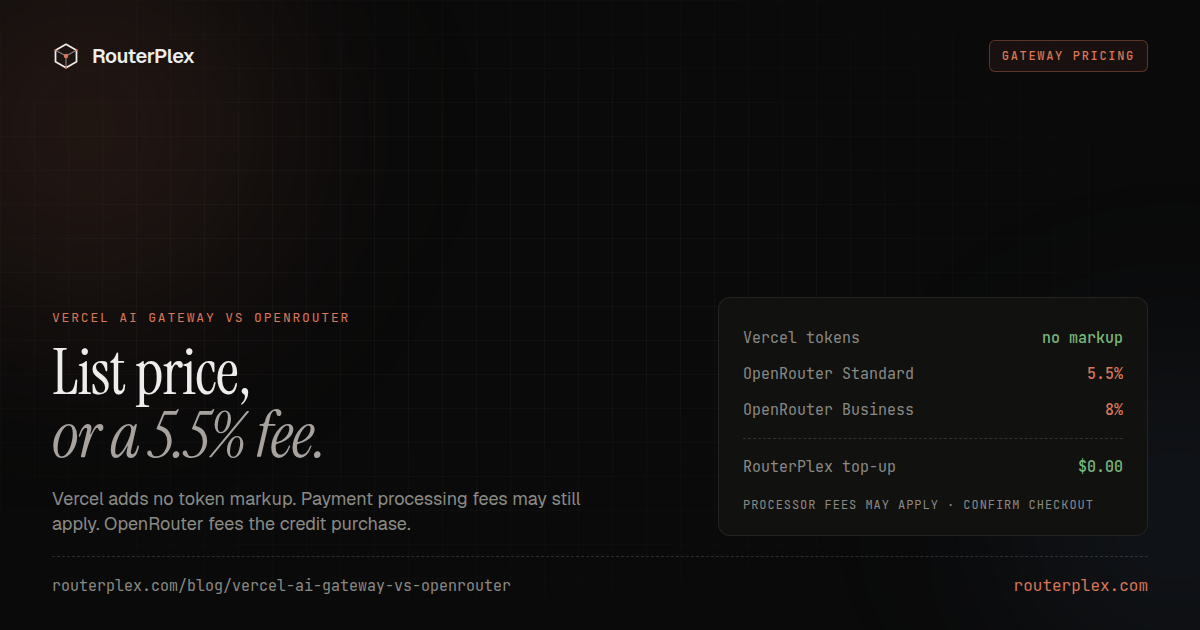
Vercel AI Gateway vs OpenRouter is a fee-shape comparison between two hosted catalogs. Checked 18 October 2026, Vercel charges no markup and no platform fee on tokens. You pay the provider list price from AI Gateway credits, and Vercel says you are responsible for any payment processing fees that may apply. It does not publish that processor percent. OpenRouter does not mark up inference either. Its fee is on the credit purchase: 5.5% on Standard, 8% on Business. RouterPlex is a smaller prepaid catalog at vendor list price, with a $0 top-up fee and a hard stop at $0.
Disclosure: RouterPlex publishes this comparison and is one of the three options. Use the vendor pages linked below before you move a production bill.
Checked 18 October 2026: Vercel AI Gateway pricing, Vercel AI Gateway overview, OpenRouter pricing, OpenRouter FAQ, and the platform-fee announcement (updated 11 June 2026). RouterPlex figures are from the pricing page and the live catalog the same day.
How do Vercel AI Gateway and OpenRouter charge? #
Both products can look like "list price" in a feature table. The invoice is where they split.
| Question | Vercel AI Gateway | OpenRouter | RouterPlex |
|---|---|---|---|
| Token markup | None. Provider list price | None on inference. The fee is on the credit purchase | None. Vendor list price |
| Fee to buy credits | Processor fees may apply. No percent is published. Enterprise invoice has none | Standard 5.5%. Business 8%. A June 2026 announcement sets non-crypto at 5.5% with a $0.80 minimum, and crypto at 5% with no minimum | $0 on card and crypto |
| Free start | $5 a month on a subset of models | Free plan: 25+ free models, 4 providers, 50 requests a day | No free-model plan. $5 minimum top-up |
| Bring your own key | Paid tier only, no AI Gateway fee. A failed key falls back to system credentials billed to your credits | $25,000 of list-price inference per month with no BYOK fee on Standard and Business, then 5% | Not offered |
| Catalog | Paid: all available models. Free: a subset. No model count is printed on the pricing page | Standard and Business: 500+ models, 80+ providers | 64 models, 15 providers |
| Empty balance, as published | Credits are deducted. Budgets and optional auto top-up are documented. A negative-balance rule is not | Cost is deducted after the provider reports tokens. The balance can then show negative, with 402 until you repay | Requests stop at $0 |
Vercel is a wallet inside a Vercel team. OpenRouter is a standalone catalog account. RouterPlex is a standalone prepaid key. The SDK you already use is often the real decision, and the fee is the part you can price before you switch.
What does Vercel AI Gateway pricing include? #
The pricing page gives every team a free tier and a paid tier.
| Free tier | Paid tier | |
|---|---|---|
| Monthly credit | $5 a month, starting at the first AI Gateway request | Purchased credits, pay as you go |
| Models | Free-tier eligible subset | All available models |
| Token price | Provider list, zero markup | Provider list, zero markup, including bring-your-own-key |
| Rate limits | Lower limits per model. Over the limit returns HTTP 429 | Higher limits. Custom limits are available |
| Bring your own key | Off | On |
| Commitment | None | None |
Buying credits moves the team to paid, and the monthly $5 stops. There is no obligation to renew. Volume discounts exist. The page does not print a discount percent, so this article does not invent one.
Extra products are off until you enable them, and then they bill on top of tokens:
| Add-on | Published price | Where it bills |
|---|---|---|
| Custom reporting writes | $0.075 per 1,000 tag, user, or quota-entity writes | AI Gateway credits |
| Custom reporting queries | $5 per 1,000 queries | AI Gateway credits |
Per-request provider only filter | $0 | Included |
| Team-wide provider allowlist | $0.10 per 1,000 successful requests | AI Gateway credits, Pro and Enterprise |
| Per-request zero data retention | $0 | Pro and Enterprise |
| Team-wide zero data retention | $0.10 per 1,000 requests | AI Gateway credits, Pro and Enterprise |
| Trace drains | $0.05 per 1,000 traces, plus $0.50 per GB egress | Drains usage on the Vercel plan, not AI Gateway credits |
Pro plans include no allowance for the trace meters, so charges start with the first delivered trace. Pausing or deleting the drain stops later charges. A higher sampling rate increases both meters.
Bring-your-own-key needs purchased credits. Vercel adds no markup on that traffic. If the provider key fails, the gateway retries with system credentials and charges the fallback to the credit balance. Budgets can cap a team, a project, an API key, or a member. Auto top-up can add credits when the balance falls under a threshold you set. It is off until you enable it.
The pricing page does not say the balance can go negative, and it does not print a 402-at-zero rule. The controls it does print are the credit balance, budgets, and auto top-up.
What does a $100 OpenRouter top-up cost on the same day? #
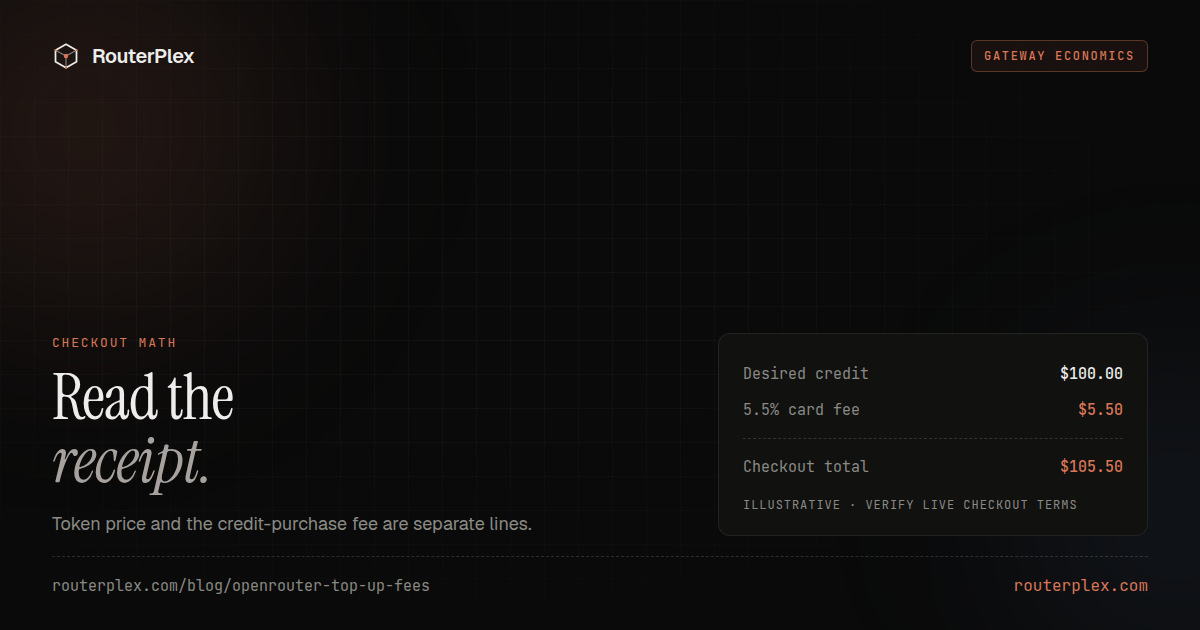
OpenRouter's fee sits on the purchase, not on the token rate. The pricing page checked 18 October 2026 lists 5.5% on Standard and 8% on Business, charged when credits are bought. The fee announcement updated 11 June 2026 prints the non-crypto schedule:
| Order size | Published fee |
|---|---|
| $5 | $0.80 |
| $10 | $0.80 |
| $25 | $1.38 |
| $100 | $5.50 |
| $1,000 | $55.00 |
Crypto on that announcement is 5.0% with no minimum, so a $100 crypto purchase is a $5.00 fee. If the account is on Business, use 8% as the plan fee and confirm the cart. The $0.80 minimum belongs to the 5.5% non-crypto schedule. It is not restated on the pricing page as a Business rule.
A $100 comparison across the three checkouts:
| Wallet | What $100 of usable model credit costs, on the pages checked |
|---|---|
| Vercel AI Gateway | $100 of credits, plus any payment processing fee the checkout adds. No percent is published. Enterprise invoice adds none |
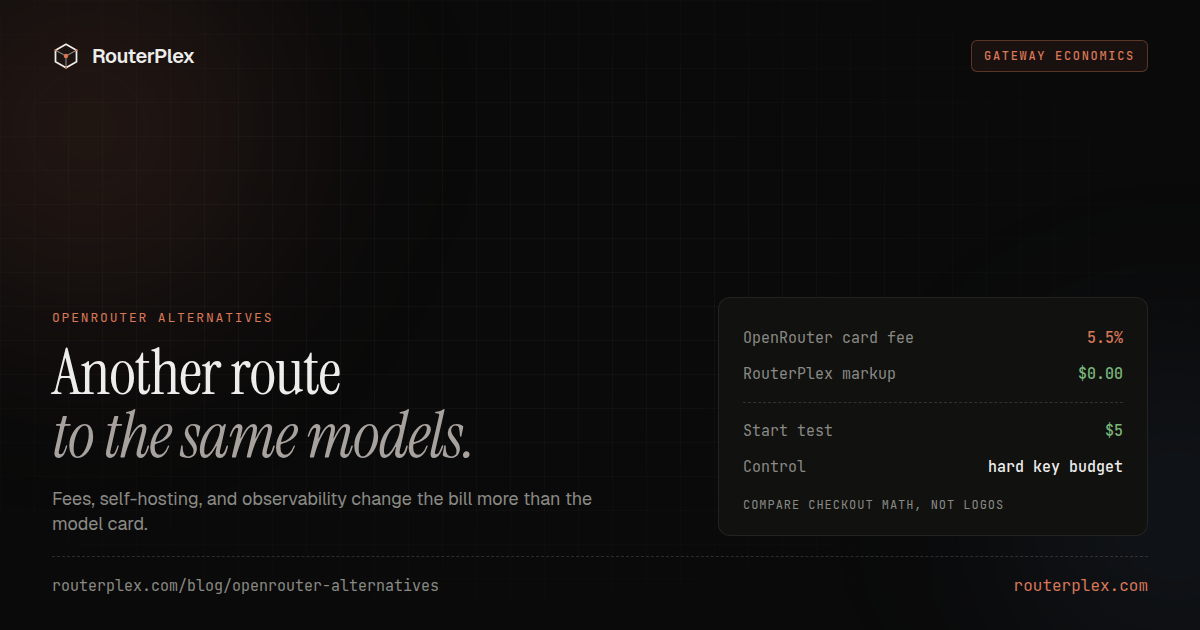
| OpenRouter, non-crypto announcement | $105.50 for $100 of credit |
| OpenRouter, crypto at 5% | $105.00 for $100 of credit |
| OpenRouter Business at 8% | $108.00 for $100 of credit, if that plan fee is what the cart applies |
| RouterPlex | $100.00 for $100 of credit |
OpenRouter's FAQ, same check, adds three rules that change a large unused balance. Unused credits may be expired one year after purchase. A refund of unused credits can be requested within 24 hours, and the platform fee is non-refundable. Cryptocurrency payments are never refundable. The longer walkthrough is OpenRouter credits and top-up fees.
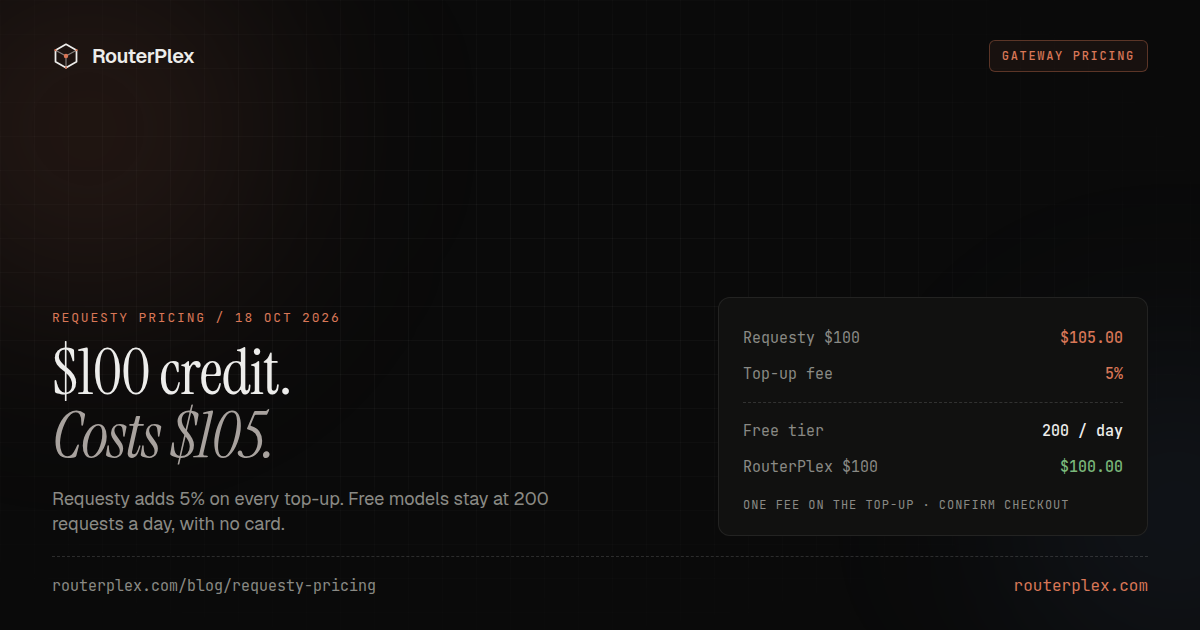
RouterPlex pay-as-you-go credit does not expire. The top-up fee is $0 on card and crypto, with a $5 minimum. Optional plans (Plex Lite $10 for $11, Plex Pro $30 for $35, Plex Max $100 for $125) add spend windows. They are not required to call the API.
What happens at an empty balance? #
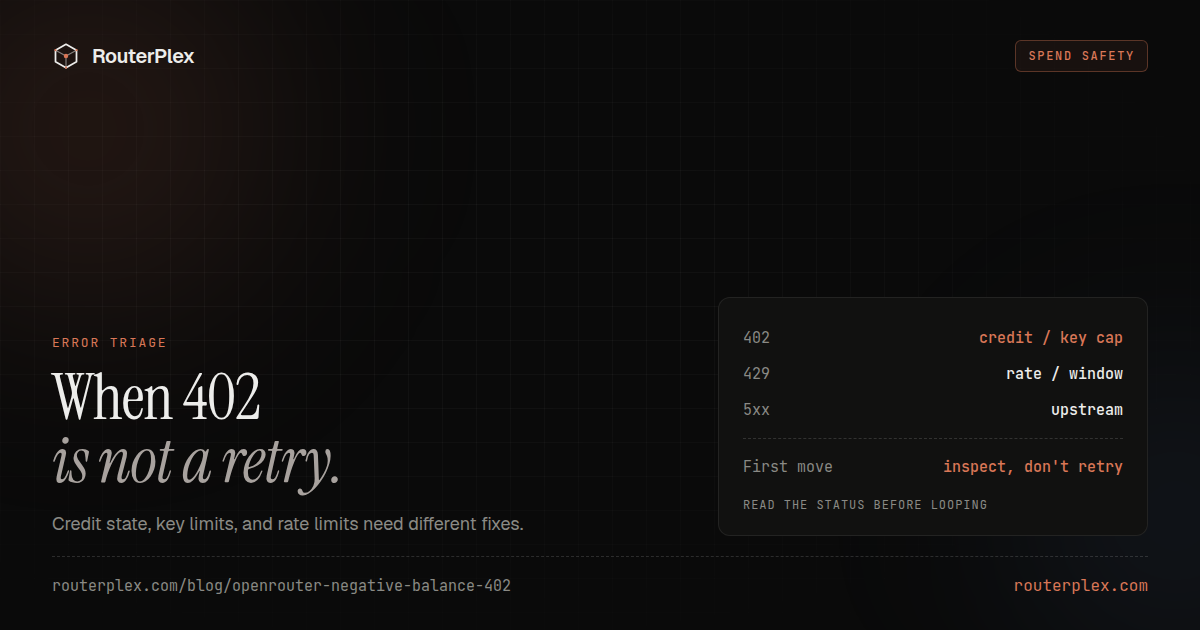
OpenRouter deducts the request after the provider reports the token count. The final number is not known when a stream starts. Several in-flight requests can each see a positive balance and then land together below zero. The account then returns HTTP 402 until the deficit is repaid. The recovery steps are in Fix an OpenRouter 402 and a negative balance.
Vercel's pricing page describes a different control set. Charges come out of AI Gateway credits. You can set budgets, and you can turn on auto top-up. This check did not find a published rule that the balance goes negative, and it did not find a published rule that new requests hard-stop at $0 with no further card charge. If that behavior matters, read the current budget docs and test a key with auto top-up off.
RouterPlex is prepaid. At $0, further requests stop. A hard lifetime budget on the key caps spend even when the organization balance is larger. A 402 means the balance or the key budget is used up. Pay as you go has no RouterPlex requests-per-minute or tokens-per-minute cap. Provider limits still apply. OpenRouter's paid plans describe the same passthrough of provider limits.
Which catalog is on the key? #
OpenRouter's pricing table lists 500+ models and 80+ providers on Standard, Business, and Enterprise, plus 25+ free models on the Free plan. That breadth is why teams pay the credit fee. A niche open model or the free pool is an OpenRouter win.
Vercel does not print a model count on the pricing page. Paid access is "all available models." Free access is a subset, listed behind a free-tier filter on the model browser. The overview curl uses provider-prefixed ids such as openai/gpt-6-astra and the base URL https://ai-gateway.vercel.sh/v1.
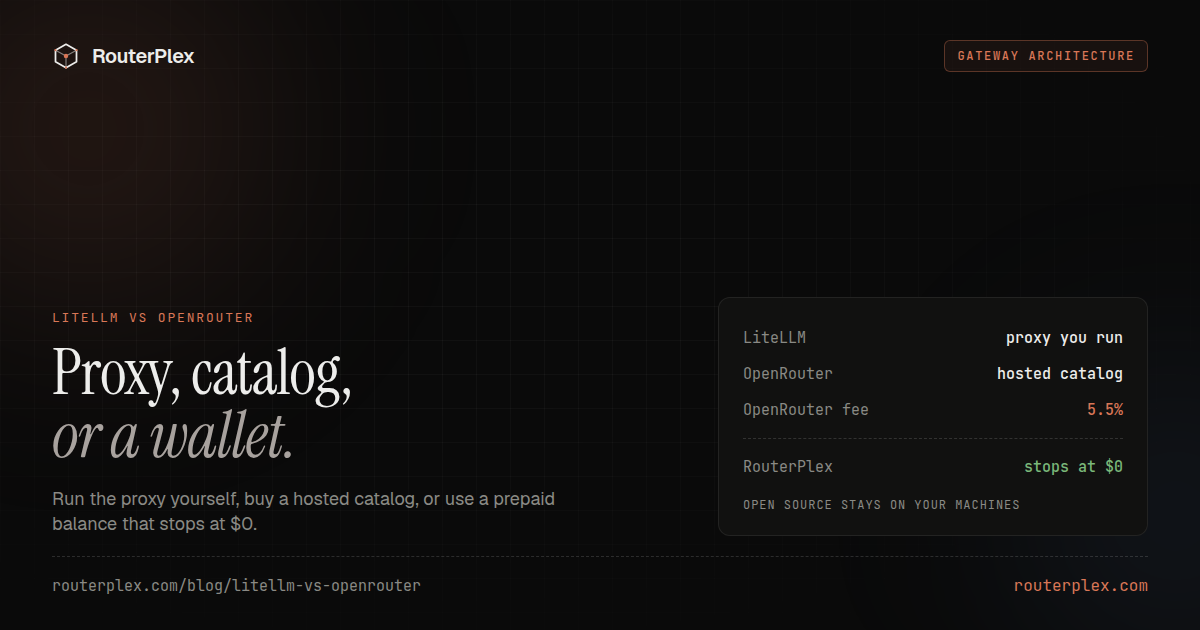
The RouterPlex catalog on 18 October 2026 was 64 models from 15 providers: 63 chat models and one image model. One live pair from that payload: claude-opus-5-5 at $4 input and $20 output per 1M tokens, and gpt-6-sol at $2 and $10. Those are list rates. If the model is missing, use the model index. The LiteLLM vs OpenRouter article is the separate choice between a proxy you run and a hosted catalog.
Bring-your-own-key changes the catalog story. Vercel can sit on your provider account once you are on the paid tier, with the fallback billed to credits if your key fails. OpenRouter BYOK allows $25,000 of list-price inference per month on Standard and Business with no BYOK fee, then 5% taken from OpenRouter credits, and you still pay the provider. RouterPlex has no BYOK path.
When should you choose each one? #
Choose Vercel AI Gateway when the app already runs on Vercel and the AI SDK is how you call models. The $5 monthly credit is a real way to try a subset. The paid tier is the right place to read if you need every model, bring-your-own-key, or custom limits. Price the add-ons before you enable team-wide zero data retention, the provider allowlist, custom reporting, or trace drains. The short product page is RouterPlex vs Vercel AI Gateway.
Choose OpenRouter when 500+ hosted models are worth the purchase fee. Standard at 5.5% is the common case. Business at 8% is the case to confirm if the account needs the Business column. Price the one-year expiry right and the 24-hour refund limit before a large top-up. OpenRouter alternatives is the wider list if the fee is the objection. The wallet page is RouterPlex vs OpenRouter.
Choose RouterPlex when the models are on the 64-route list and you want one prepaid key, a $0 funding fee, and a hard stop at $0. Crypto top-up is on the pricing page. A Vercel team is not required. Point an OpenAI SDK at https://api.routerplex.com/v1. For the Anthropic SDK, the base URL is https://api.routerplex.com.
How do you point one OpenAI client at each? #
import osfrom openai import OpenAI# Vercel AI Gateway. Model ids on the overview use a provider prefix.vercel = OpenAI(base_url="https://ai-gateway.vercel.sh/v1",api_key=os.environ["VERCEL_AI_GATEWAY_API_KEY"],)# OpenRouter hosted catalog. Model ids usually include a provider prefix.openrouter = OpenAI(base_url="https://openrouter.ai/api/v1",api_key=os.environ["OPENROUTER_API_KEY"],)# RouterPlex prepaid catalog. Use the id from /models, such as claude-opus-5-5.routerplex = OpenAI(base_url="https://api.routerplex.com/v1",api_key=os.environ["ROUTERPLEX_API_KEY"],)
Test streaming and tool calls on the model you will run. A shared request shape does not mean a shared model id. Vercel and OpenRouter often want a provider prefix. RouterPlex uses the plain catalog id.
Which bill are you paying? #
Pay Vercel when the platform around the wallet is the product and you have confirmed the processor line at checkout. Pay OpenRouter when the long catalog is worth 5.5% or 8% on the credits, plus the expiry and refund rules. Pay a prepaid wallet when the line you want on the receipt is simpler: list-price tokens, $0 to add funds, and a balance that cannot go past what you loaded.
Start a $5 RouterPlex test if the 64-model list covers the traffic. Cap the key. Keep Vercel or OpenRouter on any route the catalog does not serve.
Common questions
Frequently asked questions
Does Vercel AI Gateway charge a platform fee?
Not on tokens. The pricing page, checked 18 October 2026, says AI Gateway charges no markup and no platform fee on tokens, including bring-your-own-key on the paid tier. You pay the provider list price from AI Gateway credits. The same page says you are responsible for any payment processing fees that may apply. It does not publish that percent. Enterprise invoice has no payment processing fees.
Is Vercel AI Gateway cheaper than OpenRouter?
On the published platform fee, Vercel has none on tokens and OpenRouter Standard charges 5.5% when you buy credits (8% on Business). A processor fee may still apply to a Vercel credit purchase, and Vercel does not print the percent. A $100 OpenRouter card top-up on the fee announcement is a $5.50 fee. Compare the checkout, not the headline.
What is the Vercel AI Gateway free tier?
Every team gets $5 a month on a subset of models, with lower per-model rate limits, and bring-your-own-key is off. The credit starts at the first AI Gateway request. Buying credits moves the team to the paid tier, and the monthly free credit stops.
Does Vercel bring-your-own-key stay at list price?
On the paid tier, Vercel says there is no markup or fee from AI Gateway on your own key. The free tier cannot use bring-your-own-key. If your key fails, AI Gateway retries with system credentials and bills that fallback to your credits. You need purchased credits to turn the feature on.
Can an OpenRouter balance go negative?
OpenRouter deducts the request after the provider reports token usage. Concurrent or streaming calls can finish after the balance that was visible at the start has already been spent, and the dashboard can then show a negative balance with 402 responses until you repay it. The Vercel pricing page does not publish an equivalent negative-balance rule.
When is RouterPlex the better wallet?
When the models you call are on its 64-model catalog and you want a $0 top-up fee with requests that stop at $0. Vercel is the better wallet inside the Vercel and AI SDK workflow. OpenRouter is the better wallet when you need 500+ hosted models and will pay the credit-purchase fee.
Compare the OpenRouter alternative.
Fees, reliability, and the catalog trade-off are on the product comparison.