LiteLLM vs OpenRouter: Proxy, Catalog, or Prepaid Wallet
LiteLLM vs OpenRouter: a proxy you run, or a hosted catalog with a 5.5% credit fee. Compare both with a prepaid wallet that stops at $0.
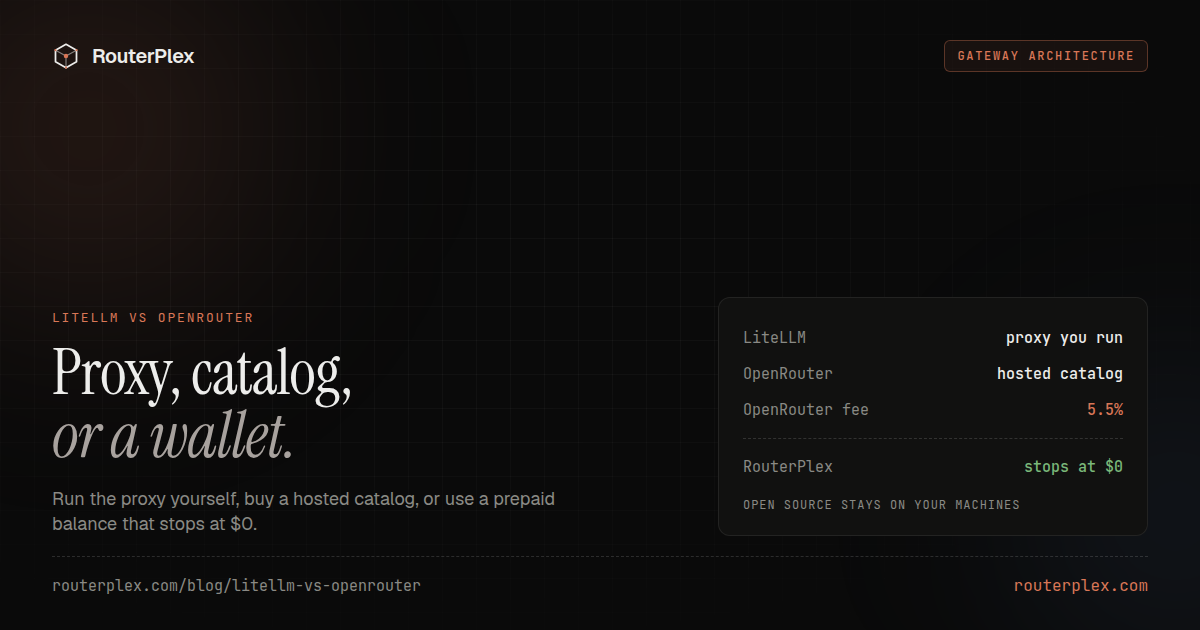
LiteLLM vs OpenRouter is a choice between a proxy you operate and a hosted catalog you fund with credits. LiteLLM's open-source gateway is free to self-host and adds no per-token fee. You bring the provider keys and you run the process. OpenRouter is a hosted API. On 18 October 2026 its pricing page listed 500+ models and a 5.5% platform fee on Standard credit purchases, or 8% on Business. A third shape is a prepaid wallet. RouterPlex bills a 64-model catalog at vendor list price, charges $0 to add funds, and stops requests at $0.
Disclosure: RouterPlex publishes this comparison and is one of the three options. Use the vendor pages linked below before you move a production bill.
Checked 18 October 2026: LiteLLM pricing, LiteLLM proxy quick start, OpenRouter pricing, OpenRouter FAQ, and the platform-fee announcement (updated 11 June 2026). RouterPlex figures are from the pricing page and the live catalog the same day. Rates change. Read the checkout before a large purchase.
How do LiteLLM and OpenRouter differ? #
LiteLLM and OpenRouter both offer an OpenAI-shaped API. The thing you are buying is different.
| Question | LiteLLM | OpenRouter | RouterPlex |
|---|---|---|---|
| What you run | The proxy, on your machines | Nothing. OpenRouter hosts the API | Nothing. RouterPlex hosts the API |
| Who holds provider keys | You | OpenRouter, unless you use BYOK | RouterPlex |
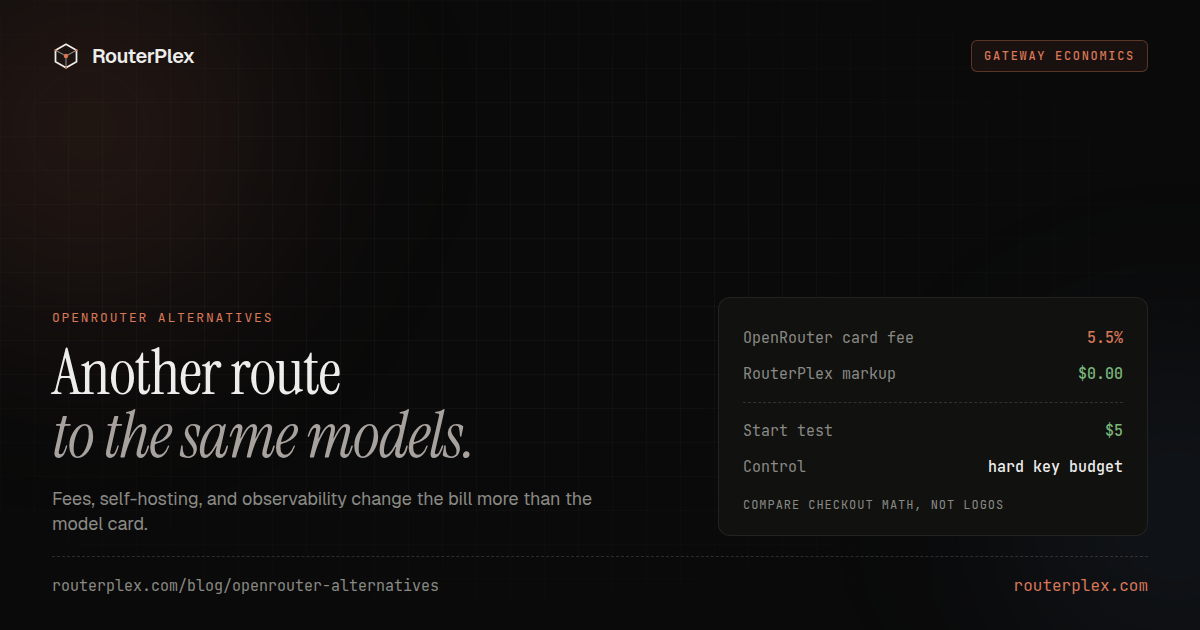
| Platform fee | $0 for the open-source proxy. Enterprise is a custom annual quote, and LiteLLM says it is never per token | Standard 5.5% when you buy credits. Business 8%. No inference markup | $0 top-up fee. Token prices are vendor list price, 0% markup |
| Catalog on one key | Providers you configure. The pricing page says 100+ providers | Standard and Business: 500+ models, 80+ providers | 64 models, 15 providers |
| Spend stop | Budgets and virtual keys you configure in the proxy | Credits deducted after usage is reported. OpenRouter reserves the right to expire unused credits after one year | Prepaid balance stops at $0. Pay-as-you-go credit does not expire |
| Free models | Only if a provider gives you that access | Free plan: 25+ free models, 4 providers, 50 requests/day, budgets off | No free-model plan. Minimum top-up is $5 |
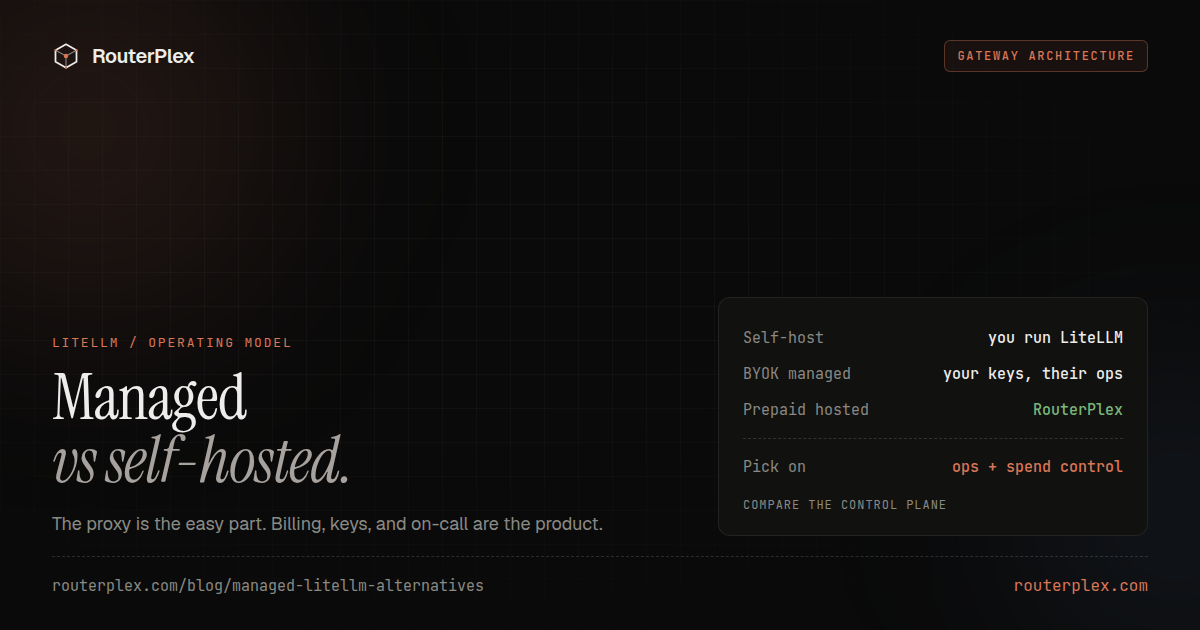
The proxy quick start, dated on the docs site 18 October 2026, says the LiteLLM server calls 100+ LLMs in the OpenAI Chat Completions format, with virtual keys, spend tracking, and budgets. A local process can be up with one CLI command. Production ownership is the database, auth, patches, provider credentials, and the incident when that process stops.
OpenRouter's FAQ describes the other end: create an account, buy credits, and the request cost is deducted from that balance. The pricing table adds auto-routing and spend controls on Standard. The Free row does not include budgets.
Who pays the model bill? #
On LiteLLM, the provider invoice stays yours. The pricing FAQ says the gateway is self-hosted, so keys and data stay on infrastructure you operate. That is the reason to pick it when a contract, a data-processing addendum, or an air-gapped network is the requirement. LiteLLM lists air-gapped deployment on Enterprise Standard and SCALE. The open-source plan is the self-hosted proxy on infrastructure you already operate.
On OpenRouter, the default path is their credits and their upstream accounts. BYOK is optional, and it is not a free alias for LiteLLM. The pricing page, checked 18 October 2026, allows $25,000 of list-price inference per month on Standard and Business with no BYOK fee, then a 5% fee taken from OpenRouter credits. You still pay the provider on your own invoice for that traffic.
On RouterPlex, the model bill is the prepaid balance. There is no BYOK mode. You do not paste an OpenAI or Anthropic key into the gateway. The trade is catalog size: 64 routes, not 500+.
What does a $100 OpenRouter top-up cost? #
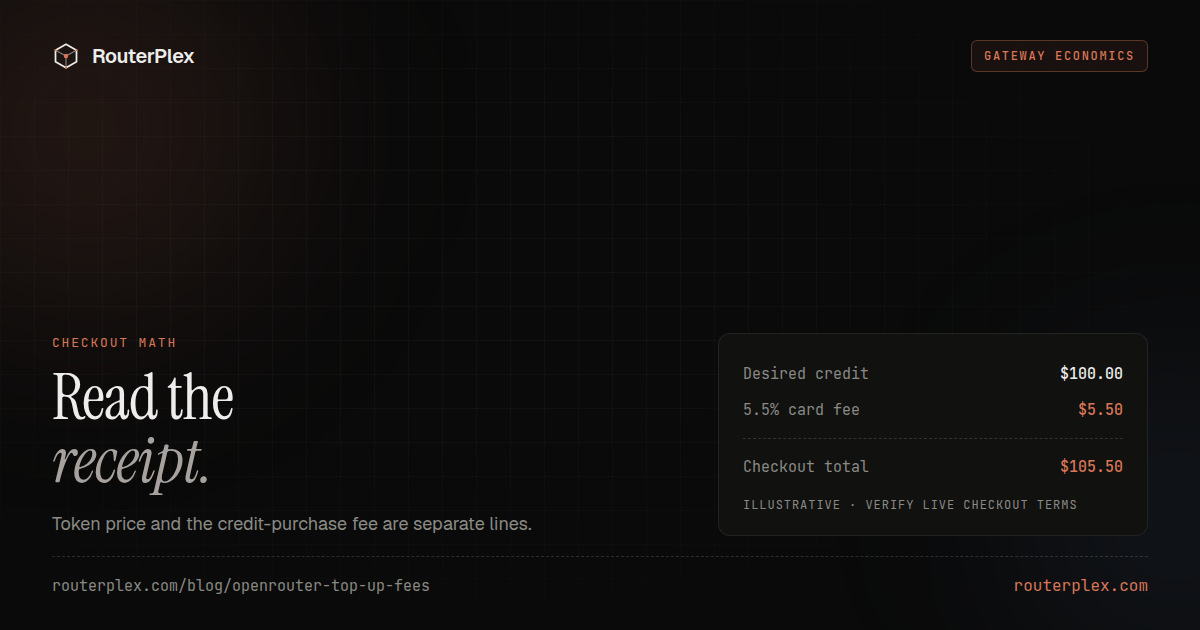
OpenRouter's fee announcement, updated 11 June 2026, prints the fee on the order size for the simplified non-crypto schedule:
| Order size | Published fee |
|---|---|
| $5 | $0.80 |
| $10 | $0.80 |
| $25 | $1.38 |
| $100 | $5.50 |
| $1,000 | $55.00 |
The same announcement sets crypto at 5.0% with no minimum. A $100 crypto purchase at that rate is a $5.00 fee. The 18 October 2026 pricing page is the plan split to read beside that table: Standard is 5.5%, Business is 8%, and the Business fee is charged when credits are bought, not on each API call. If the account is on Business, treat 8% as the plan fee and confirm the cart. The $0.80 minimum in the announcement is attached to the 5.5% non-crypto schedule, not restated as a Business rule.
A $100 RouterPlex top-up is $100 of token credit. The pricing terms set the top-up fee at $0 on card and crypto, with a $5 minimum. Token rates do not change between pay as you go and the optional plans. The full fee walkthrough, including expiry and the 24-hour refund window, is OpenRouter credits and top-up fees.
OpenRouter's FAQ, same check date, adds three billing rules that change the real cost of a large unused balance. Unused credits may be expired one year after purchase, because the terms reserve that right. A refund of unused credits can be requested within 24 hours, and the platform fee is non-refundable. Cryptocurrency payments are never refundable. RouterPlex pay-as-you-go credit does not expire. Optional plans (Plex Lite $10 for $11, Plex Pro $30 for $35, Plex Max $100 for $125) add 4-hour, weekly, and monthly spend windows. Those plans are not required to call the API.
What happens at a zero balance? #
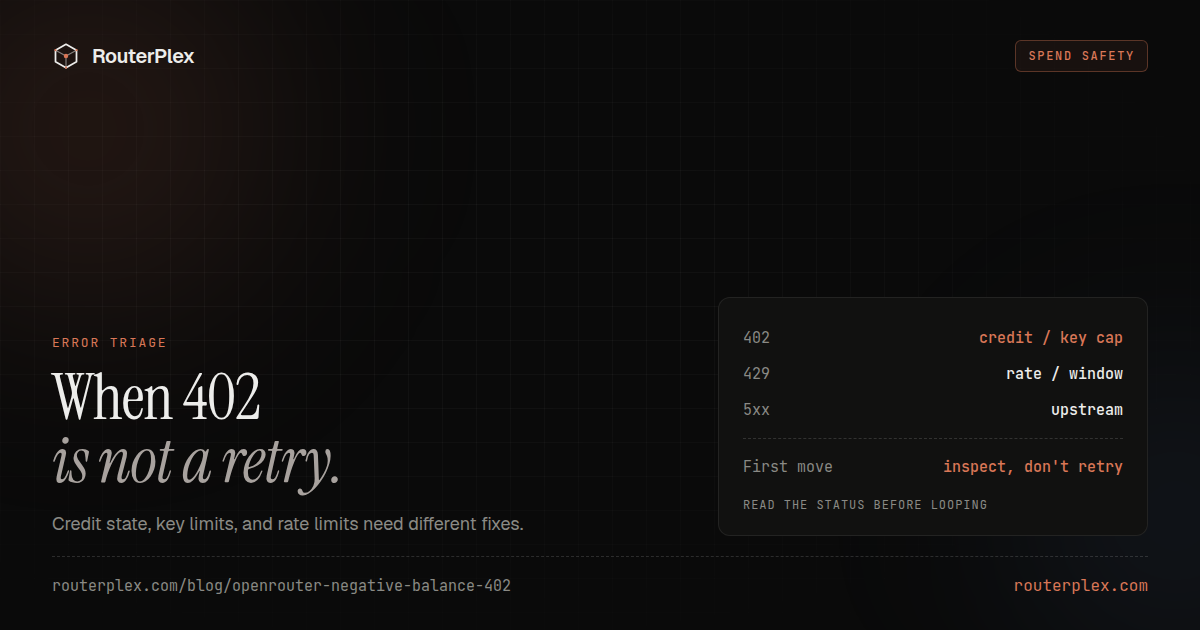
OpenRouter's FAQ says the provider reports the token count, OpenRouter computes the cost, and that cost is deducted from credits. The final number is not known when a stream starts. Several in-flight requests can each see a positive balance and then land together below zero. The account then returns HTTP 402 until the deficit is repaid. The recovery steps, and the exact 402 strings, are in Fix an OpenRouter 402 and a negative balance.
LiteLLM can record spend and enforce budgets you configure on virtual keys. It does not, by itself, sell a prepaid wallet. If the upstream provider account has no limit, the proxy budget is the control you had to turn on. A missed budget is a provider bill, not an in-product overdraft screen.
RouterPlex keeps a prepaid balance and can put a hard lifetime spend budget on each key. At $0, further requests stop. A leaked key or a looping agent can spend the amount loaded on that key, and no more. A 402 on this API means the balance or the key budget is used up. It does not mean the account went negative. Pay as you go has no RouterPlex RPM or TPM cap. Provider rate limits still apply, the same way OpenRouter's paid plans say limits pass through from the provider.
Which catalog is on the key? #
OpenRouter's pricing table lists 500+ models and 80+ providers on Standard, Business, and Enterprise, plus 25+ free models on the Free plan. That catalog is the reason a lot of teams accept the credit fee. If the workflow depends on a niche open model, a community fine-tune, or the free pool, OpenRouter covers it and RouterPlex does not.
LiteLLM's reach is the providers you can authenticate. The pricing page says 100+ providers behind one OpenAI API, with day-0 model access called out in the plan comparison. A provider RouterPlex does not resell can still sit behind your proxy.
The RouterPlex catalog on 18 October 2026 was 64 models from 15 providers: 63 chat models and one image model. Names on that list include Anthropic, OpenAI, Google, xAI, DeepSeek, Alibaba, Moonshot, and Zhipu. One live price pair from that payload: claude-opus-5-5 at $4 input and $20 output per 1M tokens, and gpt-6-sol at $2 and $10. Those are list rates on this catalog, not a discount. If a model is missing, the model index is the check, and OpenRouter or a LiteLLM provider key is the honest fallback.
When should you choose each one? #
Choose LiteLLM when the proxy is the product you meant to own. You already pay OpenAI, Anthropic, Bedrock, or a private endpoint. You need the request path on your network. You want virtual keys, fallbacks, and budgets in a process your team patches. The managed LiteLLM alternatives page separates that self-host job from hosted gateways that only look similar in a feature table. The product comparison is RouterPlex vs LiteLLM.
Choose OpenRouter when the catalog and the hosted route are worth the purchase fee. Standard at 5.5%, or Business at 8% if you need the Business column (in-region routing is one item that page locks to Business and Enterprise). Bring your own key only after you have priced the $25,000 allowance and the 5% after it. Read OpenRouter alternatives if the fee, not the model list, is the objection. The wallet comparison is RouterPlex vs OpenRouter.
Choose RouterPlex when the models you call are on the 64-route list and you want one prepaid key, a $0 funding fee, and a hard stop at $0. Point an OpenAI SDK at https://api.routerplex.com/v1. For the Anthropic SDK and Claude Code, the base URL is https://api.routerplex.com with no extra /v1, because the client appends /v1/messages. Create the key, set a lifetime budget on it, and send one small request before an agent loop.
How do you point one OpenAI client at each? #
The client is the same. The base URL, the key, and the model id are not.
import osfrom openai import OpenAI# LiteLLM proxy on your machine. The model name is the one in your proxy config.litellm = OpenAI(base_url="http://localhost:4000/v1",api_key=os.environ["LITELLM_VIRTUAL_KEY"],)# OpenRouter hosted catalog. Model ids usually include a provider prefix.openrouter = OpenAI(base_url="https://openrouter.ai/api/v1",api_key=os.environ["OPENROUTER_API_KEY"],)# RouterPlex prepaid catalog. Use the id from /models, such as claude-opus-5-5.routerplex = OpenAI(base_url="https://api.routerplex.com/v1",api_key=os.environ["ROUTERPLEX_API_KEY"],)
Test streaming, tool calls, and max_tokens on the model you will actually run. A shared request shape does not mean a shared model id or a shared bill. The OpenAI-compatible API page covers the RouterPlex request shape. A local coding-agent router is a different tool from all three of these, and the setup notes for that path are in Claude Code router setup.
Which bill are you trying to control? #
Pick LiteLLM to control the network path and the provider account. Pick OpenRouter to control access to a very large hosted catalog, and price the 5.5% or 8% purchase fee, the one-year expiry right, and the 24-hour refund limit before the first large top-up. Pick a prepaid wallet when the control you want is simpler: one key, list-price tokens, $0 to add funds, and a balance that cannot go past what you loaded.
Start a $5 RouterPlex test if the 64-model list covers the traffic. Cap the key. If it does not cover the traffic, keep LiteLLM or OpenRouter for the missing routes and use the prepaid key only where the catalog matches.
Common questions
Frequently asked questions
Is LiteLLM the same product as OpenRouter?
No. LiteLLM is an open-source proxy and SDK you run, usually in front of provider keys you already own. OpenRouter is a hosted catalog: one API, credits you buy, and OpenRouter holds the upstream route unless you turn on BYOK. Both can speak an OpenAI-compatible API. They do not bill the same way.
Does OpenRouter add a fee on top of model prices?
OpenRouter says it does not mark up inference. The fee is on the credit purchase. On 18 October 2026 the pricing page lists 5.5% on the Standard plan and 8% on Business. A fee announcement updated 11 June 2026 lists non-crypto payments at 5.5% with a $0.80 minimum and crypto at 5% with no minimum. Confirm the checkout total for your plan.
Is LiteLLM free?
The open-source proxy is free to self-host, including in production, and LiteLLM says Enterprise pricing is never per token. You still pay each model provider, and you still pay for the machine, database, upgrades, and on-call time. Enterprise features such as air-gap on the Standard and SCALE licenses are a sales quote.
Can an OpenRouter balance go negative?
OpenRouter deducts the request after the provider reports token usage. Concurrent or streaming calls can finish after the balance that was visible at the start has already been spent, and the dashboard can then show a negative balance with 402 responses until you repay it. RouterPlex is prepaid: new requests stop at $0.
When should I self-host LiteLLM instead of using OpenRouter?
Self-host when you already have provider contracts, you must keep those keys, or the request path has to stay on infrastructure you operate. OpenRouter is the better buy when you want 500+ hosted models and will pay the credit-purchase fee. RouterPlex fits when you want hosted access to a 64-model catalog, a $0 top-up fee, and a balance that stops at $0.
Does RouterPlex replace LiteLLM and OpenRouter?
It replaces the job of one hosted key for the models on its catalog. It does not replace a self-hosted proxy, OpenRouter's long-tail catalog, or OpenRouter's free-model plan. The public catalog on 18 October 2026 listed 64 models across 15 providers. Pay as you go starts at $5, with vendor list prices, a $0 top-up fee, and credit that does not expire.
Compare the OpenRouter alternative.
Fees, reliability, and the catalog trade-off are on the product comparison.