GPT-6.2 Astra API Pricing: $8/$40, Benchmarks and Setup
GPT-6.2 Astra API (gpt-6.2-astra) costs $8 input / $40 output per 1M, 20% under GPT-6 Astra. Over 272K: $16/$60. Benchmarks and setup.
Model releases·Published ·By RouterPlex·9 min
gpt-6.2-astra is live on RouterPlex at vendor list price, 0% markup, $0 top-up fee.
On this page
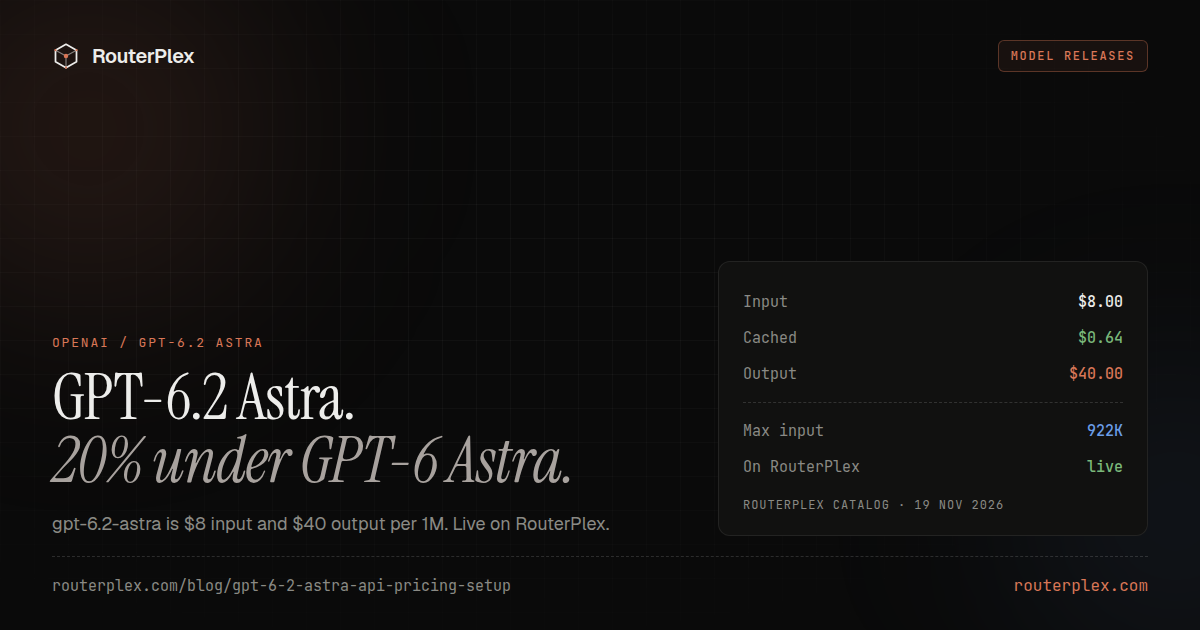
GPT-6.2 Astra API pricing is $8 per 1M input tokens and $40 per 1M output tokens, with cached input at $0.40. RouterPlex bills cached input at $0.64. Prompts over 272,000 input tokens bill the whole request at $16 input and $60 output per 1M. The model ID is gpt-6.2-astra, and it is live on RouterPlex since 19 November 2026 at the same $8 / $40 list rate.
That is 20% under GPT-6 Astra ($10 / $50) on both sides. The everyday sibling, GPT-6.2 Sol, costs $2 / $10.
Checked 19 November 2026: OpenAI's Introducing GPT-6.2 Astra and Sol, the GPT-6.2 Astra model card, the GPT-6.2 system card, and the live RouterPlex catalog. Scores below are OpenAI's reported results. Rates change. Read the checkout and the GPT-6.2 Astra price page before a large purchase.
Create a $5 RouterPlex account, put gpt-6.2-astra on a budgeted key, and send one request. The same prepaid key reaches Sol, Terra, Luna, and the rest of the catalog. Input and output bill at OpenAI's list price, with no top-up fee. The key stops at $0.
GPT-6.2 Astra API pricing
USD per 1M tokens. These are the rates RouterPlex bills on gpt-6.2-astra.
| Tier | Input | Output | Cache read |
|---|---|---|---|
| Standard (≤272K input) | $8.00 | $40.00 | $0.64 |
| Long context (>272K input) | $16.00 | $60.00 | $1.28 |
OpenAI's model card, checked the same day, lists this sheet for the same model:
| OpenAI line | Per 1M |
|---|---|
| Input | $8.00 |
| Cached input | $0.40 |
| Cache writes (30 minutes) | $10.00 |
| Output | $40.00 |
Input and output match OpenAI's list price. Cache reads do not. RouterPlex bills cached input at $0.64 per 1M, which is above OpenAI's $0.40. Our cache rate is set from what our upstream charges us for a cached token, with a floor of 8% of the input price. It does not copy the lab's rate. If most of your bill is cache hits, run the numbers both ways.
OpenAI also lists a 12-hour cache write at $20 per 1M and Batch at 50% of Standard. Fast mode costs 2x. Ultrafast costs 3x through 28 February 2027 and 6x from 1 March 2027. RouterPlex bills the standard rate in the first table. It does not sell Batch, Fast, or Ultrafast tiers on this ID.
A 40,000-token prompt that returns 2,000 tokens with no cache costs $0.40 on gpt-6.2-astra. The same turn costs $0.50 on gpt-6-astra. A $5 balance covers 625,000 input tokens, or 125,000 output tokens, if a workload used only one side. Reasoning tokens bill as output.
The 272K cliff on GPT-6.2 Astra
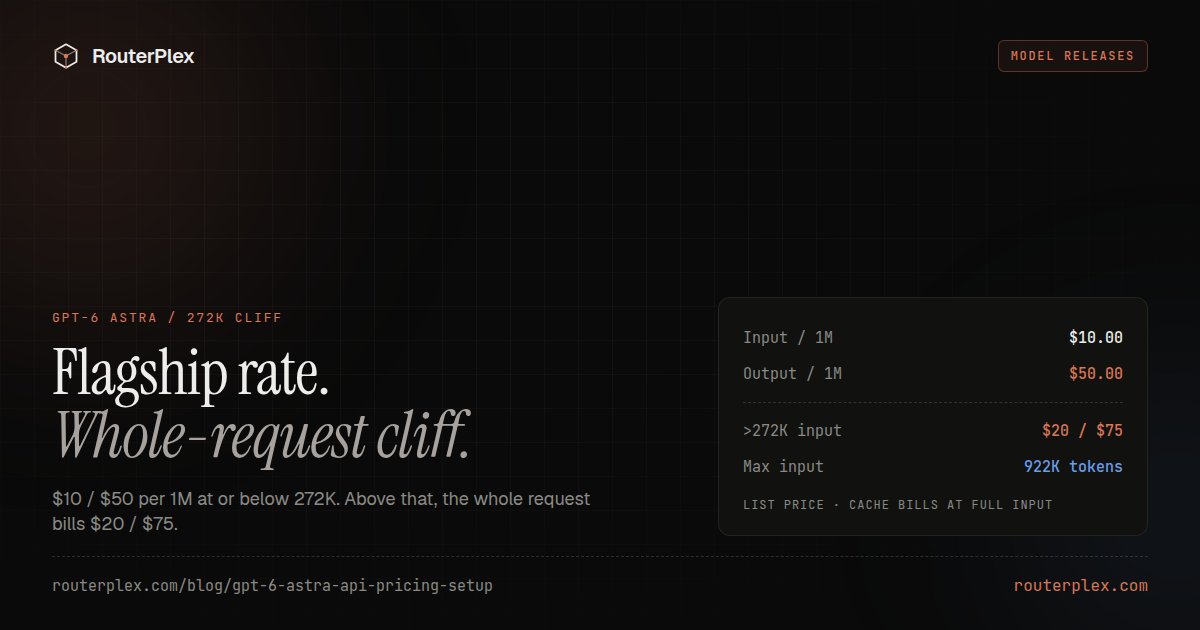
OpenAI's card says requests with more than 272K input tokens pay double the input and cache rates, and 1.5x the output rate, for the full request. RouterPlex applies the same rule.
271,000-token prompt on gpt-6.2-astra → 271,000 × $8.00/1M = $2.168273,000-token prompt on gpt-6.2-astra → 273,000 × $16.00/1M = $4.368
Two thousand extra tokens double the input bill. Output on that request moves from $40 to $60 per 1M. Coding agents that carry a whole repository in context hit this line first. Trim the prompt, or split the task, before you cross it.
GPT-6.2 Astra vs GPT-6 Astra
List prices on RouterPlex, USD per 1M tokens, and the cost of a 40,000-in / 2,000-out turn with no cache.
| Model | Input | Output | Cache read | 40K / 2K turn | Max input here |
|---|---|---|---|---|---|
gpt-6.2-astra | $8.00 | $40.00 | $0.64 | $0.400 | 922K |
gpt-6-astra | $10.00 | $50.00 | $0.80 | $0.500 | 922K |
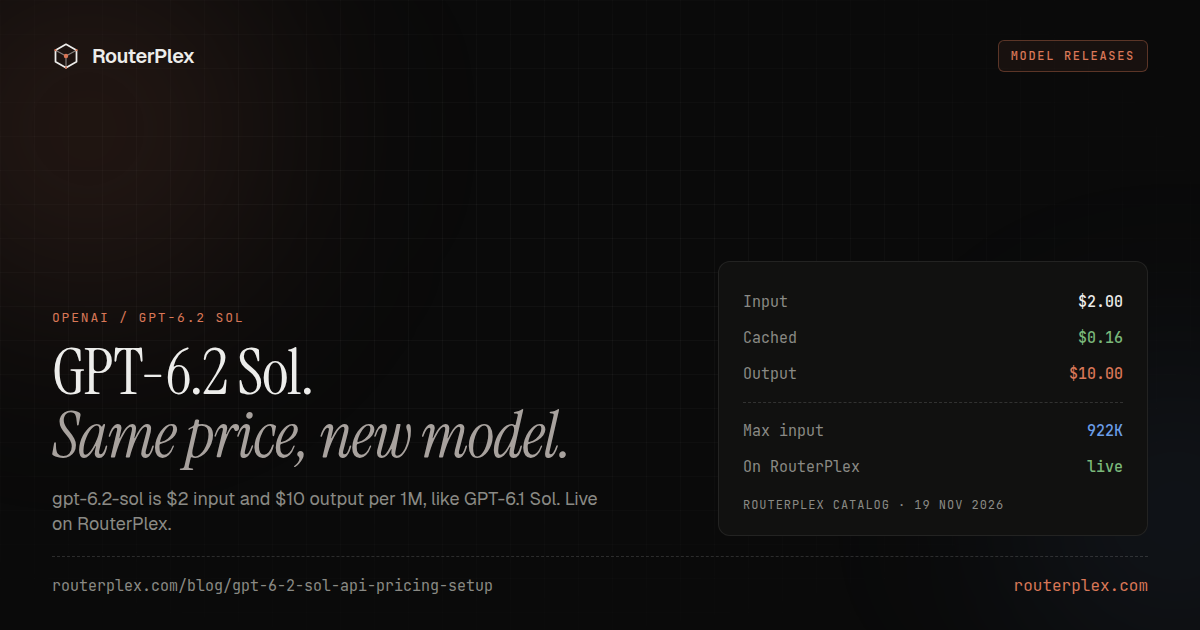
gpt-6.2-sol | $2.00 | $10.00 | $0.16 | $0.100 | 922K |
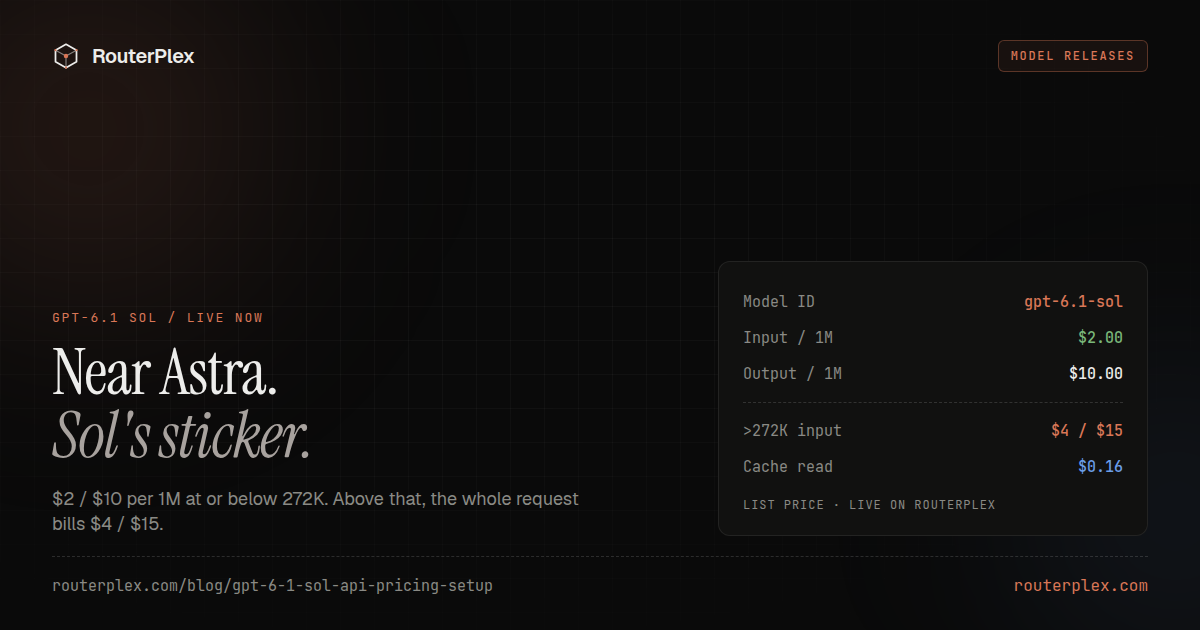
gpt-6.1-sol | $2.00 | $10.00 | $0.16 | $0.100 | 922K |
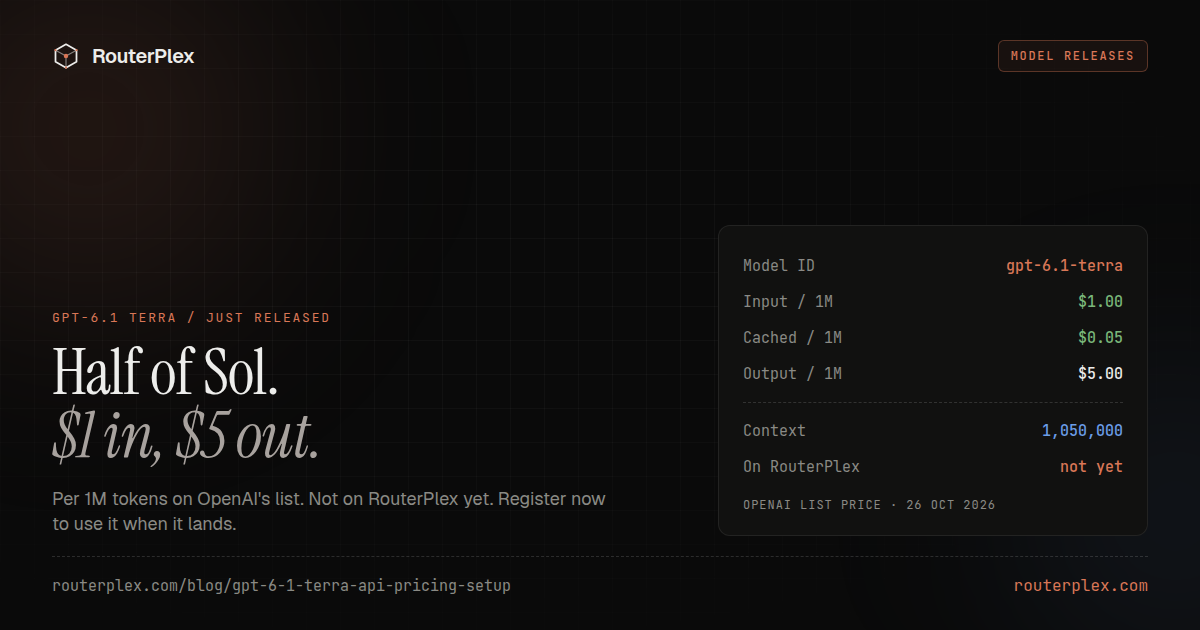
gpt-6.1-terra | $1.00 | $5.00 | $0.08 | $0.050 | 922K |
The sticker drop is 20%. OpenAI says the real saving per task is larger, because GPT-6.2 Astra also writes fewer output tokens. On its GDPval v2 benchmark, OpenAI reports Astra used 22% fewer output tokens than GPT-6 Astra while scoring 6.2 points higher. On Agents' Last Exam it reports a 5.2-point gain at less than a third of GPT-6 Astra's cost.
For most teams the move is simple. Point the old gpt-6-astra traffic at gpt-6.2-astra on a second key, run your own task set, and compare the usage rows. Keep the old ID until your results agree.
GPT-6.2 Astra benchmarks
These figures come from OpenAI's announcement, checked 19 November 2026. They are vendor-run. RouterPlex has not re-run them. The charts are interactive on OpenAI's page, so only the numbers stated in its text appear here.
| Eval | What OpenAI reports for GPT-6.2 Astra |
|---|---|
| Agents' Last Exam | New high. 5.2 points above GPT-6 Astra at less than a third of the cost, and 5.5 points above Claude Fable 5.2 at 5% of the cost |
| Terminal-Bench-Science 0.1 | 9 points above GPT-6 Astra at less than a third of the cost |
| Vals Science Index | New high (no score given in the text) |
| GDPval v2 | 6.2 points above GPT-6 Astra with 22% fewer output tokens |
| Harvey LAB-AA v1.1 | More than double Claude Fable 5.2's pass rate at about one sixth of the cost |
| AA-AnalystAgent | 62.5% of questions correct on all five independent attempts |
| AA-3D (human-judged 3D builds) | First at 1,318 Elo. Claude Fable 5.2 has 1,271 and GPT-6.2 Sol has 1,259 |
OpenAI notes that its Agents' Last Exam result for Fable 5.2 excludes nine tasks that used a fallback model. Its Terminal-Bench-Science figure for Fable 5.2 comes from Artificial Analysis. Anthropic reported 74.6% for Fable 5.2 when it ran the test in Claude Code.
What GPT-6.2 Astra is good at
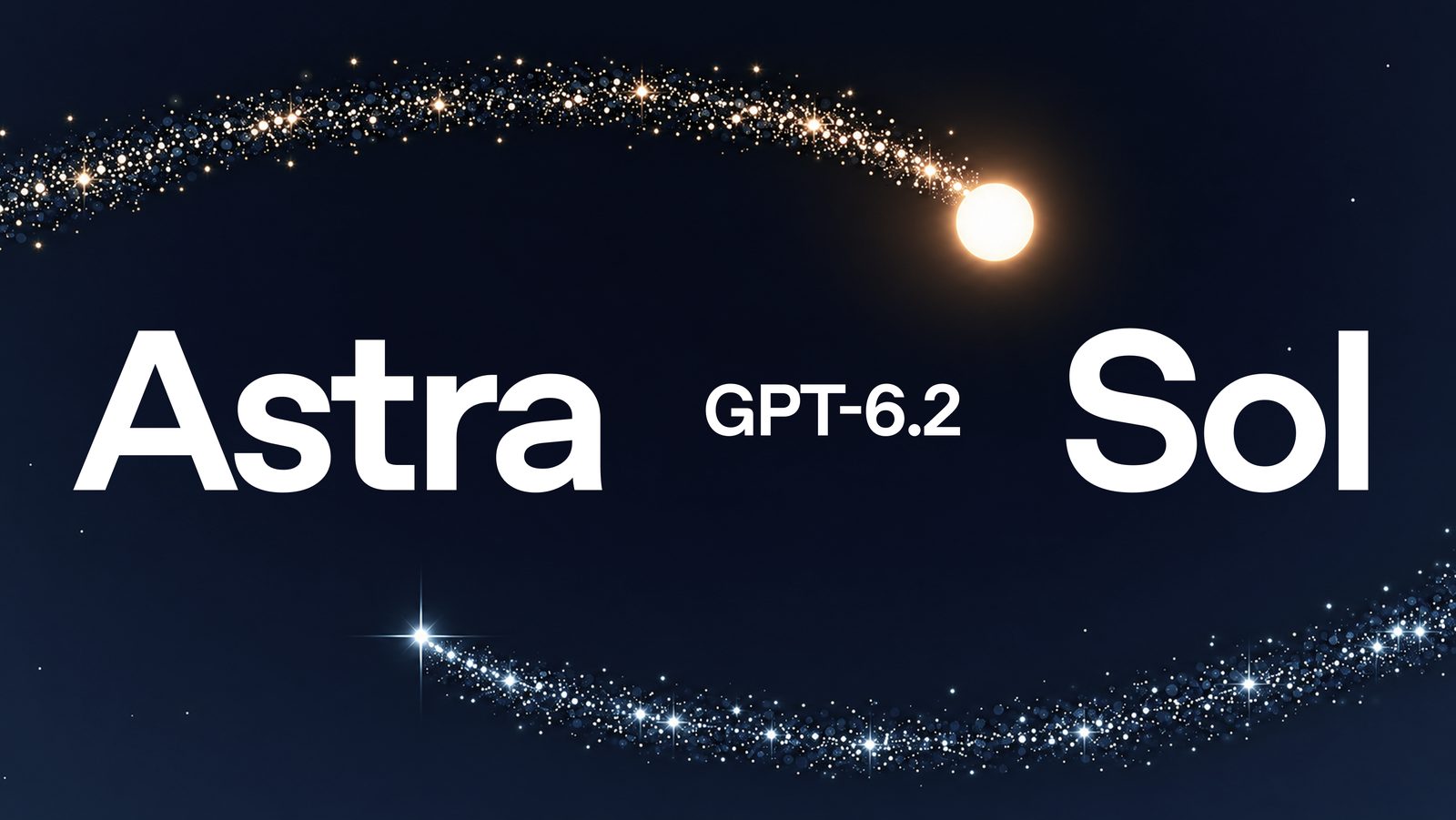
OpenAI pitches Astra at documents, spreadsheets, slides, front-end code, and computer use. Its slides follow a supplied template more closely, down to font size. The example below is OpenAI's own. Both models got the same brief to pitch team merch on OpenAI's slide template.
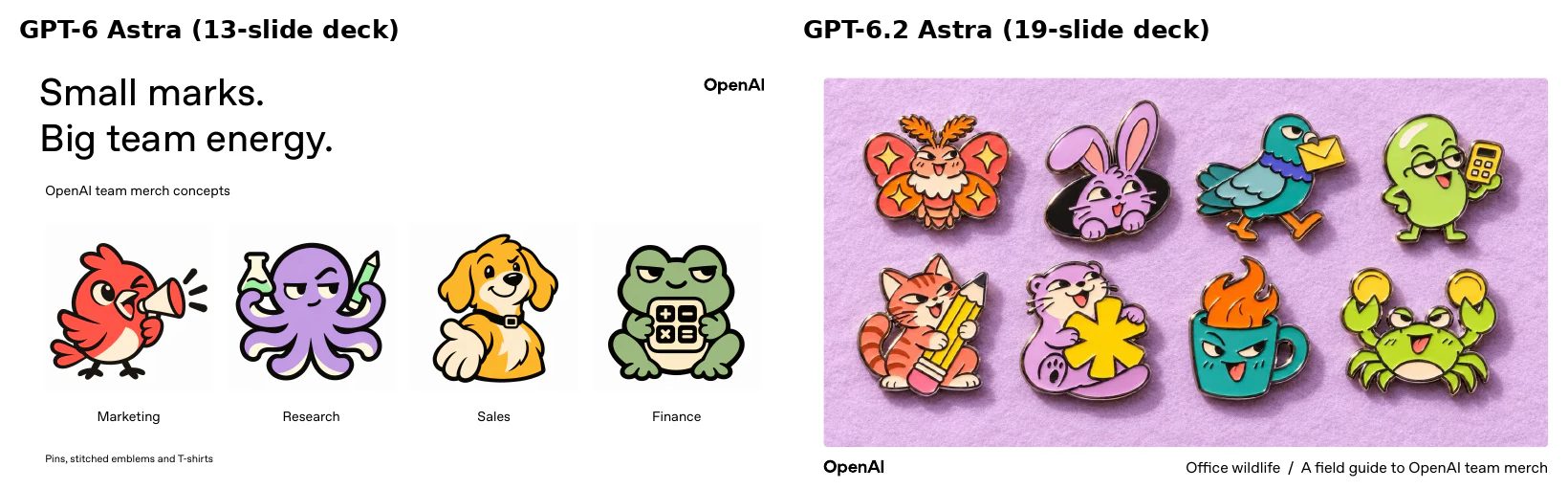
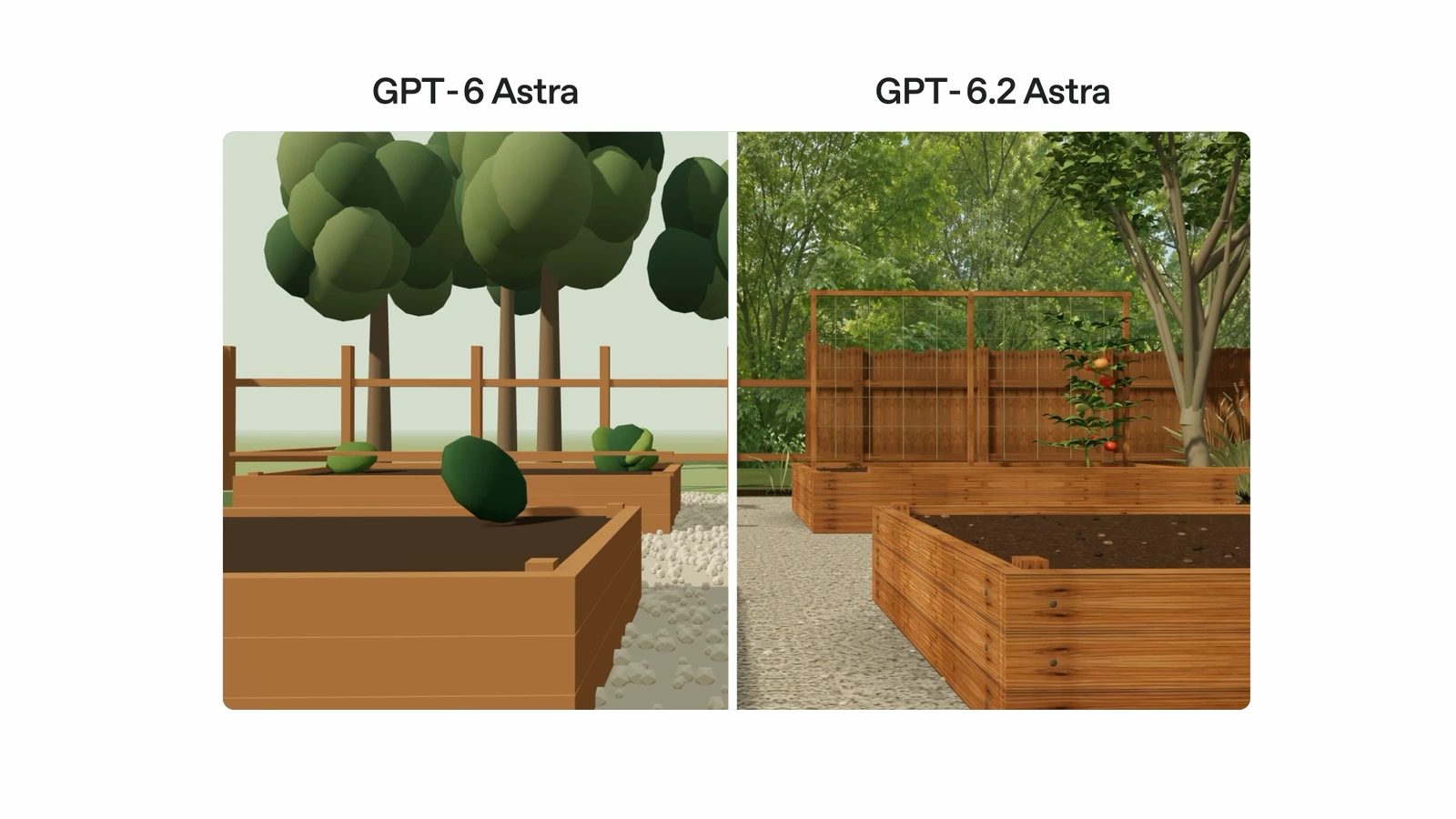
OpenAI says GPT-6.2 Astra produced all eight designs as pins, T-shirts, and patches, with vector artwork and print dimensions. GPT-6 Astra produced one design per team. OpenAI's page also shows a 3D scene from each model side by side.
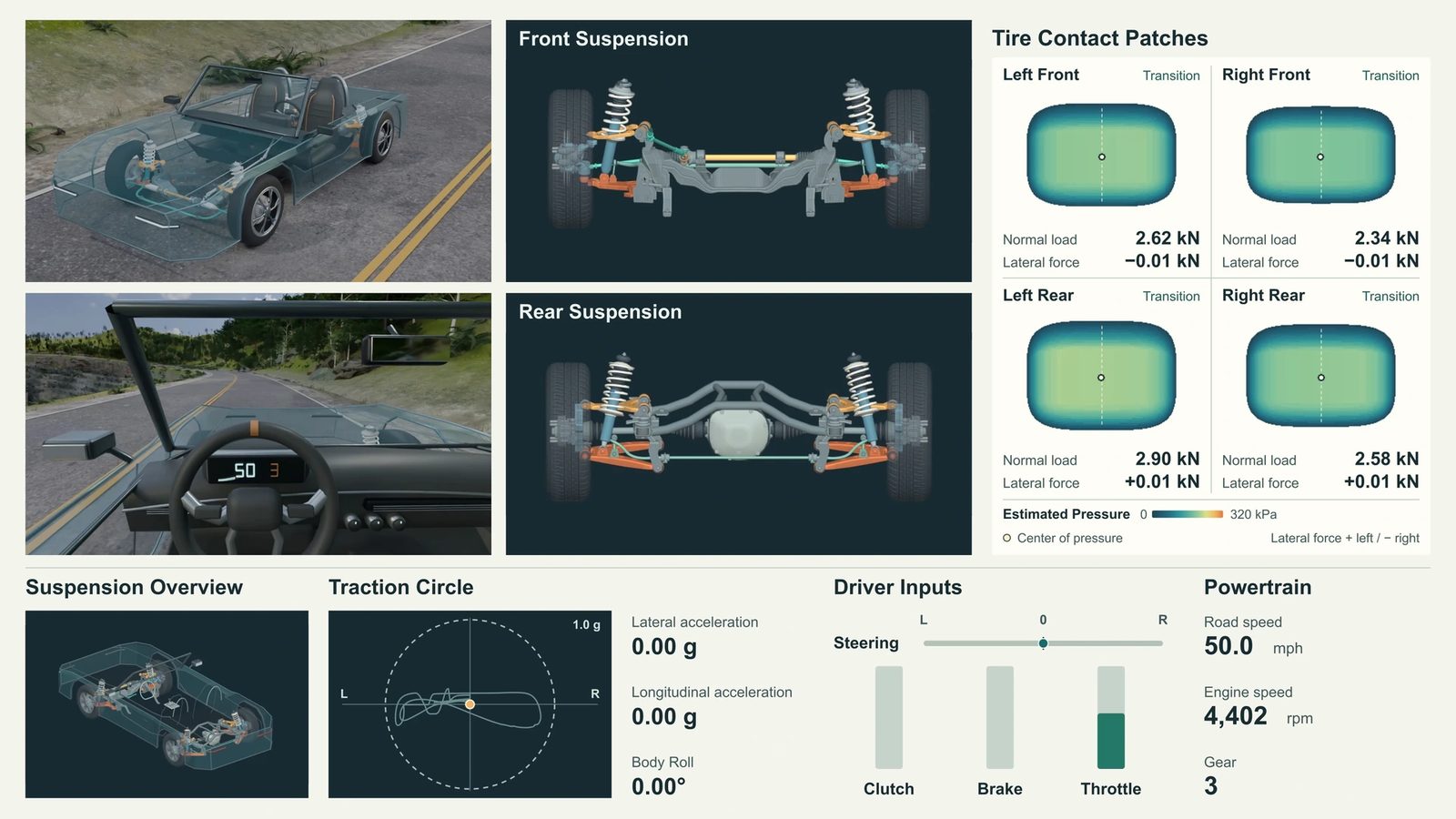
Engineering is the other headline. OpenAI had Astra model a car's chassis, write a Python solver for the tire and suspension dynamics, and animate the result. The dashboard below is from that demo.
GPT-6.2 Astra context window and model card
| Capability | GPT-6.2 Astra |
|---|---|
| Model ID | gpt-6.2-astra |
| Context window | 1,050,000 tokens |
| Max input | 922,000 tokens |
| Max output | 128,000 tokens |
| Knowledge cutoff | 18 May 2026 |
| Input / output | Text and image in, text out |
| Reasoning effort | Any level except none, which the API rejects |
| Endpoints on OpenAI | Chat Completions, Responses, Batch, Realtime and more |
The RouterPlex catalog lists 922,000 input tokens, the same max-input figure as the card. Hosted tools such as web search, file search, code interpreter, computer use, and MCP belong to OpenAI's Responses API. On RouterPlex, call this ID through Chat Completions or the Responses API at https://api.routerplex.com/v1.
Anthropic Messages clients use https://api.routerplex.com instead. OpenAI's card lists streaming, function calling, and structured outputs as supported.
Safety limits that change what Astra will answer
OpenAI rates GPT-6.2 Astra and Sol at the Critical level for cybersecurity and High for biological and chemical capability under its Preparedness Framework. Astra is the first model it has released that meets the High level for AI self-improvement.
The practical effect is tighter refusals on some security work. OpenAI says the new safeguards "also restrict some legitimate vulnerability research and security testing workflows". If your agent does exploit research or penetration testing, test it on your own prompts before you switch. The GPT-6.2 system card has the full results.
How to use the GPT-6.2 Astra API
Install the official SDK (pip install openai) and point it at RouterPlex. The key comes from your environment, never from the code.
import osfrom openai import OpenAIclient = OpenAI(api_key=os.environ["ROUTERPLEX_API_KEY"],base_url="https://api.routerplex.com/v1",)response = client.chat.completions.create(model="gpt-6.2-astra",messages=[{"role": "user", "content": "Find the weakest assumption in this valuation model."}],)print(response.choices[0].message.content)
curl https://api.routerplex.com/v1/chat/completions \-H "Authorization: Bearer $ROUTERPLEX_API_KEY" \-H "Content-Type: application/json" \-d '{"model": "gpt-6.2-astra","messages": [{"role": "user", "content": "Find the weakest assumption in this valuation model."}]}'
Claude Code and the Anthropic SDK use ANTHROPIC_BASE_URL=https://api.routerplex.com and model gpt-6.2-astra. The Claude Code setup guide has the full configuration. Codex CLI can use a custom provider, and Cursor can override the OpenAI base URL.
Where GPT-6.2 Astra calls go wrong
- A 402 error means the key has no credit left. RouterPlex is prepaid, so a key stops at $0 instead of going negative. Add credit and send the request again.
- A
model_not_founderror usually means a typo in the ID. Usegpt-6.2-astrawith a dot and a hyphen. Spellings likegpt-6-2-astraandGPT-6.2-Astrafail. - A 404 often points to the wrong base URL. The OpenAI SDK needs
https://api.routerplex.com/v1. The Anthropic SDK needshttps://api.routerplex.comwith no/v1. - OpenAI's card says its API rejects
reasoning_effort: "none". Leave the field out, or pick a higher level, so your code works on any provider. OpenAI's card says the API refuses that value. Leave the field out, or pick a higher level. - A bill that doubled usually traces back to prompt size. Past 272K input tokens, the whole request moves to $16 / $60.
Start the $5 test
Create a RouterPlex account and add $5 of prepaid credit. That is not a subscription. Put gpt-6.2-astra on its own key, set a hard budget, and send the Python snippet above. Read the usage row before you raise the cap. If the task fits a cheaper model, try GPT-6.2 Sol at $2 / $10. The pricing page lists the fees. Input and output bill at the vendor list price, and a top-up costs $0 in fees. Gateways that charge a top-up fee are compared on RouterPlex vs OpenRouter.
Common questions
Frequently asked questions
How much does the GPT-6.2 Astra API cost?
OpenAI lists GPT-6.2 Astra at $8 per 1M input tokens and $40 per 1M output tokens, checked 19 November 2026. That is 20% below GPT-6 Astra's $10 and $50. OpenAI's cached input price is $0.40 per 1M and a 30-minute cache write is $10 per 1M. When a request carries more than 272,000 input tokens, the whole request bills at double the input and cache rates and 1.5 times the output rate, so $16 input and $60 output. RouterPlex bills the same $8 and $40 on model ID gpt-6.2-astra with no top-up fee. Its cache reads are $0.64 per 1M, above OpenAI's $0.40. Reasoning tokens count as output, so a long chain of thought raises the output side of the bill.
Is GPT-6.2 Astra available on RouterPlex?
Yes. The model ID is gpt-6.2-astra and it went live on RouterPlex on 19 November 2026. Point the OpenAI Python SDK at https://api.routerplex.com/v1, or the Anthropic SDK at https://api.routerplex.com, and send a request with a prepaid key. A $5 balance is enough for a first test: it covers about 625,000 input tokens or 125,000 output tokens. The key stops at $0 and never goes negative, and you can set a hard spend budget on each key. The same key also reaches GPT-6.2 Sol, GPT-6.1 Terra, and the rest of the RouterPlex catalog.
What is the GPT-6.2 Astra cached input price on RouterPlex?
RouterPlex bills cache reads on gpt-6.2-astra at $0.64 per 1M tokens, and $1.28 per 1M once a prompt crosses 272K input tokens. OpenAI's own card lists cached input at $0.40, so our cache rate is higher than OpenAI's. RouterPlex sets cache prices from what its upstream charges for a cached token, with a floor of 8% of the input price, instead of copying the lab's rate. Input and output are billed at OpenAI's list price. If your workload is mostly cache hits, compare the totals before you move it. RouterPlex does not publish a separate cache-write price, Batch tier, or Ultrafast tier for this ID.
How does GPT-6.2 Astra compare with GPT-6 Astra?
GPT-6.2 Astra costs $8 and $40 per 1M tokens against GPT-6 Astra's $10 and $50, a 20% cut on both sides. On RouterPlex a 40,000-token prompt with a 2,000-token reply costs $0.40 on the new ID and $0.50 on the old one. OpenAI also reports better results with fewer tokens. On GDPval v2 it scored 6.2 points higher while writing 22% fewer output tokens. On Agents' Last Exam it scored 5.2 points higher at less than a third of the cost, and on Terminal-Bench-Science 0.1 it gained 9 points. These are OpenAI's numbers, checked 19 November 2026. Run your own task set before you retire gpt-6-astra.
What is the GPT-6.2 Astra context window?
OpenAI's model card lists a 1,050,000-token context window, 922,000 maximum input tokens, and 128,000 maximum output tokens. The RouterPlex catalog lists the same 922,000 input tokens. The knowledge cutoff is 18 May 2026. GPT-6.2 Astra takes text and images as input and returns text. Keep the 272K line in mind: above 272,000 input tokens the whole request bills at $16 input and $60 output per 1M on both OpenAI and RouterPlex. Reasoning effort can be set to any level except none, which OpenAI's API rejects. The card lists streaming, function calling, and structured outputs as supported.
Why does GPT-6.2 Astra refuse some security tasks?
OpenAI rates GPT-6.2 Astra and Sol at the Critical level for cybersecurity under its Preparedness Framework, so it launched both with tighter safeguards for higher-risk security help. OpenAI says these protections also restrict some legitimate vulnerability research and security testing workflows. If your agent does exploit research, binary analysis, or penetration testing, test your own prompts on gpt-6.2-astra before you switch production traffic. OpenAI says it will work to bring GPT-6.2 models to its Daybreak program for vetted defenders. Details are in the GPT-6.2 system card, checked 19 November 2026.
Run the smallest paid test.
Add $5, cap the key, and verify the result with your own workload. No subscription, and credit never expires — a first top-up of $25+ is matched with $25 extra.