OpenAI Decisions API Pricing: $0.10 Input, Free Output
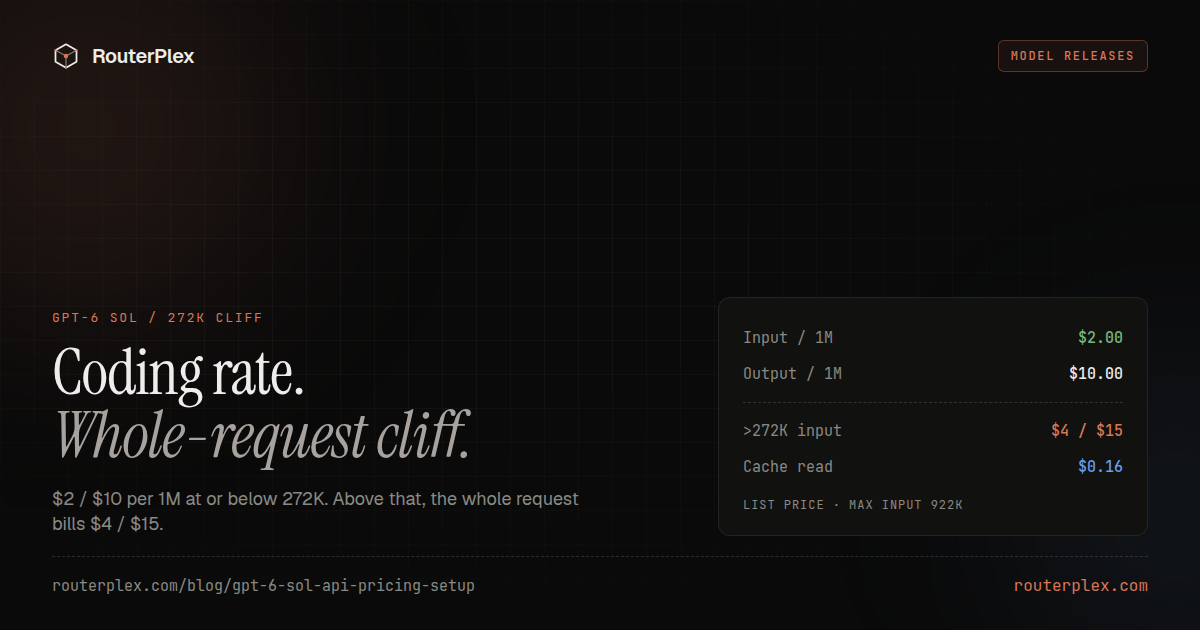
OpenAI Decisions API pricing: $0.10 per 1M input, $0.01 cached, output free, 400 questions per call. Compared with Jev, Clef and Mercury Decide.
Model releases·Published ·By RouterPlex·9 min
One API key for every model on RouterPlex: vendor list price, $0 top-up fee, from $5.
Create a key
On this page
OpenAI Decisions API pricing is $0.10 per 1M uncached input tokens and $0.01 per 1M cached input tokens. Output is not charged. The endpoint is POST /v1/decisions, the only model is gpt-6-luna, and one request can carry up to 400 questions. OpenAI made the API generally available on 22 October 2026.
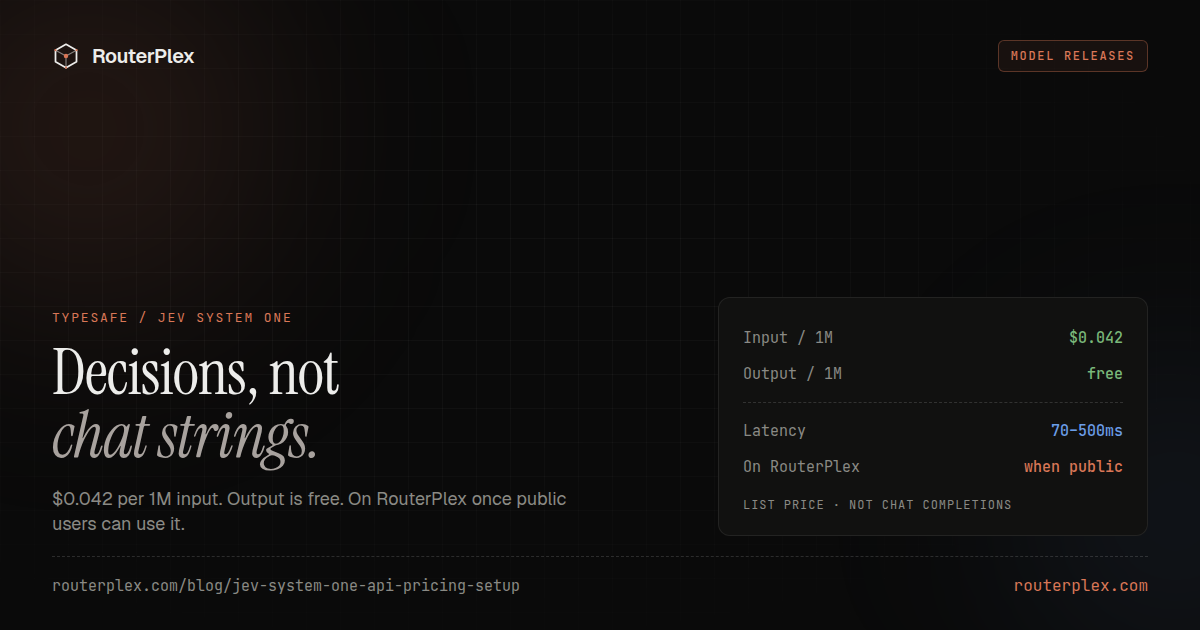
That puts OpenAI's input rate at about 2.4x TypeSafe's Jev at list price, and above every decision model in this post except Cloudflare's clef and clef-omni. With a warm cache, though, OpenAI can be the cheaper one. The tables below show where that line falls.
Checked 5 November 2026: OpenAI Decisions guide, GA announcement, OpenAI pricing, Inception models, RouterPlex decision model docs. Rates change. Read the checkout before a large purchase.
RouterPlex publishes this comparison and sells the prepaid wallet described below. RouterPlex does not resell OpenAI Decisions.
OpenAI Decisions API pricing at a glance
| Item | OpenAI Decisions API |
|---|---|
| Endpoint | POST https://api.openai.com/v1/decisions |
| Model | gpt-6-luna (the only supported model) |
| Uncached input | $0.10 per 1M tokens |
| Cached input | $0.01 per 1M tokens |
| Cache writes | $0.125 per 1M (30 minutes), $0.25 per 1M (12 hours) |
| Output | Not charged |
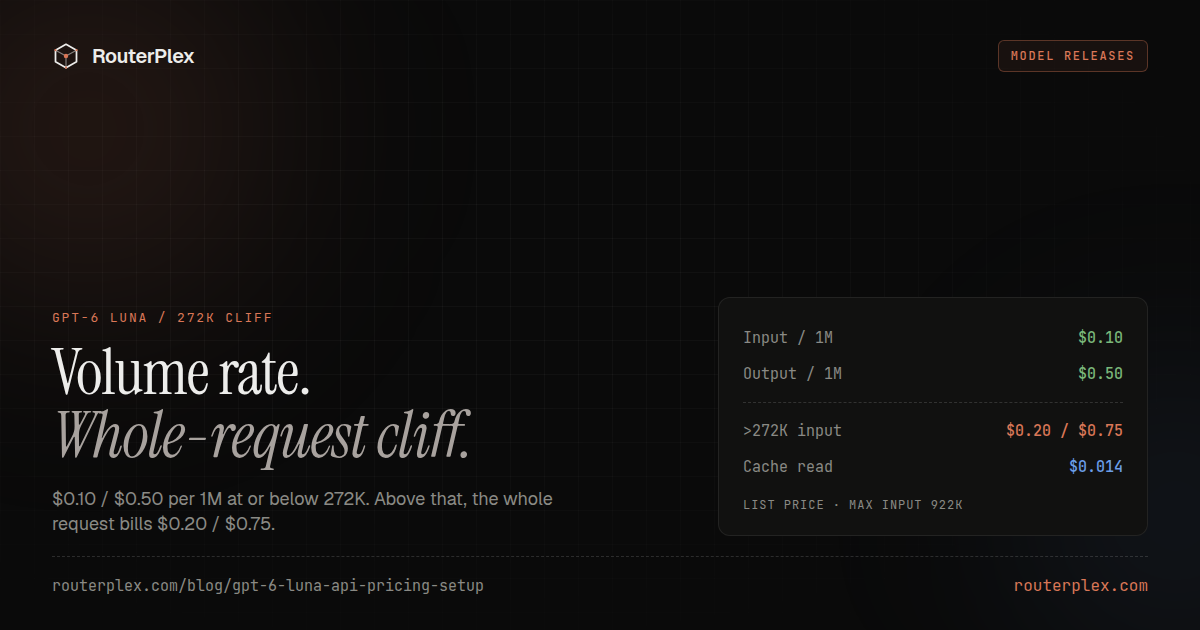
| Long context (over 272K input) | $0.20 uncached, $0.02 cached per 1M |
| Questions per request | 1 to 400 |
| Status | Generally available since 22 October 2026 |
A decision model answers typed questions about some input. It returns a probability, a choice, or a score. It does not write text. Every model in this post bills input only.
The cache write rates come from OpenAI's pricing page. The Decisions guide says writes match the standard gpt-6-luna caching rates. It also says regional processing premiums apply. OpenAI's pricing page puts that premium at 10% for data-residency endpoints.
What one decision call costs
Input tokens include the shared input plus the text of every question. Here is the math for three common shapes at OpenAI's rates.
| Call shape | Input tokens | Math | Per call | Per 1M calls |
|---|---|---|---|---|
| Routing call, 1 question | 500 uncached | 500 x $0.10 / 1M | $0.00005 | $50 |
| 5K context, 50 questions | 5,000 uncached | 5,000 x $0.10 / 1M | $0.0005 | $500 |
| Same call, warm cache | 4,500 cached + 500 new | $0.000045 + $0.00005 | $0.000095 | $95 |
The warm-cache row assumes the shared context and question set repeat, and only the last 500 tokens change. The first call in each cache window also pays a write. At the 30-minute rate, writing 4,500 tokens costs about $0.00056, once.
Packing questions pays off. Fifty questions about one ticket in one call share the same input. Fifty separate calls would send that input fifty times.
Decision model API pricing: OpenAI Decisions API vs Jev, Clef and Mercury Decide
| Vendor | Model id | Input / 1M | Cached / 1M | Output | Context | How to call it |
|---|---|---|---|---|---|---|
| OpenAI | gpt-6-luna | $0.10 | $0.01 | Free | Over 272K costs 2x | OpenAI API key, /v1/decisions |
| TypeSafe | jev-latest | $0.042 list | None listed | Free | 64,000 | RouterPlex /v1/systemone |
| Qwen | decision-model-preview | $0.045 (no vendor list; our cost) | None listed | Free | 65,536 | RouterPlex /v1/systemone |
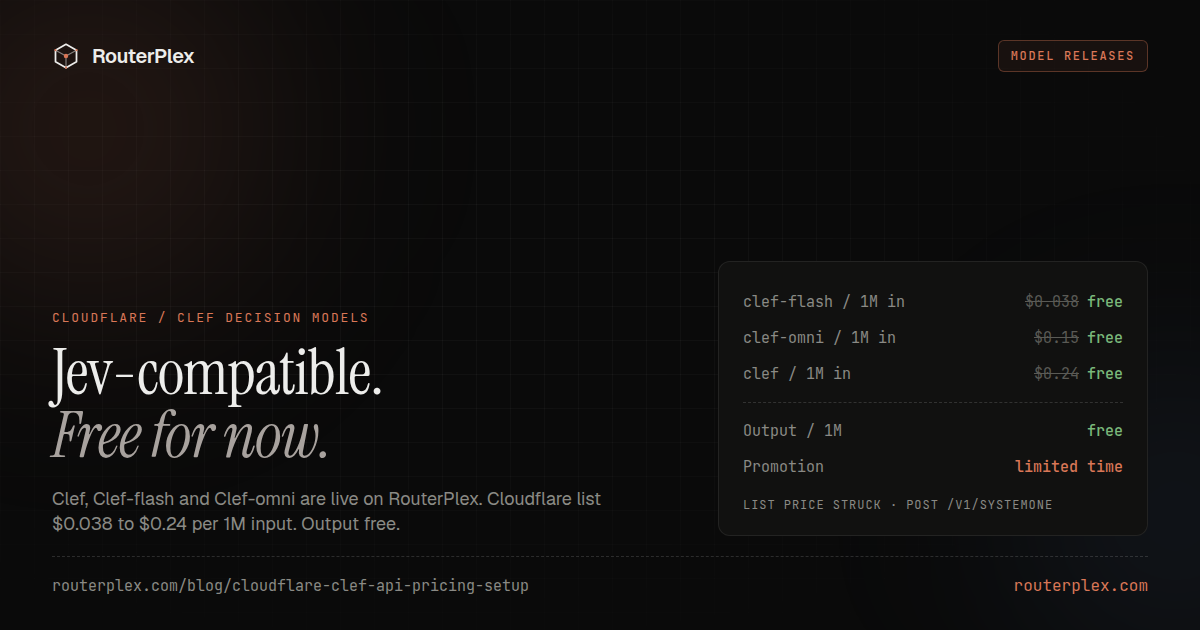
| Cloudflare | clef | $0.24 list | None listed | Free | 65,536 | RouterPlex /v1/systemone |
| Cloudflare | clef-flash | $0.038 list | None listed | Free | 24,576 | RouterPlex /v1/systemone |
| Cloudflare | clef-omni | $0.15 list | None listed | Free | 64,000 | RouterPlex /v1/systemone |
| Inception | Mercury Decide | $0.02 (50% off $0.04) | None listed | Free | Not published | Contact sales |
All rows checked 5 November 2026. The five RouterPlex models are free during the current launch promotion, and the list price is what they bill when it ends. Calls still need an active balance. See Jev, Clef Flash and decision-model-preview for the live rate.
Now the same three call shapes at list price:
| Per 1M calls | OpenAI | Jev | clef-flash | Mercury Decide (promo) |
|---|---|---|---|---|
| 500-token routing call | $50 | $21 | $19 | $10 |
| 5,000-token call, no cache | $500 | $210 | $190 | $100 |
| 5,000-token call, warm cache | $95 | $210 | $190 | $100 |
On short or uncached calls, OpenAI costs about 2.4x Jev. On long calls that repeat the same context, OpenAI's $0.01 cached rate wins, because the other models list no cache discount. Tokenizers differ, so the same text can count as a different number of tokens on each model. Treat these rows as estimates and measure your own prompts.
Inception says Mercury Decide is 50% off with no end date, and access goes through sales. Inception also claims Mercury Decide beats Jev on its benchmarks. It has not published the scores, so we do not repeat any.
What changed when the GPT-6 Luna Decisions API reached GA
The beta started on 6 October 2026. General availability on 22 October brought five changes that matter for cost and design.
Each request now takes up to 400 questions, up from 200 in the beta. Guides written in early October still say 200.
Prompt caching arrived. A repeated prefix now bills at $0.01 per 1M instead of $0.10. The response shows cached and written tokens, so you can check that the cache is working.
JSON input is native. A user message can carry an input_json part with a data field, so you can send a record without turning it into text first.
Per-question images are allowed. A question's instructions can be an array of input_text and input_image parts. That lets one question compare the input to a reference picture.
GPT-Live has a native Decisions integration, so a voice session can ask typed questions mid-call. OpenAI also added hosted image URLs, tool call history as input, an organization usage report for Decisions, and Private Link.
Question types and limits
OpenAI supports three question types. Each one returns a different answer shape.
| Type | What it asks | Extra fields | Answer fields |
|---|---|---|---|
predicate | Is this true? | None | probability, 0 to 1 |
choice | Pick one option | choices, each with value and description | choice, probabilities, confidence |
score | Rate on ordered levels | levels, 2 to 10, each with label and description | score, probabilities, confidence |
The input can be a string or a list of messages. User messages accept text, images (base64 or a public URL) and JSON. Tool calls and tool outputs are accepted too. Files, audio and file_id references are not supported.
Answers arrive in an answers array. Each answer carries the type and the name you gave the question. The model can also refuse a question. That answer comes back with type set to refusal, so check for it before you read a probability.
OpenAI says the endpoint returns typed answers "about 10x faster than the Responses API." That is OpenAI's claim. It has not published latency numbers.
Call it: OpenAI direct, or a decision model through RouterPlex
For OpenAI Decisions, call OpenAI with an OpenAI key. This is the choice example from OpenAI's guide:
curl https://api.openai.com/v1/decisions \-H "Authorization: Bearer $OPENAI_API_KEY" \-H "Content-Type: application/json" \-d '{"model": "gpt-6-luna","input": "I was charged twice for my order.","questions": [{"type": "choice","name": "department","instructions": "Which department should handle this complaint?","choices": [{"value": "billing", "description": "Payments, invoices, and refunds."},{"value": "technical", "description": "Problems using the product."},{"value": "shipping", "description": "Delivery and tracking."},{"value": "other", "description": "Requests outside these categories."}]}]}'
For Jev or Clef, use your RouterPlex key and /v1/systemone. The shape is different. You send a state and a map of named questions, and the true/false type is called noul.
curl https://api.routerplex.com/v1/systemone \-H "Authorization: Bearer $ROUTERPLEX_API_KEY" \-H "Content-Type: application/json" \-d '{"model": "jev-latest","state": "I was charged twice for my order.","questions": {"is_urgent": {"type": "noul", "instructions": "Does this convey urgency?"},"department": {"type": "choice","instructions": "Which department should handle this complaint?","criteria": {"billing": "Payments, invoices, refunds", "technical": "Problems using the product", "shipping": "Delivery and tracking"}}}}'
Change jev-latest to clef-flash, clef, clef-omni or decision-model-preview to try another model. The request stays the same. Field details are in the decision model docs.
Where it goes wrong
| Symptom | Cause | Fix |
|---|---|---|
Error on api.routerplex.com/v1/decisions | RouterPlex does not proxy OpenAI Decisions | Call OpenAI directly, or switch to /v1/systemone |
400 on /v1/systemone | OpenAI's questions array or predicate type sent to Jev | Use a questions object and noul |
402 on /v1/systemone at a $0 price | The RouterPlex balance is used up | Top up; the promotion still needs an active balance |
| Decision model in Cursor or Claude Code fails | Decision models are not chat models | Use a chat model id there |
| A 200-question limit in old code | Beta-era cap | Raise it to 400 for OpenAI |
Which decision model should you use
Pick OpenAI Decisions if you need images, GPT-Live voice, or tool history as input. It is also the better price when long, repeated context hits the cache.
Pick clef-flash or Jev for the lowest uncached input rate. Clef Flash lists at $0.038 and Jev at $0.042 per 1M. Both are free on RouterPlex during the promotion. Clef Flash has the smallest window at 24,576 tokens, so size your state against it.
Pick a RouterPlex decision model if your agents already run on one RouterPlex key. You get one prepaid balance and a hard per-key budget. A request stops at $0 instead of going negative. The gpt-6-luna chat route is live in the RouterPlex catalog at $0.10 input and $0.50 output. Chat model rates for both gateways are in the OpenRouter comparison and the model index. For more on each decision model, read the Jev post and the Clef post.
Create a $5 RouterPlex account and run your first decision on jev-latest. It is free during the launch promotion and needs an active balance.
Common questions
Frequently asked questions
Is output free on the OpenAI Decisions API?
Yes. OpenAI's Decisions guide says output tokens are not charged on POST /v1/decisions. You pay for input only: $0.10 per 1M uncached tokens and $0.01 per 1M cached tokens on gpt-6-luna. The same model costs $0.50 per 1M output on other endpoints, so the free output applies to Decisions only. Every other decision model in this post (Jev, Clef, decision-model-preview and Mercury Decide) also bills input only. Checked 5 November 2026 on OpenAI's Decisions guide and the GA announcement of 22 October 2026.
Does the Decisions API have a cached input rate?
Yes. Prompt caching arrived with general availability on 22 October 2026. A cache hit costs $0.01 per 1M input tokens, a tenth of the $0.10 uncached rate. Cache writes are charged at gpt-6-luna's normal write rates, which OpenAI's pricing page lists as $0.125 per 1M for a 30-minute write and $0.25 per 1M for a 12-hour write. The response reports cached_tokens and cache_write_tokens under usage.input_tokens_details, so you can see what each call paid for. Checked 5 November 2026.
Can I call OpenAI Decisions through RouterPlex?
No. RouterPlex does not proxy POST /v1/decisions. Call OpenAI directly with an OpenAI key for that endpoint. RouterPlex sells decision models on its own endpoint, POST https://api.routerplex.com/v1/systemone, with jev-latest, decision-model-preview, clef, clef-flash and clef-omni. The request shape there is different: a state plus a map of named questions. gpt-6-luna is live in the RouterPlex chat catalog at $0.10 input and $0.50 output, for chat requests only.
How many questions can one Decisions API request carry?
Between 1 and 400. OpenAI raised the cap from 200 to 400 when the API left public beta on 22 October 2026. Each question needs a unique name, and the answer comes back under that name. Every question counts toward input tokens, and so does the shared input. Packing many questions into one call therefore costs less than repeating the same input across many calls. Older beta guides that still say 200 questions are out of date. Checked 5 November 2026 on OpenAI's Decisions guide and changelog.
Is the Batch API cheaper for Decisions?
OpenAI has not said. Its pricing page lists a gpt-6-luna Batch input rate of $0.05 per 1M and a Fast rate of $0.20 per 1M. The Decisions guide does not say whether those tiers apply to POST /v1/decisions. Until OpenAI confirms it, plan your budget on the $0.10 uncached and $0.01 cached rates. The guide does say regional processing premiums and long-context multipliers apply, so data-residency endpoints and inputs over 272K tokens cost more. Checked 5 November 2026.
Is Jev still free on RouterPlex?
Yes, as of 10 November 2026. Jev, decision-model-preview and the three Clef models are free on RouterPlex during the launch promotion. The promotion has no announced end date. When it ends, RouterPlex bills each one at its list price with no markup: $0.042 per 1M input for Jev, $0.045 for decision-model-preview (our cost, since no vendor publishes a list price), and $0.038 to $0.24 for Clef. Output stays free. Calls still need an account with an active balance, and a used-up balance returns 402 even when the price is $0.
Run the smallest paid test.
Add $5, cap the key, and verify the result with your own workload. No subscription, and credit never expires — a first top-up of $25+ is matched with $25 extra.