Kimi K3.1 Pro Abliterated API: $4/$6.50 Pricing and Setup
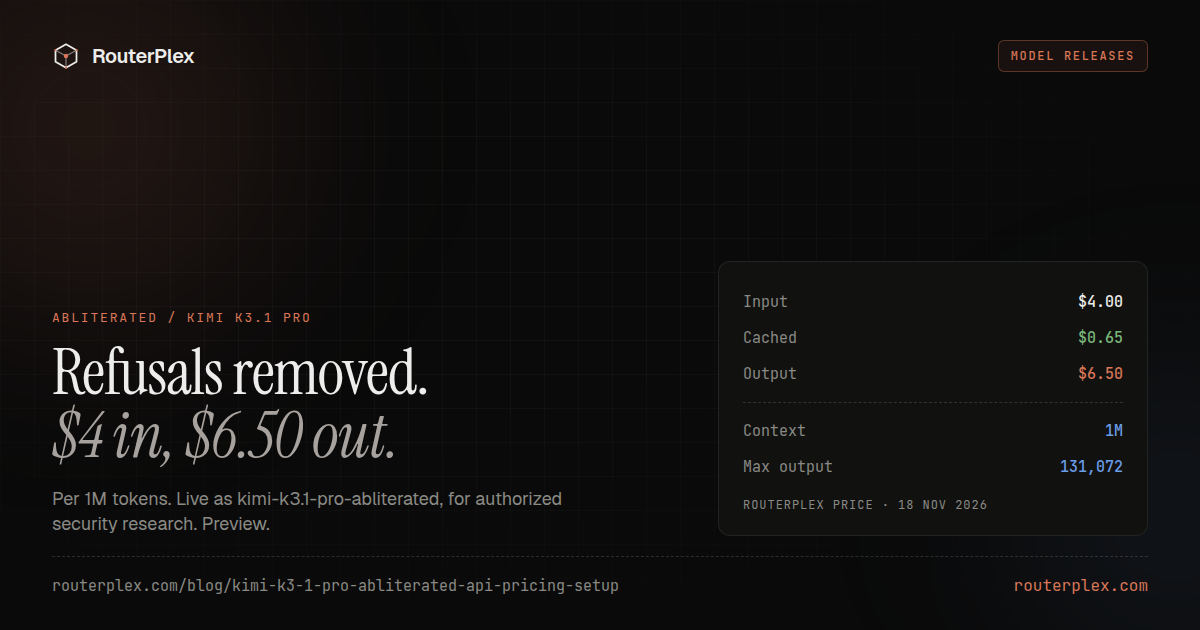
Kimi K3.1 Pro Abliterated API: $4 input, $6.50 output per 1M tokens on RouterPlex, 1M context, for authorized security research. Checked 18 Nov 2026.
Model releases·Published ·By RouterPlex·8 min
On this page
Key facts
As of November 18, 2026
kimi-k3.1-pro-abliterated: $4.00 input, $0.65 cached, $6.50 output per 1M, a RouterPlex rate checked 18 November 2026.- Stock
kimi-k3.1-prois $2.00 / $10.00: the abliterated build costs more on input and less on output. - 1M context, 131,072 max output, tool calls, image input, reasoning (low, high, max), streaming, and caching.
- Slow by design: short requests took 30 to 40 s in our tests. Stream, and set long client timeouts.
- Paid credit only, requests stored 1 to 365 days for abuse review, and the full terms still apply.
Kimi K3.1 Pro Abliterated API pricing on RouterPlex is $4.00 per 1M input tokens and $6.50 per 1M output tokens. Cached input is $0.65, and the model id is kimi-k3.1-pro-abliterated. Prices checked 18 November 2026. The route was added on 18 November 2026 and is in preview. Its page is Kimi K3.1 Pro Abliterated.
This is an abliterated build of Moonshot AI's Kimi K3.1 Pro open weights. The refusal behaviour was removed from the weights, so the model takes on security work that the stock model declines. RouterPlex sets the rate. No vendor list price exists for an abliterated checkpoint.
RouterPlex publishes this page and sells the prepaid wallet described below.
Create a free RouterPlex account and add a paid top-up. Put a hard spend cap on the key, then send one short request before you move a real job onto this id.
Acceptable use
Removing refusals from the weights does not remove the RouterPlex terms. Every request to this model falls under section 04 (acceptable use, all models) and section 05 (abliterated models). RouterPlex strictly prohibits:
- Sexual or adult content of any kind, in text or images. That includes erotica, explicit sexual role-play, and adult, companion, or romantic chatbots. This ban covers every model on RouterPlex, this one included.
- Anything involving minors that sexualises, exploits, or abuses them. This leads to immediate permanent termination, and RouterPlex reports it to the authorities where the law requires or permits.
- Attacks on systems that are not yours. You must not test, scan, attack, or gain access to any system, network, app, or account that you do not own or are not explicitly authorised in writing to test. You must not create malware or exploits for use against such systems. RouterPlex may ask you for proof of that authorisation.
- Weapons, including explosives and chemical, biological, radiological, or nuclear weapons.
- Illegal use, and content that facilitates serious harm to others, such as harassment or fraud.
A model that does not refuse a request does not make that request permitted. RouterPlex stores every request you send to an abliterated model, with your account identifier, the model name, and the time. Stored requests are kept for 1 to 365 days and reviewed for abuse. Requests to other models are not stored. The privacy policy states the same rule.
If you break these rules, RouterPlex may suspend or permanently ban the account without notice. Any remaining balance is forfeited and is not refunded. If you do not accept request storage, do not use abliterated models.
What it is for
Stock models often refuse legitimate security work. This route answers it. Typical jobs:
- Authorized penetration testing. Test plans and reports for systems you own or have written permission to test.
- Red-teaming your own LLM apps. Real attack prompts against your own guardrails, to see where they fail.
- CVE analysis. How a disclosed bug works, which versions it affects, and how to patch it.
- Malware analysis for defense. Read a suspicious script you captured and explain what it does.
- Detection engineering. Turn that analysis into detection rules for your own logs.
It also helps with work that stock models refuse by mistake. Examples include classifying medical, legal, or safety-research text, and labeling content-moderation datasets, such as threats, hate speech, and scam messages, for your own filters.
Authorized work is your responsibility. The model can be wrong, so check what it gives you before you act on it. Background on the weight edit is in what abliteration is.
Kimi K3.1 Pro Abliterated API pricing
USD per 1M tokens, checked 18 November 2026.
| Line | kimi-k3.1-pro-abliterated | Stock kimi-k3.1-pro |
|---|---|---|
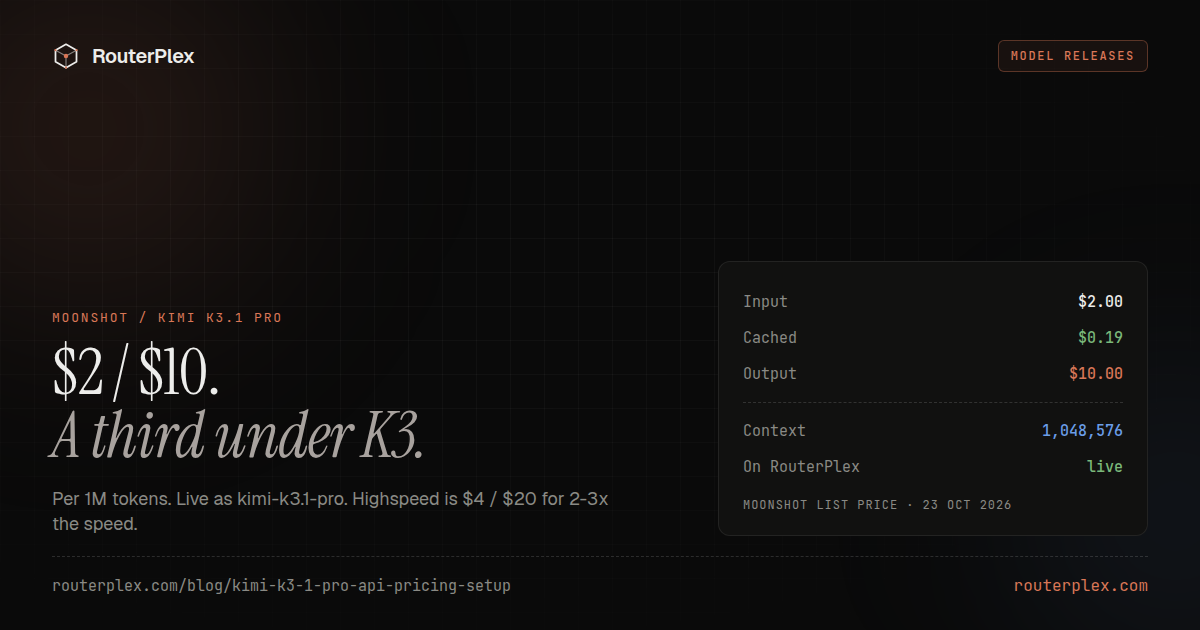
| Input | $4.00 | $2.00 |
| Cached input | $0.65 | $0.19 |
| Output | $6.50 | $10.00 |
| Context | 1M | 1M |
| Max output | 131,072 | 131,072 |
| Who sets the rate | RouterPlex | Moonshot list price |
The abliterated build costs twice as much on input and 35% less on output. Which route is cheaper depends on the mix. On a cold call, this route costs less when input is under 1.75 times the output. Reasoning tokens bill as output, so long reasoning pushes the mix toward output.
Three worked sums:
- A cold 40,000-token prompt with a 2,000-token reply costs $0.173: $0.16 of input and $0.013 of output. Stock
kimi-k3.1-procosts $0.10 for the same call. - The same call with 30,000 tokens cached costs $0.0725: $0.04 fresh, $0.0195 cached, and $0.013 output.
- An output-heavy call of 5,000 tokens in and 20,000 out costs $0.15 here and $0.21 on the stock route.
Cached input is 84% off the fresh rate. Caching is real on this route: a repeated 11,173-token prompt came back with 11,136 cached tokens on the second call. A $5 balance covers 1.25 million fresh input tokens, or about 769,000 output tokens.
Other abliterated models on RouterPlex
USD per 1M tokens, from the RouterPlex price list on 18 November 2026.
| Model id | Input | Cached | Output | Context | Max output | Guide |
|---|---|---|---|---|---|---|
kimi-k3.1-pro-abliterated | $4.00 | $0.65 | $6.50 | 1M | 131,072 | this page |
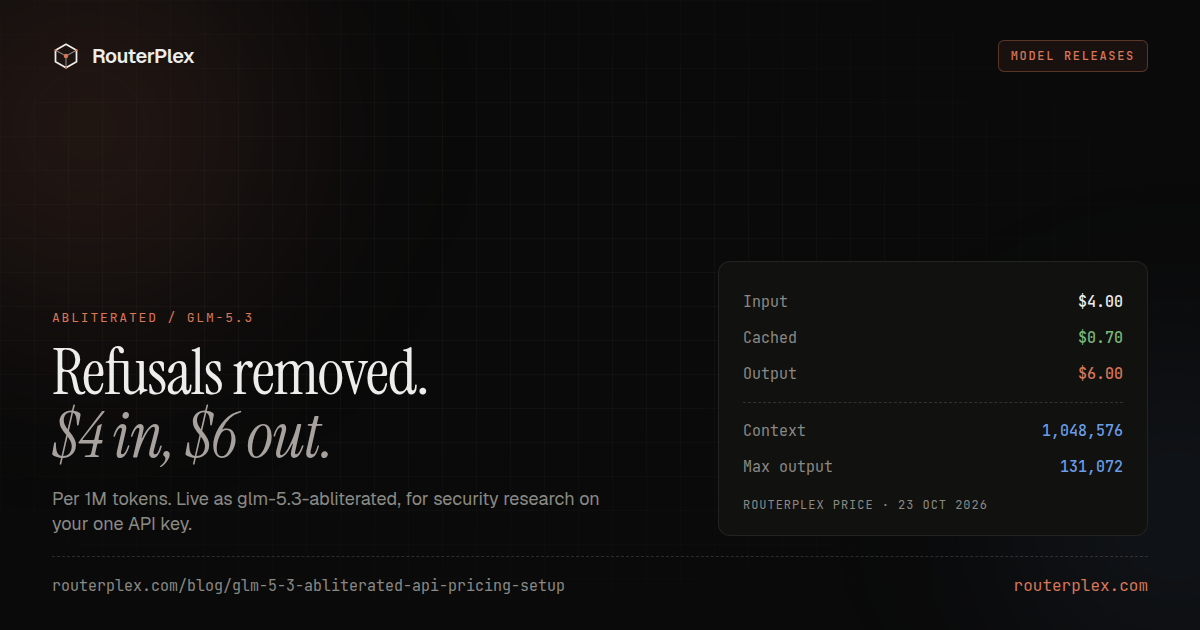
glm-5.3-abliterated | $2.00 | $0.30 | $4.00 | 1,048,576 | 131,072 | guide |
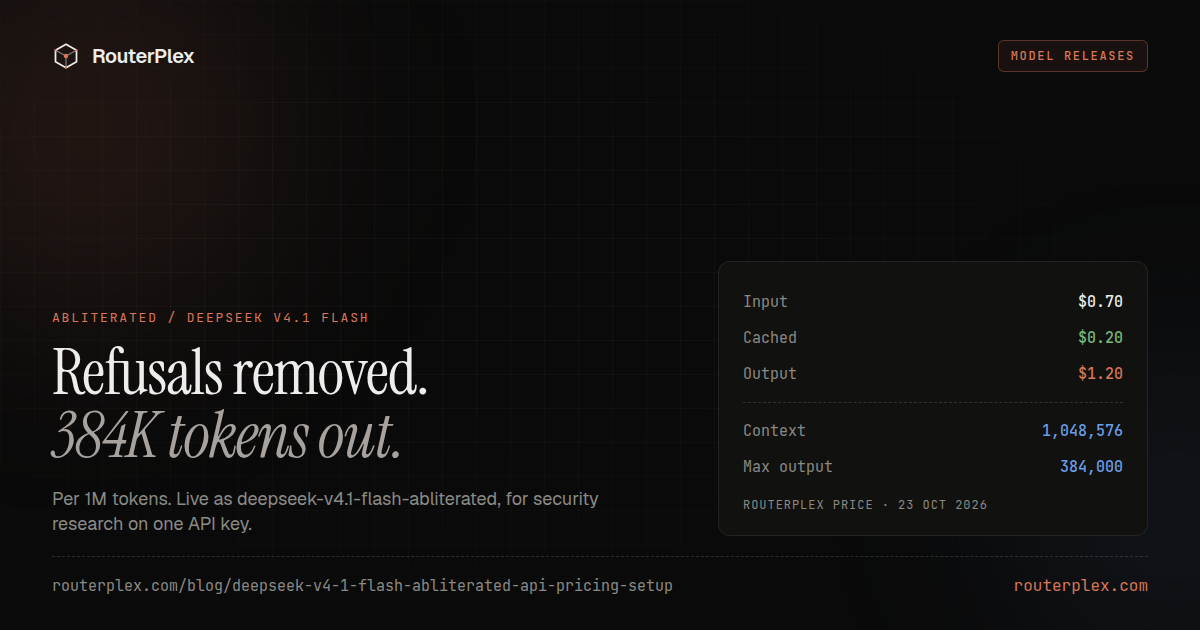
deepseek-v4.1-flash-abliterated | $0.50 | $0.07 | $1.50 | 1,048,576 | 131,072 | guide |
glm-5.3-flash-abliterated | $0.25 | $0.06 | $1.00 | 1,048,576 | 131,072 | guide |
gemma-4-26b-abliterated | $0.25 | $0.25 | $0.75 | 256,000 | 8,192 | guide |
glm-4.7-flash-abliterated | $0.12 | $0.09 | $0.60 | 200,000 | 24,000 | guide |
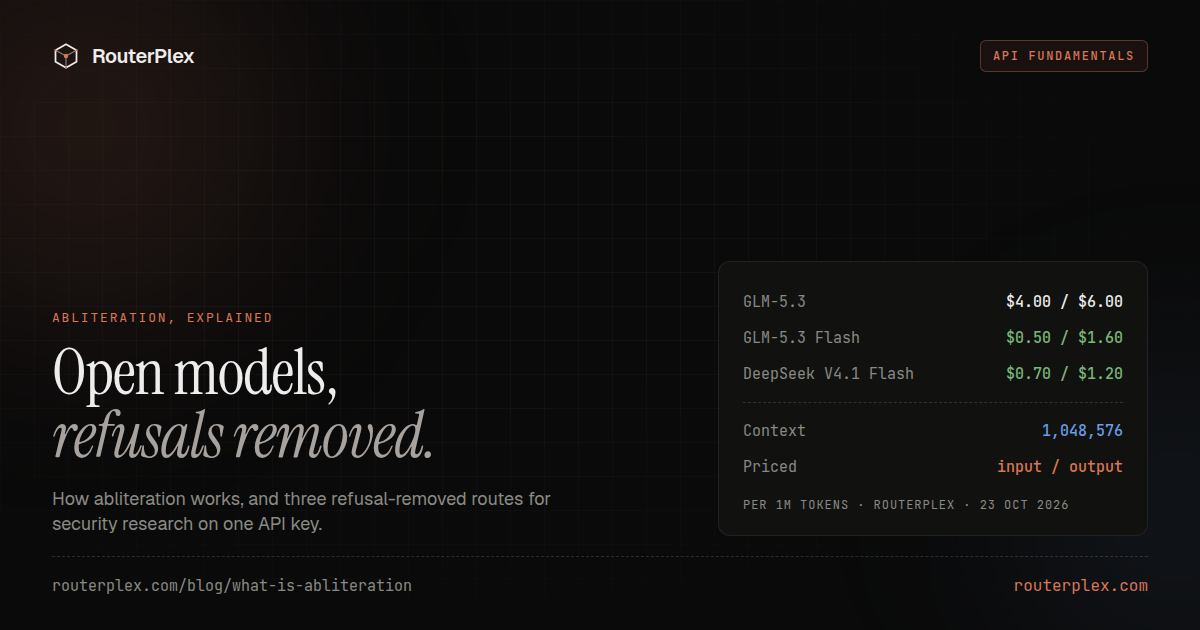
Kimi K3.1 Pro Abliterated is the most expensive abliterated route on RouterPlex. Pick it when you want the Kimi K3.1 Pro base and can wait for answers. GLM-5.3 Abliterated costs half as much on input and less on output. All routes are compared on the abliterated models page.
Specs and speed
We checked each feature with live calls on 18 November 2026:
- 1M-token context window and up to 131,072 output tokens.
- Tool calling and image input.
- Reasoning with
reasoning_effortset tolow,high, ormax. The default islow. - Streaming, with token usage in the final chunk.
- Prompt caching, as shown above.
The model is served quantized (MXFP4). Quantization can cost some quality against full precision, and RouterPlex has not benchmarked this build. Run your own evaluation set before you depend on it.
It is slow. The host quotes roughly 65 tokens per second of generation, and the model reasons before it answers, so the first token takes a while. In our tests on 18 November 2026, short requests took about 30 to 40 seconds end to end. One tool-call request took 86 seconds. This route suits batch jobs and background agents, not a chat window where a person waits. Stream the response and set a client timeout of several minutes.
Setup with curl
Export your key as ROUTERPLEX_API_KEY. The prompt below only checks that the route answers.
curl https://api.routerplex.com/v1/chat/completions \--max-time 600 \-H "Authorization: Bearer $ROUTERPLEX_API_KEY" \-H "Content-Type: application/json" \-d '{"model": "kimi-k3.1-pro-abliterated","reasoning_effort": "low","max_tokens": 4000,"messages": [{"role": "user", "content": "Reply with exactly: RouterPlex connected."}]}'
Use the dotted id in JSON. The browser page uses hyphens: /models/kimi-k3-1-pro-abliterated.
Python with the OpenAI SDK
Install the official SDK (pip install openai) and point it at RouterPlex. The long timeout is deliberate.
import osfrom openai import OpenAIclient = OpenAI(api_key=os.environ["ROUTERPLEX_API_KEY"],base_url="https://api.routerplex.com/v1",timeout=600,)response = client.chat.completions.create(model="kimi-k3.1-pro-abliterated",reasoning_effort="high",max_tokens=8000,messages=[{"role": "user","content": "Explain the root cause of a path traversal bug in a file ""download endpoint, then draft a detection rule for our own nginx access logs.",}],)print(response.choices[0].message.content)print(response.usage)
Streaming
Streaming shows progress during the long wait, and the last chunk carries token usage when you ask for it.
stream = client.chat.completions.create(model="kimi-k3.1-pro-abliterated",messages=[{"role": "user", "content": "Summarize this Nmap report from our own lab network."}],stream=True,stream_options={"include_usage": True},)for chunk in stream:if chunk.choices and chunk.choices[0].delta.content:print(chunk.choices[0].delta.content, end="", flush=True)if chunk.usage:print("\n", chunk.usage)
The same client handles tool calls and image input in the standard OpenAI chat format. The OpenAI-compatible API guide covers that shape.
Claude Code and the Anthropic format
RouterPlex also serves this model on the Anthropic-compatible /v1/messages endpoint. For Claude Code, or any Anthropic-style client, point the base URL at the gateway root and set the model id.
export ANTHROPIC_BASE_URL=https://api.routerplex.comexport ANTHROPIC_AUTH_TOKEN=$ROUTERPLEX_API_KEYexport ANTHROPIC_MODEL=kimi-k3.1-pro-abliterated
Given the speed, this fits long background runs better than live pair programming. Keep the key in the environment and do not commit it.
Paid credit only
Abliterated models draw only on credit you paid for. The $1 trial and bonus credit, including top-up match bonuses and vouchers, cannot pay for them. Bonus credit is used on other models first. A trial key gets HTTP 402 with type paid_model_required until the account has a paid top-up.
Errors and no fallback
This route has no fallback to a stock model. A silent swap would bring the refusals back, so when the upstream fails, the error goes straight to your client. Retry with backoff in batch jobs, and log the failed request ids.
A timeout on your side usually means the client gave up first. Raise the timeout or stream the response. A hard spend cap stops the key even when the account balance remains. Model not found means the id string is wrong. Send kimi-k3.1-pro-abliterated, not the page slug.
Next step
Create a free RouterPlex account, add a paid top-up, and open Kimi K3.1 Pro Abliterated before you set a budget. Read the acceptable use rules first.
Common questions
Frequently asked questions
How much does the Kimi K3.1 Pro Abliterated API cost?
On RouterPlex, checked 18 November 2026, kimi-k3.1-pro-abliterated is $4.00 per 1M input tokens, $0.65 per 1M cached input tokens, and $6.50 per 1M output tokens. RouterPlex sets this rate; no vendor list price exists for an abliterated checkpoint. Stock kimi-k3.1-pro is $2.00 input and $10.00 output, so the abliterated build costs more on input and less on output.
What uses does RouterPlex prohibit on this model?
Removing refusals does not remove the RouterPlex terms. RouterPlex strictly prohibits sexual or sexually explicit content of any kind, including erotica and explicit sexual role-play; anything that sexualises, exploits, or abuses minors; attacking, scanning, or accessing systems you do not own or are not authorised in writing to test, or building malware or exploits for use against them; weapons development; and content that is illegal or facilitates serious harm to others, such as harassment or fraud. Requests to abliterated models are stored for 1 to 365 days and reviewed. Accounts that break these rules can be suspended or permanently banned without notice, and the remaining balance is forfeited without refund.
Can I use the $1 trial, a match bonus, or a voucher on it?
No. Abliterated models draw only on credit you paid for. Trial credit and bonus credit, including top-up match bonuses and vouchers, cannot pay for them. A trial key gets HTTP 402 with type paid_model_required until the account has a paid top-up.
Why is Kimi K3.1 Pro Abliterated slow?
It reasons before it answers and is served quantized (MXFP4) at roughly 65 tokens per second of generation, per the host. In our tests on 18 November 2026, short requests took about 30 to 40 seconds end to end and one tool-call request took 86 seconds. Use it for batch and agent jobs, stream the response, and set a client timeout of several minutes.
Are my requests to this model stored?
Yes. RouterPlex stores requests sent to abliterated models, with your account identifier, the model name, and the time, for security, abuse prevention, and enforcement of the terms. They are kept for at least 1 day and no more than 365 days, then deleted. Requests to non-abliterated models are not stored. This is stated in section 05 of the Terms and section 02 of the Privacy Policy.
What features does it support?
A 1M-token context window, up to 131,072 output tokens, tool calling, image input, reasoning effort low, high, or max (default low), streaming with usage, and prompt caching. We checked each of these with live calls on 18 November 2026. It works on the OpenAI-compatible /v1/chat/completions endpoint and the Anthropic-compatible /v1/messages endpoint.
Run the smallest paid test.
Add $5, cap the key, and verify the result with your own workload. No subscription, and credit never expires — a first top-up of $25+ is matched with $25 extra.